Collection › Cambodia › #103
1 Riel
P-1
Needs review
✦ AI 90%
The AI flagged these for your attention. Use ✦ Fact-check to cross-check factual fields against another model's world-knowledge, or 🔍 Re-look at image when you suspect the AI misread the pixels.
-
Some fields the AI was unsure about — please verify:
- Series year: “—” (0%)
- Issue year: “—” (0%)
- Printer: “—” (0%)
- Watermark: “Unknown” (0%)
- Front portrait: “—” (0%)
Click ✦ Ask AI to verify or fix any below. -
Overall AI confidence is 90% (auto-approve threshold is 92%).Skim the Identity tab; the dots next to each field show what the AI was unsure about.
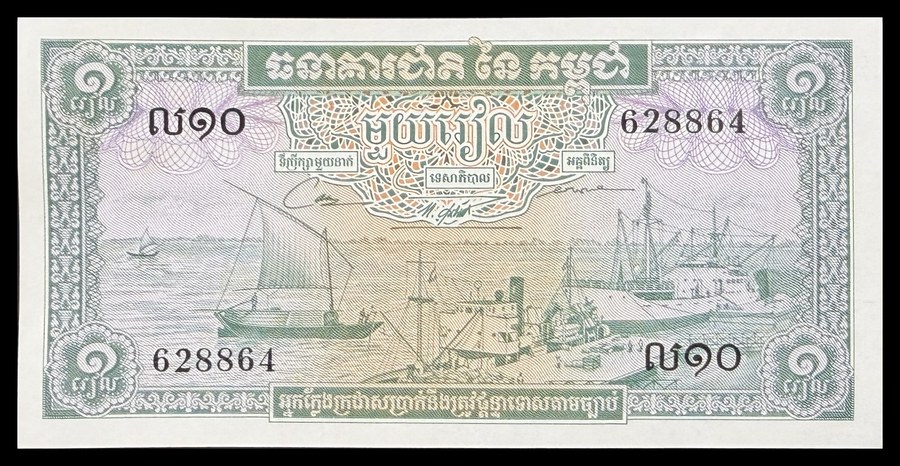
IMG_6255.jpeg
cropped
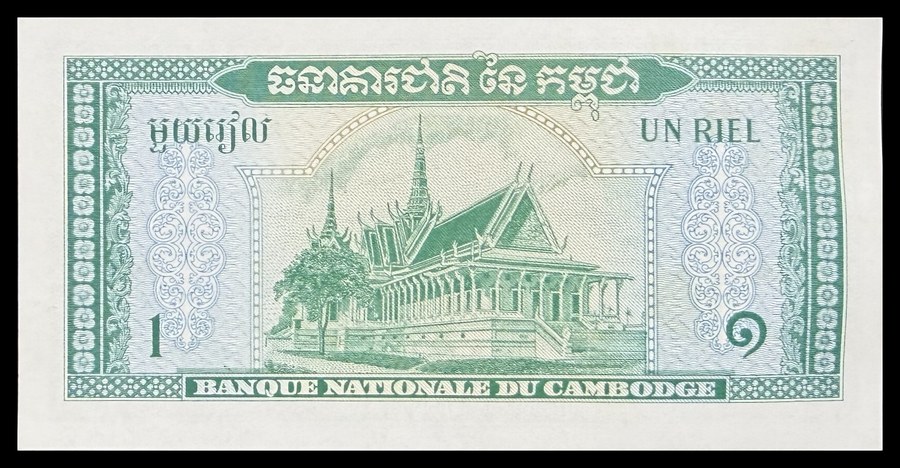
IMG_6256.jpeg
cropped
Where & when
What's on the note
Front: Agricultural scene depicting farmers planting rice in flooded paddy fields, representing Cambodia's traditional agricultural economy and the centrality of rice cultivation to Cambodian culture and livelihood. This imagery was chosen to emphasize the rural character and agrarian foundation of the newly independent Kingdom of Cambodia in the 1950s.
Back: The Royal Palace in Phnom Penh (Chan Chaya Pavilion), the official residence of the King of Cambodia since its construction in the 1860s under King Norodom. The palace complex serves as a symbol of the Cambodian monarchy and nation, combining traditional Khmer architecture with French colonial influences; it remains the preeminent symbol of Cambodian sovereignty and royal authority.
How it was made
Signatures: Governor: Unknown; Minister of Economy: Unknown
Security features: microprint,intaglio
Cambodia in Asia
Cambodia in Asia. Other countries on the same continent shown in muted grey.
Background & history
This note belongs to the first series of the Cambodian riel, introduced in 1955 following Cambodia's independence from France in 1953. The riel replaced the Indochinese piastre at par. This series circulated during the Kingdom of Cambodia period under King Norodom Sihanouk until 1975, when the Khmer Rouge abolished money entirely. The currency was demonetized and destroyed during the Khmer Rouge regime (1975–1979), making these notes historical artifacts of pre-revolutionary Cambodia. A second riel was introduced in 1980 following the fall of the Khmer Rouge.
Collector references
How it came to me
Note shows moderate circulation with visible folds and wear but retains good detail and color
What it's worth now
Valuation history (1)
| date | low | high | currency | source | note |
|---|---|---|---|---|---|
| 2026-05-08 16:34:02 | 3.0 | 8.0 | USD | ai | from claude-sonnet-4-5 |
History & extractions
AI extractions (3)
Edits & decisions (0)
No edits yet.
Manual fixups
Find near-duplicates
Manual pairing override
Edit specimen #103
All fields below post to the same save endpoint. Sections collapse to focus on what you need.
Re-crop manually
Drag the four corners to mark the banknote in each image. Click Save crop to apply.