Collection › Cambodia › #106
200 KHR
P-New
AI extracted
✦ AI 93%
The AI flagged these for your attention. Use ✦ Fact-check to cross-check factual fields against another model's world-knowledge, or 🔍 Re-look at image when you suspect the AI misread the pixels.
-
Some fields the AI was unsure about — please verify:
- Printer: “—” (0%)
- Watermark: “—” (0%)
Click ✦ Ask AI to verify or fix any below.
IMG_6261.jpeg
cropped
IMG_6262.jpeg
cropped
Where & when
What's on the note
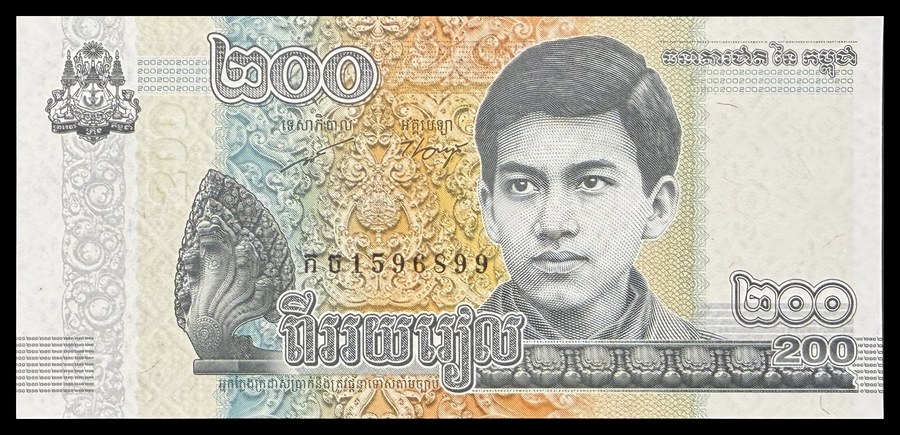
Front: King Norodom Sihamoni (born 1953), current monarch of Cambodia who ascended to the throne in 2004 following the abdication of his father King Norodom Sihanouk. The portrait shows him in traditional royal attire. To the left appears a Buddha head from Angkor-era sculpture, symbolizing Cambodia's rich Khmer heritage. King Sihamoni is honored on modern Cambodian banknotes as the constitutional head of state.
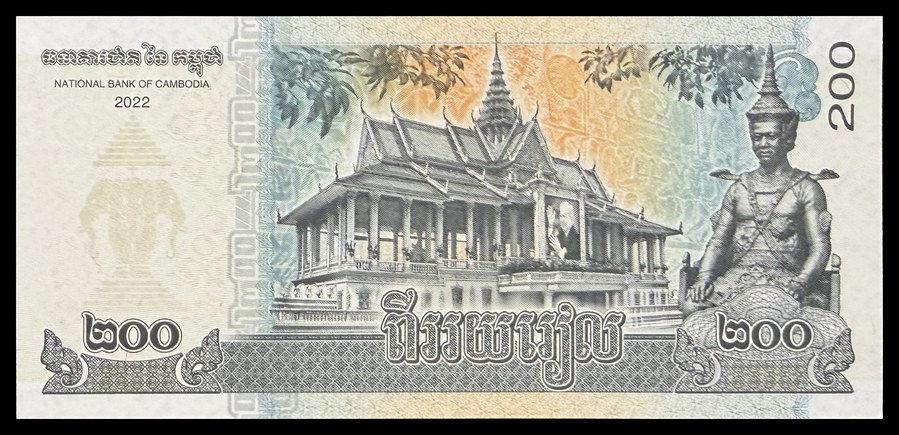
Back: The Royal Palace throne hall in Phnom Penh, the official residence of the King of Cambodia and one of the nation's most important architectural landmarks, built in traditional Khmer style with characteristic tiered roofs and spire. To the right stands a classical Apsara dancer statue, representing the celestial dancers of Khmer mythology and culture immortalized in the bas-reliefs of Angkor Wat. These motifs celebrate Cambodia's royal heritage and classical artistic traditions.
How it was made
Security features: hologram,see_through_register,optically_variable_ink,microprint
Cambodia in Asia
Cambodia in Asia. Other countries on the same continent shown in muted grey.
Background & history
This 200 riels note is part of Cambodia's 2022 polymer banknote series issued by the National Bank of Cambodia. The series represents a modernization of Cambodia's currency with enhanced security features including polymer substrate, replacing earlier paper notes. The denomination of 200 riels is a standard mid-value note in Cambodia's monetary system. The design emphasizes national identity through royal symbolism, Khmer architectural heritage, and classical dance traditions that trace back to the Angkorian period.
Collector references
How it came to me
What it's worth now
No current value set. Use Edit to add one, or run "Value all" on the collection page.
History & extractions
AI extractions (1)
Edits & decisions (0)
No edits yet.
Manual fixups
Find near-duplicates
Manual pairing override
Edit specimen #106
All fields below post to the same save endpoint. Sections collapse to focus on what you need.
Re-crop manually
Drag the four corners to mark the banknote in each image. Click Save crop to apply.