Collection › Croatia › #138
25 HRK
P-30a
Needs review
✦ AI 90%
The AI flagged these for your attention. Use ✦ Fact-check to cross-check factual fields against another model's world-knowledge, or 🔍 Re-look at image when you suspect the AI misread the pixels.
-
Overall AI confidence is 90% (auto-approve threshold is 92%).Skim the Identity tab; the dots next to each field show what the AI was unsure about.
IMG_6325.jpeg
cropped
IMG_6326.jpeg
cropped
Where & when
What's on the note
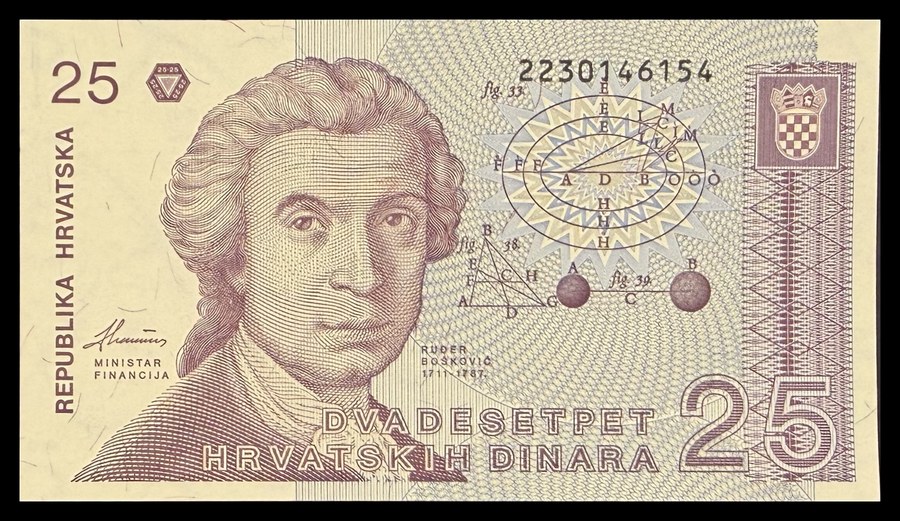
Front: Ruđer Josip Bošković (1711–1787), Croatian physicist, astronomer, mathematician, philosopher, diplomat, and Jesuit priest. He is best known for his atomic theory and his work in astronomy, making contributions to the determination of planetary orbits; he founded the Brera Observatory in Milan and served as the first professor of mathematics at the University of Pavia. His portrait appears alongside a geometric diagram representing his scientific work in optics and astronomy, with the Croatian coat of arms at right.
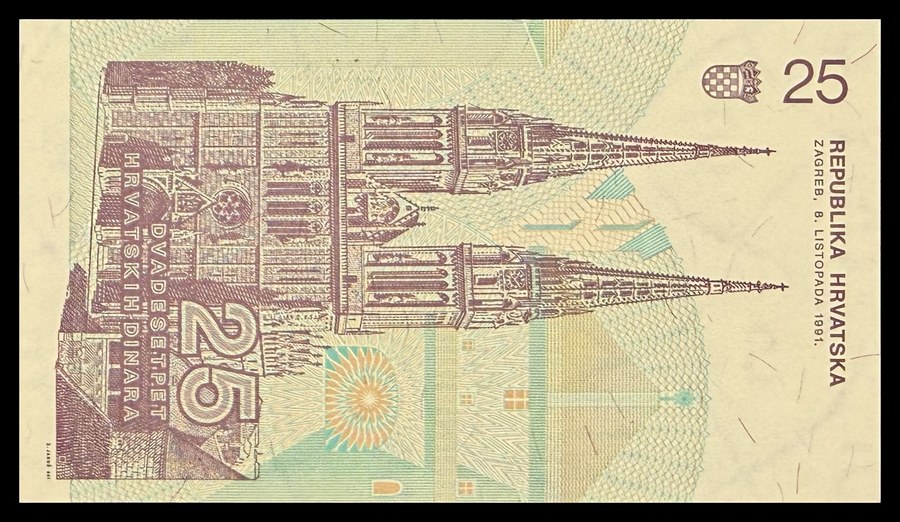
Back: Zagreb Cathedral (Cathedral of the Assumption of the Blessed Virgin Mary), the tallest building in Croatia and a prominent Gothic Revival landmark in Zagreb. The cathedral's twin neo-Gothic spires dominate the skyline; originally built in the 11th century, it was substantially reconstructed after the 1880 Zagreb earthquake. The text '25 DVADESET PET HRVATSKIH DINARA' identifies the denomination as twenty-five Croatian dinars, indicating this is from the 1991 transition period.
How it was made
Signatures: Ministar Financija: Ruder Bošković 1711–1787
Security features: microprint,latent_image,intaglio
Croatia in Europe
Croatia in Europe. Other countries on the same continent shown in muted grey.
Background & history
This note belongs to the first Croatian Kuna series issued in 1991 following Croatia's declaration of independence from Yugoslavia. However, the denomination text reads 'DVADESET PET HRVATSKIH DINARA' (25 Croatian Dinars), indicating this is actually from the brief Croatian Dinar series (October 1991–May 1994) that preceded the Kuna. The Croatian Dinar was introduced to replace the Yugoslav Dinar during the war of independence and suffered significant inflation before being replaced by the Croatian Kuna in 1994 at a rate of 1 Kuna = 1000 Dinars. The Croatian Kuna itself was withdrawn on January 1, 2023, when Croatia adopted the Euro.
Collector references
How it came to me
Note shows light handling with minor corner wear and slight soiling, but retains good color and detail
What it's worth now
Valuation history (1)
| date | low | high | currency | source | note |
|---|---|---|---|---|---|
| 2026-05-08 16:40:52 | 2.0 | 5.0 | USD | ai | from claude-sonnet-4-5 |
History & extractions
AI extractions (3)
Edits & decisions (0)
No edits yet.
Manual fixups
Find near-duplicates
Manual pairing override
Edit specimen #138
All fields below post to the same save endpoint. Sections collapse to focus on what you need.
Re-crop manually
Drag the four corners to mark the banknote in each image. Click Save crop to apply.