Collection › Croatia › #139
100 Croatian Dinar
P-P-20a
AI extracted
✦ AI 93%
The AI flagged these for your attention. Use ✦ Fact-check to cross-check factual fields against another model's world-knowledge, or 🔍 Re-look at image when you suspect the AI misread the pixels.
-
Some fields the AI was unsure about — please verify:
- Printer: “—” (0%)
Click ✦ Ask AI to verify or fix any below.
IMG_6327.jpeg
cropped
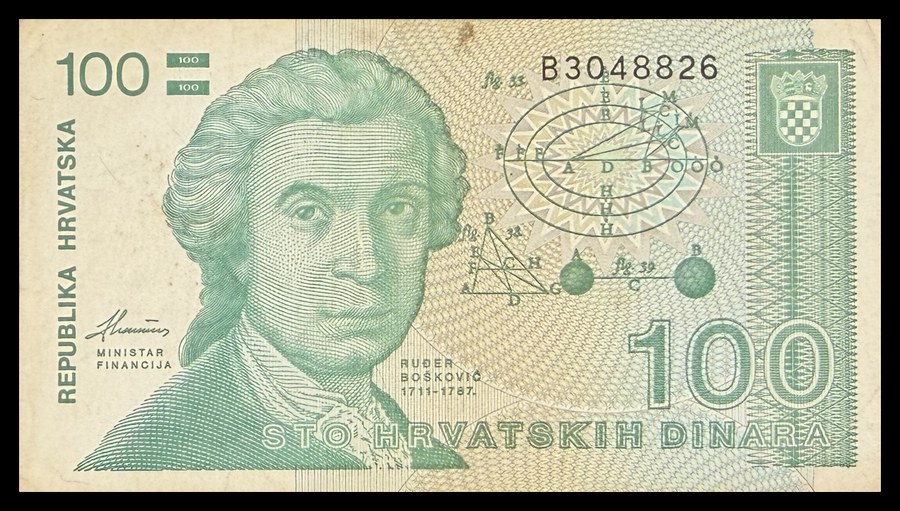
IMG_6328.jpeg
cropped
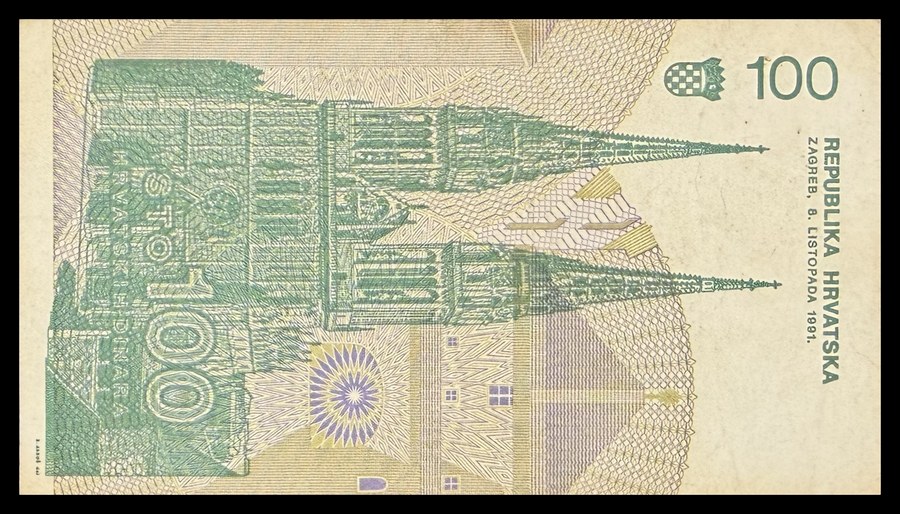
Where & when
What's on the note
Front: Ruđer Bošković (1711–1787), Croatian physicist, astronomer, mathematician, philosopher, diplomat, poet, and Jesuit priest. He is best known for his atomic theory and his work in astronomy and mathematics; he produced a precursor to atomic theory and made significant contributions to the determination of a meridian arc. Bošković was one of the greatest scientists of his era and is celebrated as a national hero in Croatia. The inscription 'STO HRVATSKIH DINARA' (One Hundred Croatian Dinars) appears at bottom, with the Croatian coat of arms (red-and-white checkerboard shield) at upper right.
Back: Zagreb Cathedral (Cathedral of the Assumption of the Blessed Virgin Mary), the tallest building in Croatia and a symbol of Zagreb. The Gothic-style cathedral was originally constructed in the 13th century, destroyed by the Mongols in 1242, rebuilt, and subsequently modified with Neo-Gothic twin spires added in the late 19th century after an 1880 earthquake. It is the seat of the Archbishop of Zagreb and one of Croatia's most important religious and architectural landmarks.
How it was made
Signatures: Ministar Financija: (signature present)
Security features: microprint,intaglio,latent_image,see_through_register
Croatia in Europe
Croatia in Europe. Other countries on the same continent shown in muted grey.
Background & history
This 100-dinar note belongs to the first Croatian Dinar series issued following Croatian independence from Yugoslavia in 1991. The Croatian dinar was introduced on December 23, 1991, to replace the Yugoslav dinar at par, and served as Croatia's currency during the period of the Croatian War of Independence and early statehood. The series featured prominent Croatian historical figures and landmarks to assert national identity. The dinar was replaced by the Croatian kuna on May 30, 1994, at a rate of 1 kuna = 1,000 dinars, following a period of hyperinflation. The choice of Ruđer Bošković reflected Croatia's emphasis on its scientific and cultural heritage.
Collector references
How it came to me
Note shows circulation wear, multiple stamps/markings, some soiling, and creasing throughout. Overall structural integrity intact but clearly used.
What it's worth now
Valuation history (1)
| date | low | high | currency | source | note |
|---|---|---|---|---|---|
| 2026-05-08 16:41:22 | 2.0 | 5.0 | USD | ai | from claude-sonnet-4-5 |
History & extractions
AI extractions (1)
Edits & decisions (0)
No edits yet.
Manual fixups
Find near-duplicates
Manual pairing override
Edit specimen #139
All fields below post to the same save endpoint. Sections collapse to focus on what you need.
Re-crop manually
Drag the four corners to mark the banknote in each image. Click Save crop to apply.