Collection › Egypt › #176
5 piastres Egyptian pound
P-163
AI extracted
✦ AI 92%
The AI flagged these for your attention. Use ✦ Fact-check to cross-check factual fields against another model's world-knowledge, or 🔍 Re-look at image when you suspect the AI misread the pixels.
-
Some fields the AI was unsure about — please verify:
- Issue year: “—” (0%)
- Dimensions (mm): “—” (0%)
- Reverse subject: “—” (0%)
Click ✦ Ask AI to verify or fix any below.
IMG_6401.jpeg
cropped
IMG_6402.jpeg
cropped
Where & when
What's on the note
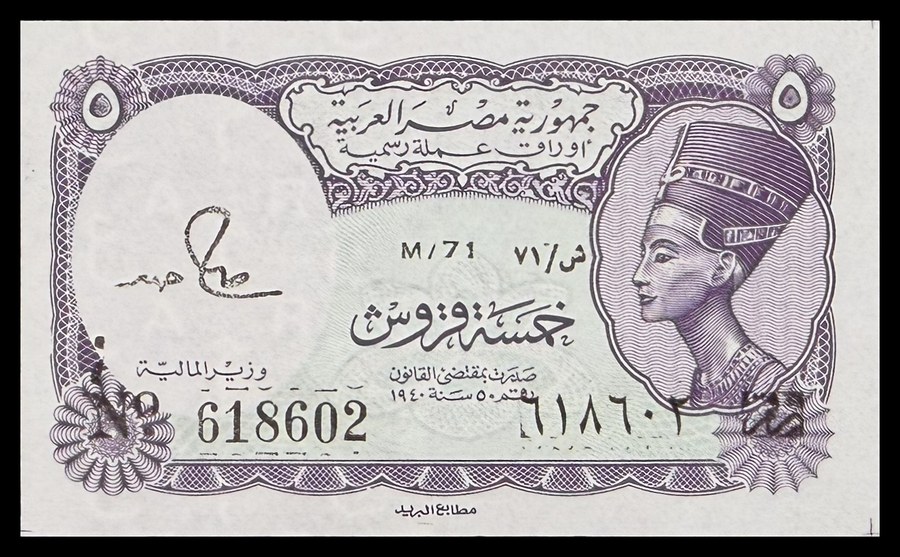
Front: Tutankhamun (c. 1341–1323 BCE), pharaoh of Egypt's Eighteenth Dynasty during the New Kingdom period. He ascended to the throne at around age nine and ruled until his death at approximately eighteen; his tomb (KV62) discovered by Howard Carter in 1922 is one of the most famous archaeological finds in history. The portrait shows him wearing the iconic Nefertiti-style crown (actually the Blue Crown or Khepresh), and his image became emblematic of Egyptian currency during the mid-20th century.
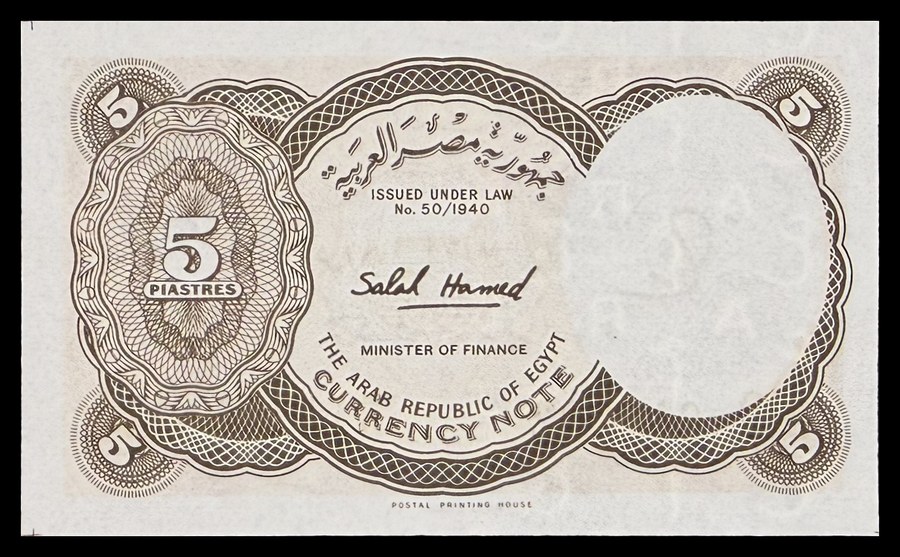
Back: Geometric guilloche patterns surrounding the denomination '5 PIASTRES' with bilingual inscriptions in Arabic and English identifying the issuing authority as 'The Arab Republic of Egypt' and 'ISSUED UNDER LAW No. 50/1940'. The signature of Saleh Hamed as Minister of Finance appears in both Arabic and English.
How it was made
Signatures: Minister of Finance: Saleh Hamed
Security features: microprint,intaglio
Egypt in Africa
Egypt in Africa. Other countries on the same continent shown in muted grey.
Background & history
This note belongs to the Law No. 50/1940 series issued by the Egyptian Ministry of Finance during World War II and the final years of the British protectorate period. These currency notes were printed domestically by the Postal Printing House rather than by foreign printers, reflecting Egypt's move toward greater monetary independence. The series circulated until the early 1950s when replaced by later issues following the Egyptian Revolution of 1952. The use of Tutankhamun's image on Egyptian currency began in this era and continued for decades, symbolizing national heritage and pharaonic legacy.
Collector references
How it came to me
Note shows moderate circulation with some creasing and edge wear; purple ink remains relatively vivid; no major tears or stains visible.
What it's worth now
Valuation history (1)
| date | low | high | currency | source | note |
|---|---|---|---|---|---|
| 2026-05-08 17:07:59 | 5.0 | 15.0 | USD | ai | from claude-sonnet-4-5 |
History & extractions
AI extractions (1)
Edits & decisions (0)
No edits yet.
Manual fixups
Find near-duplicates
Manual pairing override
Edit specimen #176
All fields below post to the same save endpoint. Sections collapse to focus on what you need.
Re-crop manually
Drag the four corners to mark the banknote in each image. Click Save crop to apply.