Collection › Egypt › #178
5 EGP
P-56
Needs review
✦ AI 85%
The AI flagged these for your attention. Use ✦ Fact-check to cross-check factual fields against another model's world-knowledge, or 🔍 Re-look at image when you suspect the AI misread the pixels.
-
Some fields the AI was unsure about — please verify:
- Series name: “—” (0%)
- Series year: “—” (0%)
- Issue year: “—” (0%)
- Printer: “—” (0%)
- Front portrait: “—” (0%)
Click ✦ Ask AI to verify or fix any below. -
Overall AI confidence is 85% (auto-approve threshold is 92%).Skim the Identity tab; the dots next to each field show what the AI was unsure about.
IMG_6405.jpeg
cropped
IMG_6406.jpeg
cropped
Where & when
What's on the note
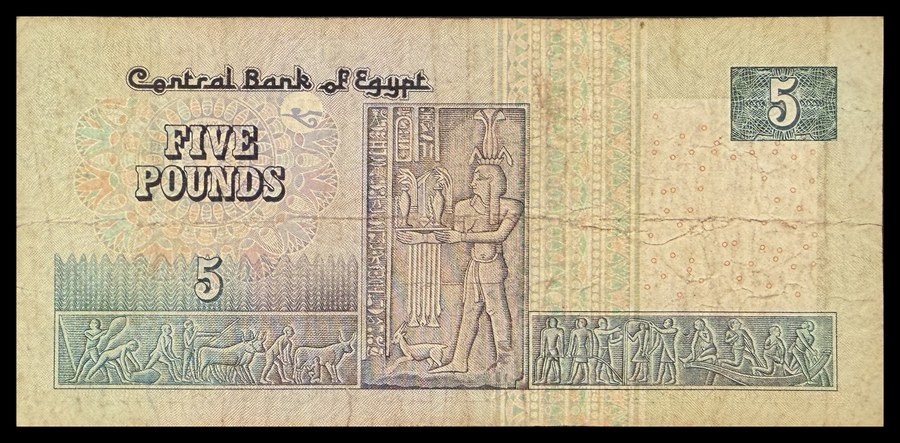
Front: Ancient Egyptian motifs depicting scenes from pharaonic civilization including agricultural workers in the lower register and a central figure playing a harp, representing Egypt's rich cultural heritage. The imagery draws from temple reliefs and tomb paintings that documented daily life and religious practices in ancient Egypt. These scenes symbolize the continuity between ancient and modern Egyptian identity, a recurring theme on Central Bank of Egypt banknotes from this era.
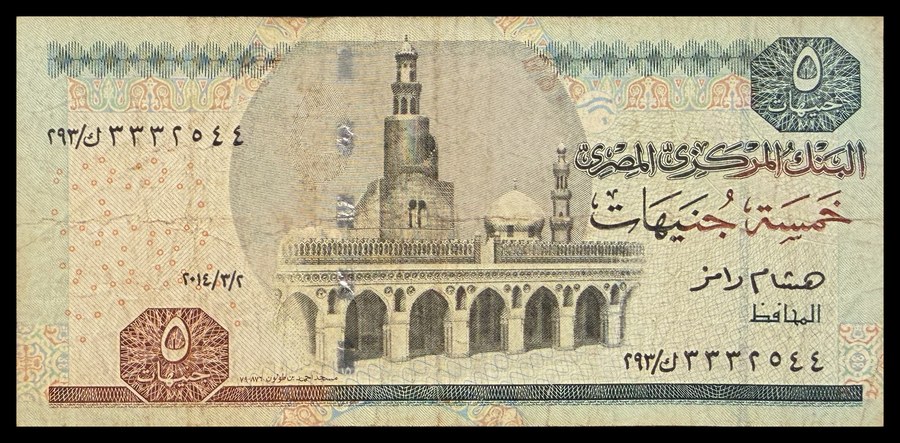
Back: The Mosque of Ibn Tulun in Cairo, completed in 879 CE and one of the oldest mosques in Egypt still standing in its original form. Built by Ahmad ibn Tulun, founder of the Tulunid dynasty, it features a distinctive spiral minaret (malwiya) and is the largest mosque in Cairo by area. The mosque represents Islamic architectural heritage and is a UNESCO-recognized monument, symbolizing Egypt's medieval Islamic Golden Age and its position as a center of Islamic civilization.
How it was made
Signatures: Governor: Hesham Ramez
Security features: thread,microprint,intaglio
Egypt in Africa
Egypt in Africa. Other countries on the same continent shown in muted grey.
Background & history
This five pound note is part of a series issued by the Central Bank of Egypt during the 1990s-2000s period. The design combines pharaonic motifs on the obverse with Islamic architecture on the reverse, reflecting Egypt's dual identity as inheritor of both ancient Egyptian and Islamic civilizations. The note features extensive Arabic text and Eastern Arabic numerals alongside Western Arabic numerals. This series was eventually replaced by newer designs with enhanced security features.
Collector references
How it came to me
Moderate circulation wear with visible folds, creases, and some soiling. Paper integrity intact but showing age.
What it's worth now
Valuation history (1)
| date | low | high | currency | source | note |
|---|---|---|---|---|---|
| 2026-05-08 17:08:19 | 2.0 | 5.0 | USD | ai | from claude-sonnet-4-5 |
History & extractions
AI extractions (3)
Edits & decisions (1)
Manual fixups
Find near-duplicates
Manual pairing override
Edit specimen #178
All fields below post to the same save endpoint. Sections collapse to focus on what you need.
Re-crop manually
Drag the four corners to mark the banknote in each image. Click Save crop to apply.