Collection › Estonia › #183
1 EEK
P-P-69
AI extracted
✦ AI 93%
The AI flagged these for your attention. Use ✦ Fact-check to cross-check factual fields against another model's world-knowledge, or 🔍 Re-look at image when you suspect the AI misread the pixels.
-
Some fields the AI was unsure about — please verify:
- Printer: “—” (0%)
- Watermark: “—” (30%)
Click ✦ Ask AI to verify or fix any below.
IMG_6415.jpeg
cropped
IMG_6416.jpeg
cropped
Where & when
What's on the note
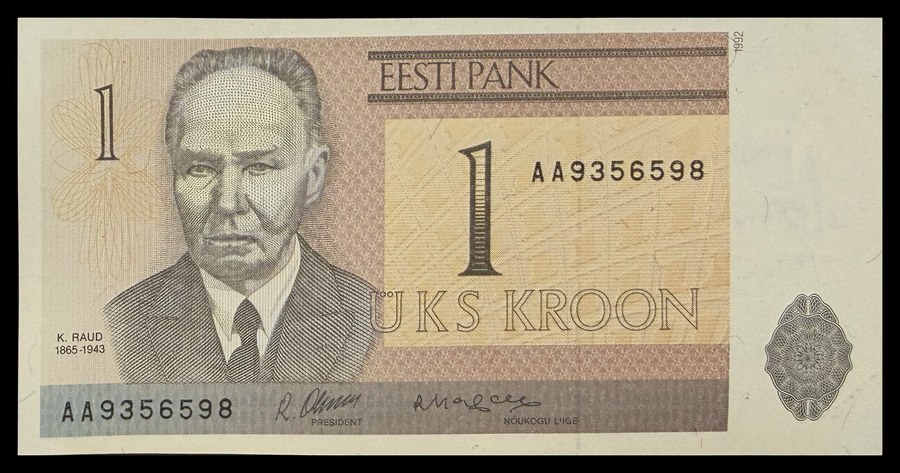
Front: Kristjan Raud (1865–1943), Estonian painter and graphic artist, one of the founders of Estonian national art. Raud is celebrated for his contributions to Estonian cultural identity through his paintings and illustrations depicting Estonian mythology, folklore, and rural life, particularly his illustrations for the national epic Kalevipoeg. He was a founding member of the Estonian Artists' Association and played a pivotal role in establishing a distinctly Estonian artistic tradition during the National Awakening period.
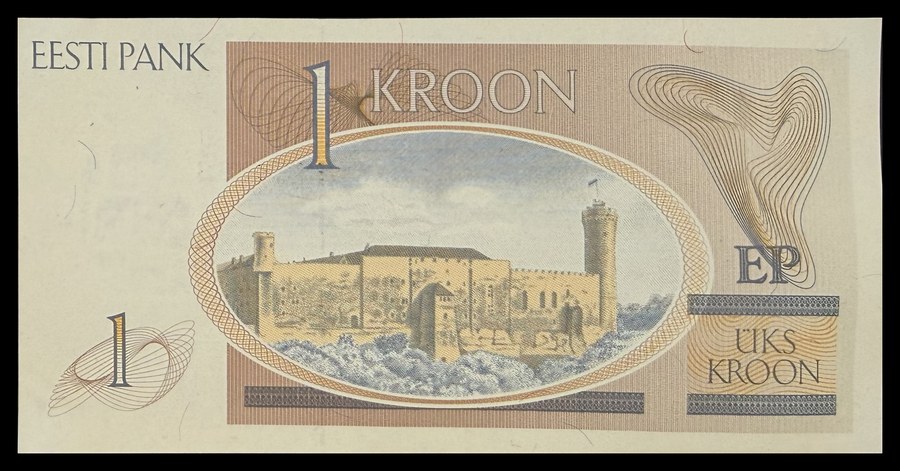
Back: Toompea Castle in Tallinn, the seat of the Riigikogu (Estonian Parliament). Originally built as a fortress by the Teutonic Order in the 13th–14th centuries on Toompea hill, the castle has served as the seat of power in Estonia for over 700 years. The distinctive pink baroque façade visible on the note was added in the 18th century when the building served as the seat of the Russian Governor-General of Estonia. The castle symbolizes Estonian statehood and sovereignty, making it an appropriate choice for the nation's restored currency.
How it was made
Signatures: President: R. Otsason; Chairman of the Supervisory Board: Siim Kallas
Security features: microprint,intaglio,latent_image
Estonia in Europe
Estonia in Europe. Other countries on the same continent shown in muted grey.
Background & history
First kroon series, issued in 1992 following Estonia's restoration of independence from the Soviet Union in 1991. The Estonian kroon (EEK) replaced the Soviet ruble at a rate of 1 kroon = 10 rubles as part of monetary reform that established one of the most stable currencies in Eastern Europe. The series was designed to emphasize Estonian national identity and cultural heritage, featuring prominent Estonian cultural figures on the obverse and architectural landmarks on the reverse. The 1 kroon note, the smallest denomination, honored Kristjan Raud as a symbol of Estonian national art and cultural awakening. The kroon remained in circulation until January 1, 2011, when Estonia adopted the euro, becoming the first former Soviet republic to join the eurozone.
Collector references
How it came to me
Note shows light circulation with minor handling wear, good centering, intact corners
What it's worth now
Valuation history (1)
| date | low | high | currency | source | note |
|---|---|---|---|---|---|
| 2026-05-08 17:09:11 | 2.0 | 5.0 | USD | ai | from claude-sonnet-4-5 |
History & extractions
AI extractions (1)
Edits & decisions (0)
No edits yet.
Manual fixups
Find near-duplicates
Manual pairing override
Edit specimen #183
All fields below post to the same save endpoint. Sections collapse to focus on what you need.
Re-crop manually
Drag the four corners to mark the banknote in each image. Click Save crop to apply.