Collection › Estonia › #184
2 EEK
P-P-70
AI extracted
✦ AI 92%
The AI flagged these for your attention. Use ✦ Fact-check to cross-check factual fields against another model's world-knowledge, or 🔍 Re-look at image when you suspect the AI misread the pixels.
-
Some fields the AI was unsure about — please verify:
- Printer: “—” (30%)
- Watermark: “—” (50%)
Click ✦ Ask AI to verify or fix any below.
IMG_6417.jpeg
cropped
IMG_6418.jpeg
cropped
Where & when
What's on the note
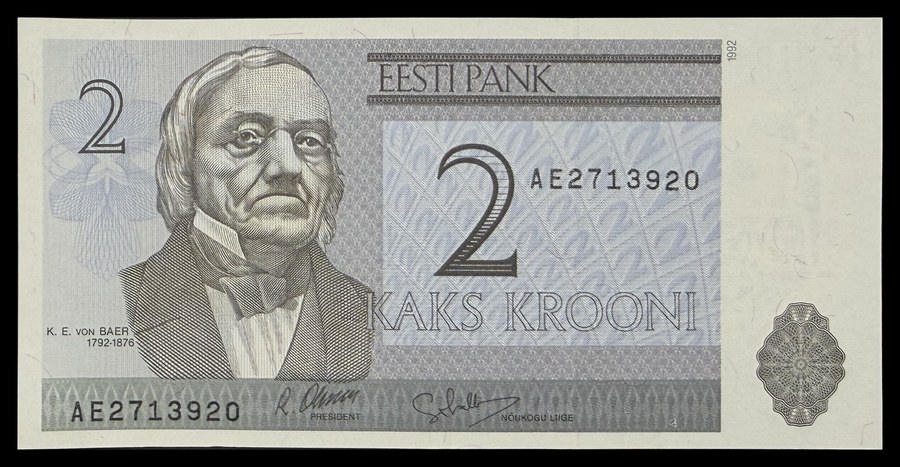
Front: Karl Ernst von Baer (1792–1876), Baltic German naturalist, biologist, geologist, meteorologist, geographer, and a founding father of embryology. He discovered the mammalian ovum and the notochord, formulated the germ layer theory of development, and made significant contributions to comparative anatomy and anthropology. Von Baer was born in what is now Estonia and is honoured as one of the most distinguished scientists associated with the region; his work established fundamental principles of developmental biology that remain influential to this day.
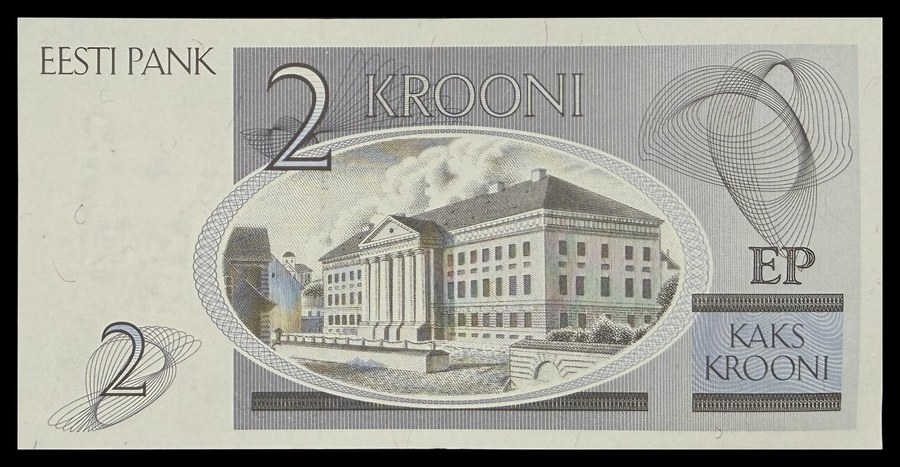
Back: The University of Tartu main building, a neoclassical structure completed in 1809 and designed by Johann Wilhelm Krause. The university, founded in 1632 by King Gustavus Adolphus of Sweden, is the oldest and most prestigious university in Estonia and one of the oldest in Northern Europe. The building serves as the symbolic heart of Estonian higher education and intellectual life, representing the country's academic traditions and commitment to scholarship.
How it was made
Signatures: President: signature present; Noukogu liige: signature present
Security features: intaglio,microprint,thread
Estonia in Europe
Estonia in Europe. Other countries on the same continent shown in muted grey.
Background & history
This note belongs to the first kroon series issued in 1992 following Estonia's restoration of independence from the Soviet Union in 1991. The Estonian kroon replaced the Soviet ruble at a rate of 1 kroon = 10 rubles, marking a crucial step in Estonia's economic independence and transition to a market economy. The series was designed to celebrate Estonian national identity and cultural heritage, featuring prominent historical figures and landmarks. The kroon remained in circulation until January 1, 2011, when Estonia adopted the euro, becoming the 17th eurozone member. The 2-kroon denomination was among the lower-value notes of the series and circulated widely throughout the 1990s and 2000s.
Collector references
How it came to me
Note shows moderate circulation with some handling marks and minor soiling visible, particularly at edges and corners.
What it's worth now
Valuation history (1)
| date | low | high | currency | source | note |
|---|---|---|---|---|---|
| 2026-05-08 17:09:39 | 2.0 | 5.0 | USD | ai | from claude-sonnet-4-5 |
History & extractions
AI extractions (1)
Edits & decisions (0)
No edits yet.
Manual fixups
Find near-duplicates
Manual pairing override
Edit specimen #184
All fields below post to the same save endpoint. Sections collapse to focus on what you need.
Re-crop manually
Drag the four corners to mark the banknote in each image. Click Save crop to apply.