Collection › Argentina › #19
1000 Austral
P-329
Needs review
✦ AI 90%
The AI flagged these for your attention. Use ✦ Fact-check to cross-check factual fields against another model's world-knowledge, or 🔍 Re-look at image when you suspect the AI misread the pixels.
-
Some fields the AI was unsure about — please verify:
- Series year: “—” (0%)
Click ✦ Ask AI to verify or fix any below. -
The photo is blurry.Mark Retake — re-photograph in better focus.
-
Overall AI confidence is 90% (auto-approve threshold is 92%).Skim the Identity tab; the dots next to each field show what the AI was unsure about.
IMG_6062.HEIC
cropped
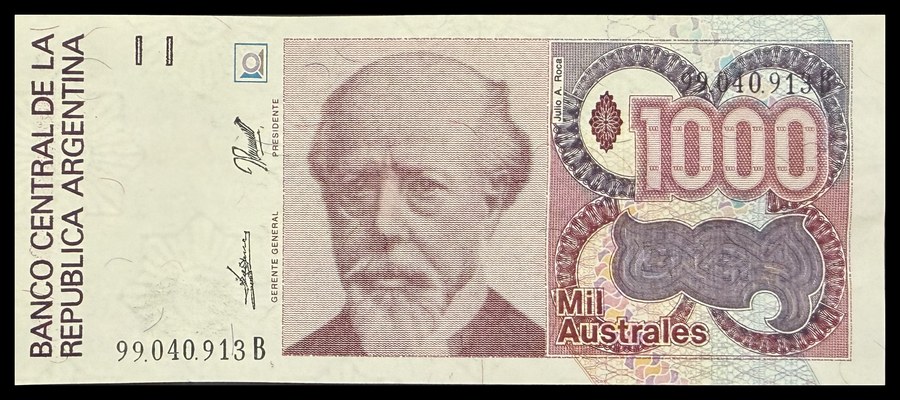
IMG_6063.HEIC
cropped
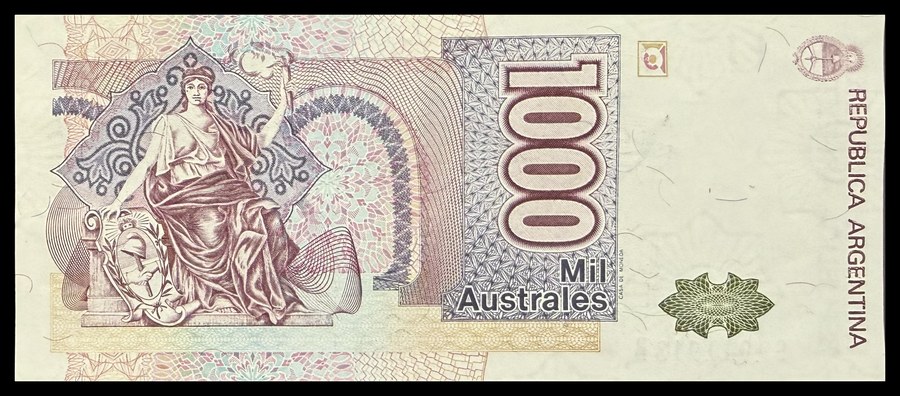
Where & when
What's on the note
Front: The front features the denomination '1000 Mil Australes' prominently displayed with the issuer's name 'BANCO CENTRAL DE LA REPUBLICA ARGENTINA' vertically aligned. The design includes intricate guilloche patterns in burgundy and brown tones forming the main security background. Two signatures appear with titles 'PRESIDENTE' and 'GERENTE GENERAL'. The Austral currency was introduced in June 1985 to combat hyperinflation, replacing the Peso Argentino at a rate of 1 Austral = 1,000 Pesos Argentinos, but itself succumbed to hyperinflation by the early 1990s.
Back: Allegory of Liberty or Progress, a classical female figure in flowing robes with Phrygian cap, seated with agricultural and industrial symbols including wheat sheaves and a cornucopia, representing Argentina's wealth and productive capacity. This allegorical representation has appeared on various Argentine currency issues throughout history, symbolizing the nation's aspirations for freedom, prosperity, and advancement. The figure is rendered in detailed intaglio engraving against elaborate geometric security patterns.
How it was made
Signatures: Presidente: [illegible]; Gerente General: [illegible]
Security features: thread,microprint,intaglio
Argentina in South America
Argentina in South America. Other countries on the same continent shown in muted grey.
Background & history
The Austral series was introduced on June 15, 1985, as part of the Austral Plan (Plan Austral) designed by Economy Minister Juan Vital Sourrouille under President Raúl Alfonsín to combat Argentina's severe hyperinflation. The Austral replaced the Peso Argentino at a rate of 1 Austral = 1,000 Pesos Argentinos. Initially successful in stabilizing prices, the currency ultimately failed as hyperinflation resumed in 1989-1990. The Austral was demonetized in 1992 when the Peso Convertible was introduced at a rate of 1 Peso = 10,000 Australes. The 1,000 Australes note was one of the higher denominations issued as inflation escalated. Designs featured allegorical figures rather than historical portraits, a departure from earlier Argentine currency traditions.
Collector references
How it came to me
Note shows moderate circulation with visible creases, minor edge wear, and some surface soiling. Colors remain relatively bright.
What it's worth now
Valuation history (1)
| date | low | high | currency | source | note |
|---|---|---|---|---|---|
| 2026-05-08 08:12:25 | 1.0 | 3.0 | USD | ai | claude-sonnet-4-5: The 1000 Austral P-329 is a common circulated note from Argentina's hyperinflation era (1985-1991); VF examples typically sell for $1-3 in the retail market. |
History & extractions
AI extractions (3)
Edits & decisions (0)
No edits yet.
Manual fixups
Find near-duplicates
Manual pairing override
Edit specimen #19
All fields below post to the same save endpoint. Sections collapse to focus on what you need.
Re-crop manually
Drag the four corners to mark the banknote in each image. Click Save crop to apply.