Collection › Germany › #193
20 Pfennig Pfennig (Notgeld)
The AI flagged these for your attention. Use ✦ Fact-check to cross-check factual fields against another model's world-knowledge, or 🔍 Re-look at image when you suspect the AI misread the pixels.
-
Some fields the AI was unsure about — please verify:
- Dimensions (mm): “—” (0%)
- Watermark: “—” (0%)
- Front portrait: “—” (0%)
- Pick #: “—” (0%)
Click ✦ Ask AI to verify or fix any below. -
Overall AI confidence is 85% (auto-approve threshold is 92%).Skim the Identity tab; the dots next to each field show what the AI was unsure about.
IMG_6435.jpeg
cropped
IMG_6436.jpeg
cropped
Where & when
What's on the note
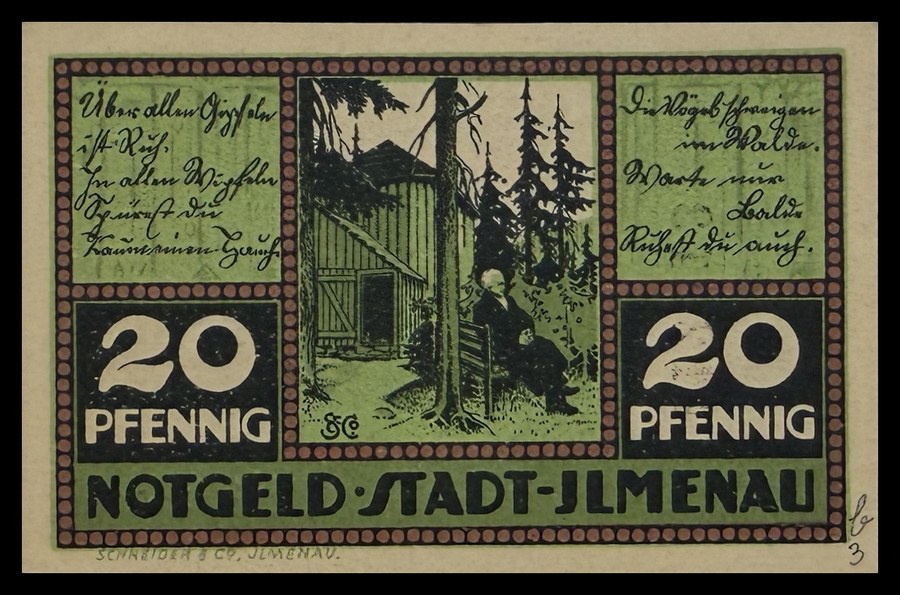
Front: A wooden cabin or barn structure set in a forested mountain landscape with conifer trees, representing a traditional Thuringian Forest scene. The central vignette shows rustic mountain architecture characteristic of the Ilmenau region in Thuringia. Text panels on either side contain Gothic script inscriptions validating the note's acceptance by local merchants and authorities. This imagery evokes Ilmenau's identity as a gateway to the Thuringian Forest and its timber industry heritage.
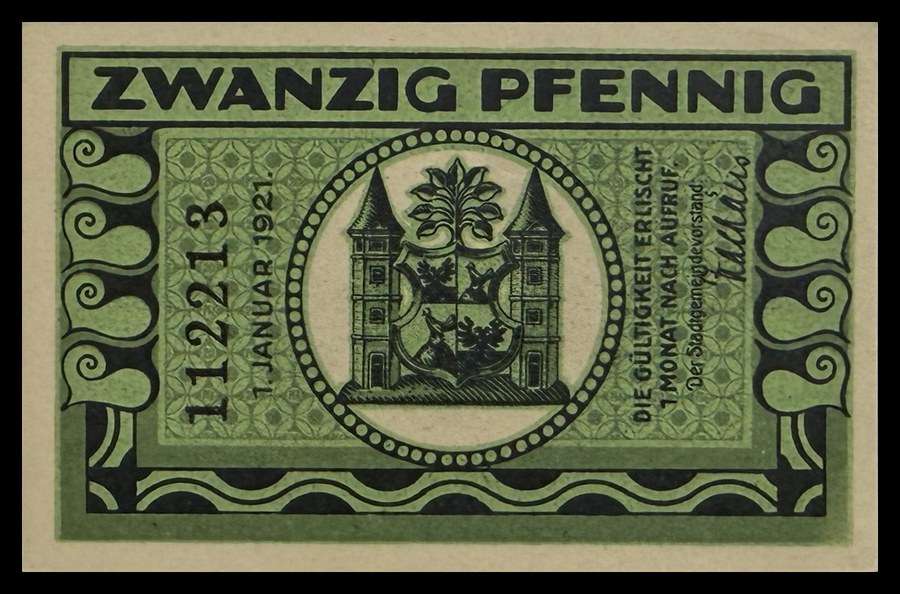
Back: The coat of arms of Ilmenau, showing a shield quartered with a palm or tree motif in the upper section and mining hammers in the lower section, flanked by two tower structures representing the city's medieval fortifications. The heraldic design reflects Ilmenau's dual identity as both a mining town and a center of forestry. The back bears the date '11 JANUAR 1921' and validation text stating the note's official acceptance after stamping by the magistrate ('Die Gültigkeit erlischt nach Aufhuf').
How it was made
Germany in Europe
Germany in Europe. Other countries on the same continent shown in muted grey.
Background & history
This is an example of German Notgeld (emergency money) issued by the town of Ilmenau in Thuringia during the severe inflation and currency shortage following World War I. Ilmenau, located in the Thuringian Forest, issued numerous artistic Notgeld notes between 1921-1923, many featuring local scenes, folklore, and the town's association with Goethe, who frequented the area. These notes were typically printed by local firms such as Schreiber & Co. and circulated as small-denomination currency when official Reich coinage was hoarded. The Notgeld period ended with the introduction of the Rentenmark in November 1923, which stabilized the currency. Ilmenau's Notgeld series is well-documented among collectors of German emergency currency.
Collector references
How it came to me
Note shows even circulation with some edge wear and minor soiling; printing remains clear with good color retention.
What it's worth now
Valuation history (1)
| date | low | high | currency | source | note |
|---|---|---|---|---|---|
| 2026-05-08 17:15:08 | 2.0 | 8.0 | USD | ai | from claude-sonnet-4-5 |
History & extractions
AI extractions (3)
Edits & decisions (0)
No edits yet.
Manual fixups
Find near-duplicates
Manual pairing override
Edit specimen #193
All fields below post to the same save endpoint. Sections collapse to focus on what you need.
Re-crop manually
Drag the four corners to mark the banknote in each image. Click Save crop to apply.