Collection › Germany › #204
10000000 Papiermark
P-106b
Needs review
✦ AI 90%
The AI flagged these for your attention. Use ✦ Fact-check to cross-check factual fields against another model's world-knowledge, or 🔍 Re-look at image when you suspect the AI misread the pixels.
-
Some fields the AI was unsure about — please verify:
- Watermark: “—” (0%)
- Front portrait: “—” (0%)
- Reverse subject: “—” (0%)
Click ✦ Ask AI to verify or fix any below. -
Overall AI confidence is 90% (auto-approve threshold is 92%).Skim the Identity tab; the dots next to each field show what the AI was unsure about.
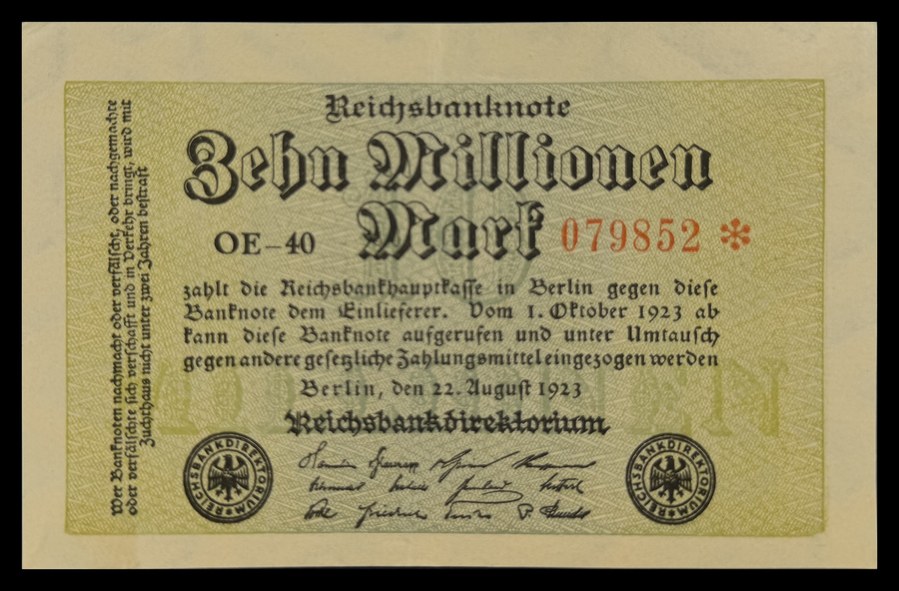
IMG_6457.jpeg
cropped
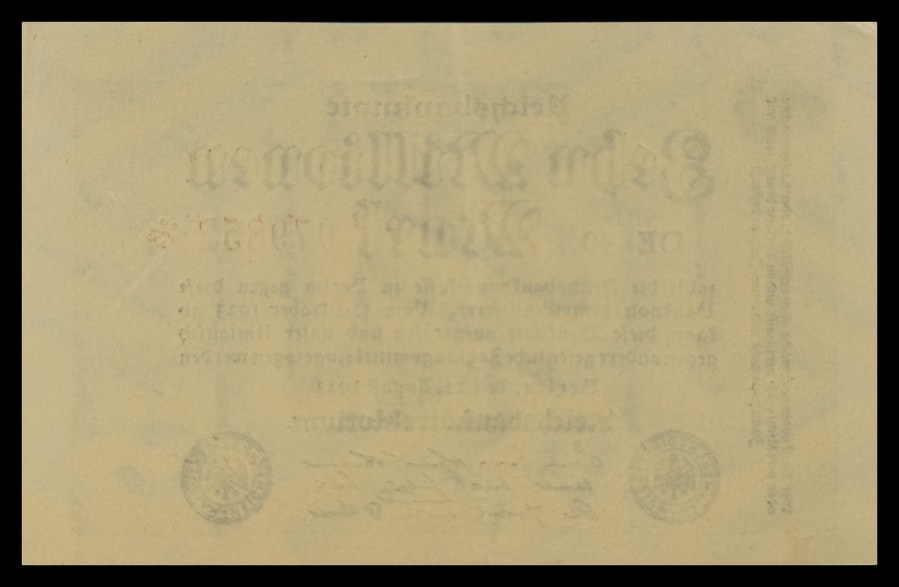
IMG_6458.jpeg
cropped
Where & when
What's on the note
Front: Weimar Republic hyperinflation emergency banknote issued during the catastrophic inflation of 1923. The note is dated August 22, 1923 and marked 'OE-40' with serial number 079852 and a replacement asterisk. The text warns that the note is payable by the Reichsbankhauptkasse in Berlin and can be called in starting October 1, 1923, to be exchanged for other legal tender. The Reichsadler (Imperial Eagle) seal appears at both lower corners, representing the authority of the Weimar Republic. This denomination represents the peak of German hyperinflation when the Papiermark became essentially worthless.
Back: The reverse shows a heavily faded or blank design with very faint text and Reichsadler seals visible at the corners, typical of the simplified emergency printing during the hyperinflation crisis when speed of production took precedence over elaborate security features.
How it was made
Signatures: Reichsbankdirektor: Simon, Reichsbankdirektor: Pinner
Security features: microprint
Germany in Europe
Germany in Europe. Other countries on the same continent shown in muted grey.
Background & history
This 10 million Mark note was issued during the Weimar Republic hyperinflation of 1923, one of history's most severe monetary crises. By August 1923, the German mark had lost virtually all purchasing power due to war reparations, economic disruption, and government money-printing. Notes were printed in increasingly astronomical denominations – this 10 million mark note was soon followed by billion and trillion mark issues. The replacement asterisk after the serial number indicates this is a replacement note used to replace defective notes in a print run. The crisis ended in November 1923 with the introduction of the Rentenmark at a rate of 1 Rentenmark = 1 trillion Papiermark. These hyperinflation notes, while common, serve as historical artifacts of economic catastrophe and the fragility of fiat currency.
Collector references
How it came to me
Note shows moderate circulation with some discoloration/aging to the paper. The back is significantly faded. Overall intact with clear printing on the front.
What it's worth now
Valuation history (1)
| date | low | high | currency | source | note |
|---|---|---|---|---|---|
| 2026-05-08 17:18:01 | 2.0 | 8.0 | USD | ai | from claude-sonnet-4-5 |
History & extractions
AI extractions (3)
Edits & decisions (1)
Manual fixups
Find near-duplicates
Manual pairing override
Edit specimen #204
All fields below post to the same save endpoint. Sections collapse to focus on what you need.
Re-crop manually
Drag the four corners to mark the banknote in each image. Click Save crop to apply.