Collection › Germany › #209
2 Rentenmark
P-P-175
AI extracted
✦ AI 92%
The AI flagged these for your attention. Use ✦ Fact-check to cross-check factual fields against another model's world-knowledge, or 🔍 Re-look at image when you suspect the AI misread the pixels.
-
Some fields the AI was unsure about — please verify:
- Serial number: “—” (0%)
- Watermark: “—” (30%)
Click ✦ Ask AI to verify or fix any below.
IMG_6467.jpeg
cropped
IMG_6468.jpeg
cropped
Where & when
What's on the note
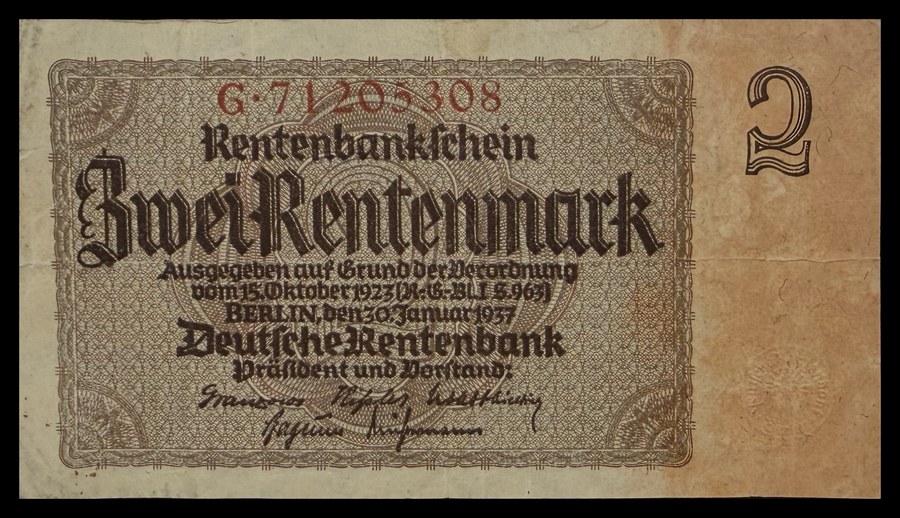
Front: German Rentenbank 2 Rentenmark note issued on January 30, 1937. The Rentenmark was an emergency currency introduced in November 1923 to stabilize the German economy during the hyperinflation crisis of the Weimar Republic. Backed by land and industrial assets rather than gold, it successfully ended the hyperinflation and circulated alongside the Reichsmark until 1948. The note features elaborate guilloche patterns and Gothic blackletter typography with the text 'Rentenbankschein Zwei Rentenmark' (Rentenbank Note Two Rentenmarks) and legal tender declaration.
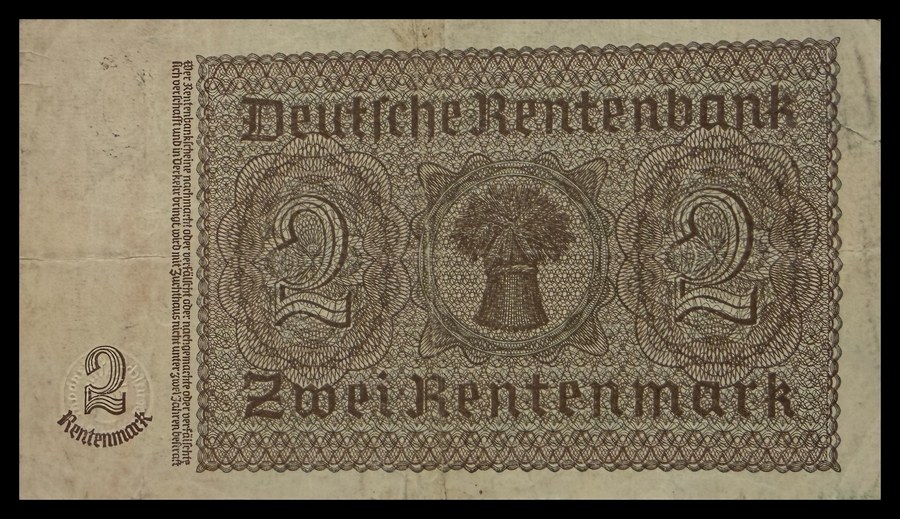
Back: Oak tree with acorns in a circular medallion at center, flanked by the numeral '2' on both sides. The oak tree is a traditional German national symbol representing strength, endurance, and steadfastness. The inscription 'Deutsche Rentenbank' appears at top in Fraktur typeface, with 'Zwei Rentenmark' (Two Rentenmarks) below the central design. The reverse reinforces the agricultural and natural resource backing that gave the Rentenmark its stability.
How it was made
Security features: guilloche_patterns,microprint
Germany in Europe
Germany in Europe. Other countries on the same continent shown in muted grey.
Background & history
This note belongs to the Rentenmark series issued by the Deutsche Rentenbank from 1923-1948. The Rentenmark was created in November 1923 as an emergency currency to halt the catastrophic hyperinflation of the Weimar Republic, where the Papiermark had become virtually worthless. Unlike previous currency, the Rentenmark was notionally backed by mortgages on agricultural and industrial land (Rentenbrief bonds). The exchange rate was set at 1 Rentenmark = 1 trillion Papiermarks. Though intended as temporary, it circulated alongside the Reichsmark (introduced 1924) until both were replaced by the Deutsche Mark in 1948 after World War II. The 1937 issue represents the later period of Rentenmark circulation during the Nazi era.
Collector references
How it came to me
Note shows moderate circulation wear with visible folds, slight discoloration, and aging consistent with an 87-year-old note. Paper remains intact with no major tears.
What it's worth now
Valuation history (1)
| date | low | high | currency | source | note |
|---|---|---|---|---|---|
| 2026-05-08 17:18:59 | 5.0 | 15.0 | USD | ai | from claude-sonnet-4-5 |
History & extractions
AI extractions (1)
Edits & decisions (0)
No edits yet.
Manual fixups
Find near-duplicates
Manual pairing override
Edit specimen #209
All fields below post to the same save endpoint. Sections collapse to focus on what you need.
Re-crop manually
Drag the four corners to mark the banknote in each image. Click Save crop to apply.