Collection › Germany › #211
5000 Mark Papiermark
P-P-81
AI extracted
✦ AI 95%
The AI flagged these for your attention. Use ✦ Fact-check to cross-check factual fields against another model's world-knowledge, or 🔍 Re-look at image when you suspect the AI misread the pixels.
-
Some fields the AI was unsure about — please verify:
- Issue year: “—” (0%)
- Reverse subject: “—” (0%)
- Watermark: “—” (30%)
Click ✦ Ask AI to verify or fix any below.
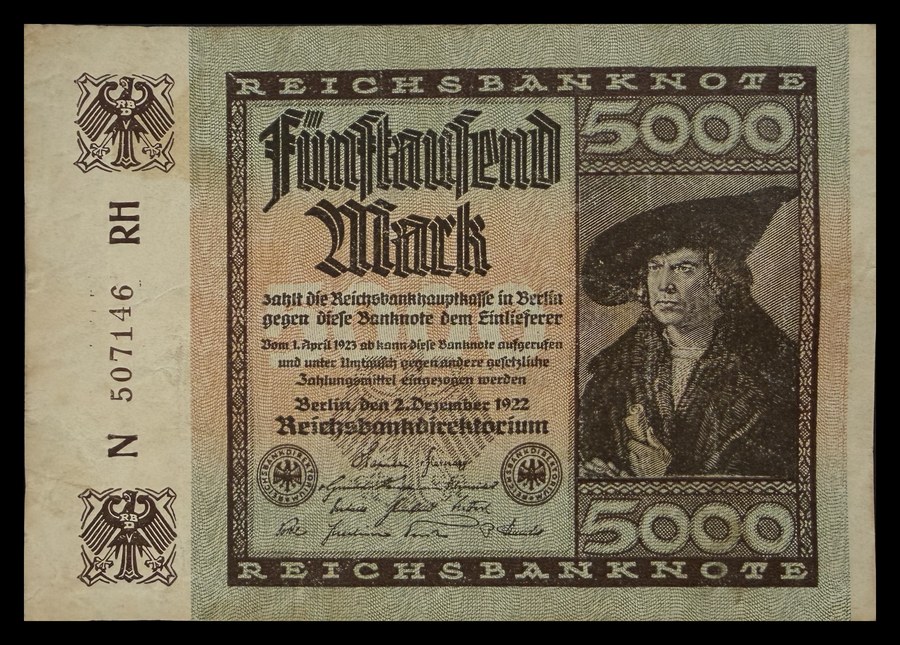
IMG_6471.jpeg
cropped
IMG_6472.jpeg
cropped
Where & when
What's on the note
Front: Albrecht Dürer (1471–1528), German Renaissance artist and printmaker from Nuremberg. Dürer was one of the most important figures of the Northern Renaissance, renowned for his engravings, paintings, and theoretical writings on art and mathematics; his self-portrait appears on this inflation-era banknote as a symbol of German cultural achievement. The note is dated 'Berlin, den 2. Dezember 1922' and bears the text stating it is legal tender payable by the Reichsbank hauptkasse in Berlin, valid from 1 April 1923 onwards and exchangeable under certain conditions for other payment instruments.
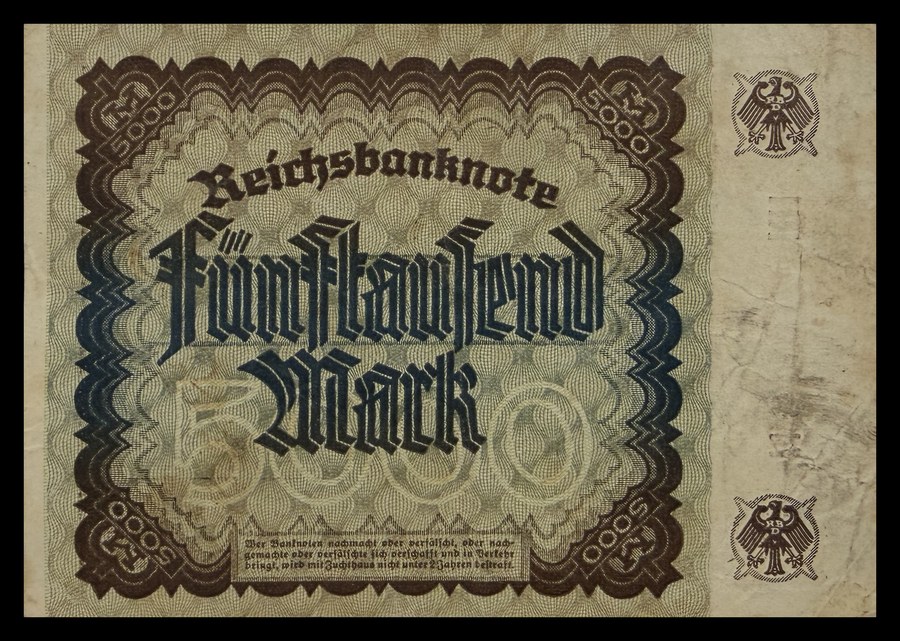
Back: Ornamental guilloche pattern with the denomination 'Fünftausend Mark' (Five Thousand Mark) in Gothic script within decorative borders. The reverse features intricate geometric security printing patterns typical of Weimar-era German banknotes, with the denomination repeated at corners alongside the imperial eagle motif. A warning text at bottom states that counterfeiting will be punished with imprisonment.
How it was made
Security features: microprint,guilloche_patterns
Germany in Europe
Germany in Europe. Other countries on the same continent shown in muted grey.
Background & history
This 5000 Mark note was issued during the hyperinflation period of the Weimar Republic (1922–1923), when the Papiermark collapsed due to war reparations, economic crisis, and excessive money printing. By December 1922, inflation was already severe; within a year, the currency became virtually worthless, with trillion-mark notes issued in 1923. The Papiermark was replaced by the Rentenmark in November 1923 at a rate of 1 Rentenmark = 1 trillion Papiermark. This series features prominent German cultural figures as a means of projecting national pride during economic catastrophe. P-81 is among the most common hyperinflation notes and is widely available to collectors.
Collector references
How it came to me
Note shows light soiling and handling wear consistent with circulation. Serial numbers and printed details remain clear. Some edge wear and minor staining visible on left margin.
What it's worth now
Valuation history (1)
| date | low | high | currency | source | note |
|---|---|---|---|---|---|
| 2026-05-08 17:19:00 | 2.0 | 8.0 | USD | ai | from claude-sonnet-4-5 |
History & extractions
AI extractions (1)
Edits & decisions (0)
No edits yet.
Manual fixups
Find near-duplicates
Manual pairing override
Edit specimen #211
All fields below post to the same save endpoint. Sections collapse to focus on what you need.
Re-crop manually
Drag the four corners to mark the banknote in each image. Click Save crop to apply.