Collection › Germany › #214
100 Mark
P-P-33
Needs review
✦ AI 90%
The AI flagged these for your attention. Use ✦ Fact-check to cross-check factual fields against another model's world-knowledge, or 🔍 Re-look at image when you suspect the AI misread the pixels.
-
Overall AI confidence is 90% (auto-approve threshold is 92%).Skim the Identity tab; the dots next to each field show what the AI was unsure about.
IMG_6477.jpeg
cropped
IMG_6478.jpeg
cropped
Where & when
What's on the note
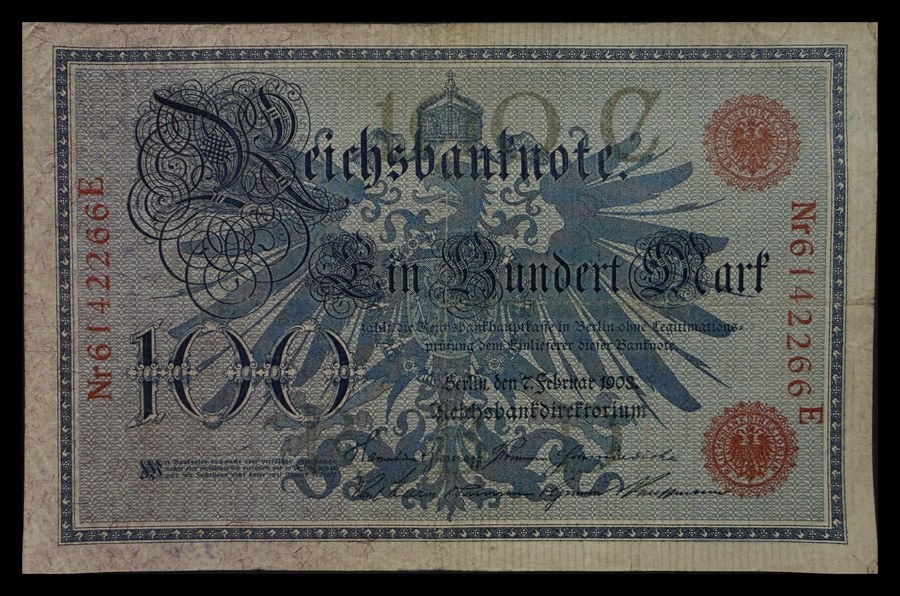
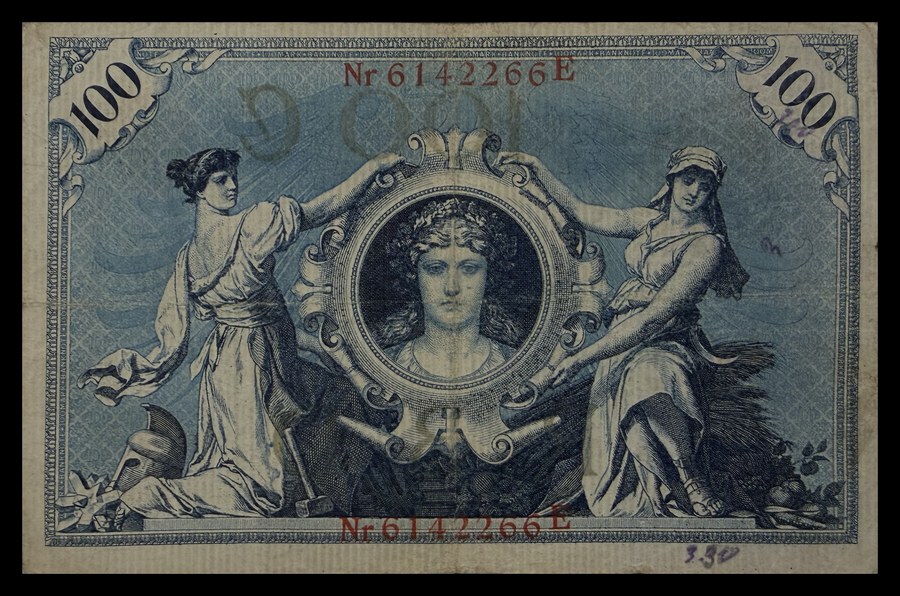
Front: Germania, the allegorical female personification of the German nation, shown in an ornate medallion at center. She is flanked by two allegorical female figures representing aspects of German virtue and prosperity. Germania was widely used on Imperial German banknotes and coins as a national symbol during the German Empire period (1871–1918), representing the unity and strength of the German nation. The neoclassical design reflects the artistic conventions of late Imperial Germany.
Back: The German Imperial Eagle (Reichsadler) with crown, the heraldic symbol of the German Empire. The eagle holds an orb and scepter, traditional symbols of imperial authority. The text 'Reichsbanknote Einhundert Mark' (Reichsbank Note One Hundred Marks) is prominently displayed in ornate Gothic script. The note is dated Berlin, 7 February 1908, and bears the red seals of the Reichsbank with the Imperial Eagle. This design represents the authority of the German Empire under Kaiser Wilhelm II.
How it was made
Signatures: Reichsbankdirektorium signatures
Security features: intaglio,microprint
Germany in Europe
Germany in Europe. Other countries on the same continent shown in muted grey.
Background & history
This is a 100 Mark Reichsbanknote from the 1908 series, issued by the Reichsbank during the German Empire period. These notes circulated from 1908 until the end of World War I and into the early Weimar Republic. The series was gradually withdrawn during the hyperinflation period of 1921–1923, when the Mark lost virtually all its value. The notes were formally demonetized in 1924 with the introduction of the Rentenmark and then the Reichsmark. The 1908 series is notable for its elaborate engraving and use of traditional German imperial symbolism, reflecting the confidence and stability of the pre-WWI German economy.
Collector references
How it came to me
Note shows circulation wear with some soiling and aging consistent with age. Colors remain visible though faded. Some edge wear present.
What it's worth now
Valuation history (1)
| date | low | high | currency | source | note |
|---|---|---|---|---|---|
| 2026-05-08 17:19:57 | 15.0 | 40.0 | USD | ai | from claude-sonnet-4-5 |
History & extractions
AI extractions (3)
Edits & decisions (0)
No edits yet.
Manual fixups
Find near-duplicates
Manual pairing override
Edit specimen #214
All fields below post to the same save endpoint. Sections collapse to focus on what you need.
Re-crop manually
Drag the four corners to mark the banknote in each image. Click Save crop to apply.