Collection › Germany › #218
100000 Reichsmark
P-P-83
Needs review
✦ AI 88%
The AI flagged these for your attention. Use ✦ Fact-check to cross-check factual fields against another model's world-knowledge, or 🔍 Re-look at image when you suspect the AI misread the pixels.
-
Lighting is too dim for confident reading.Mark Retake — re-photograph with more light.
-
Overall AI confidence is 88% (auto-approve threshold is 92%).Skim the Identity tab; the dots next to each field show what the AI was unsure about.
IMG_6485.jpeg
cropped
IMG_6486.jpeg
cropped
Where & when
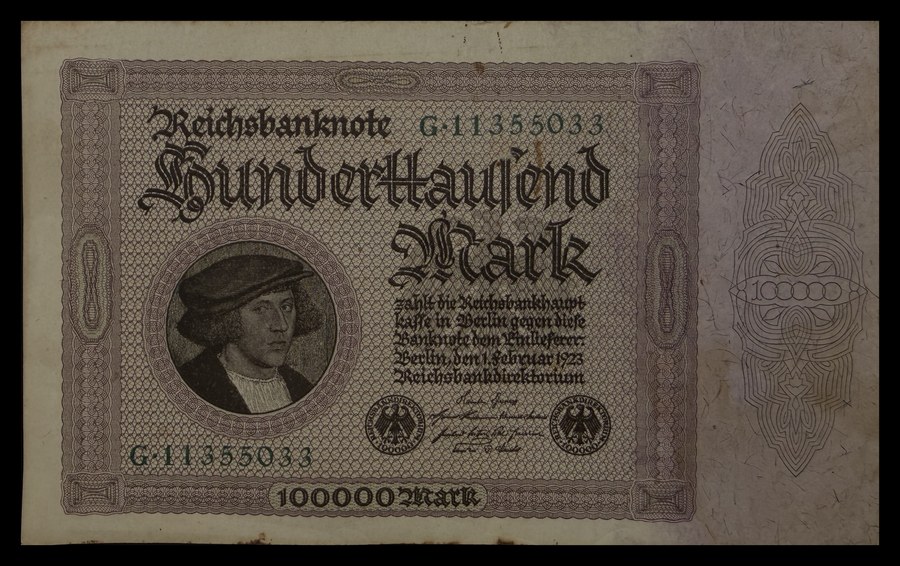
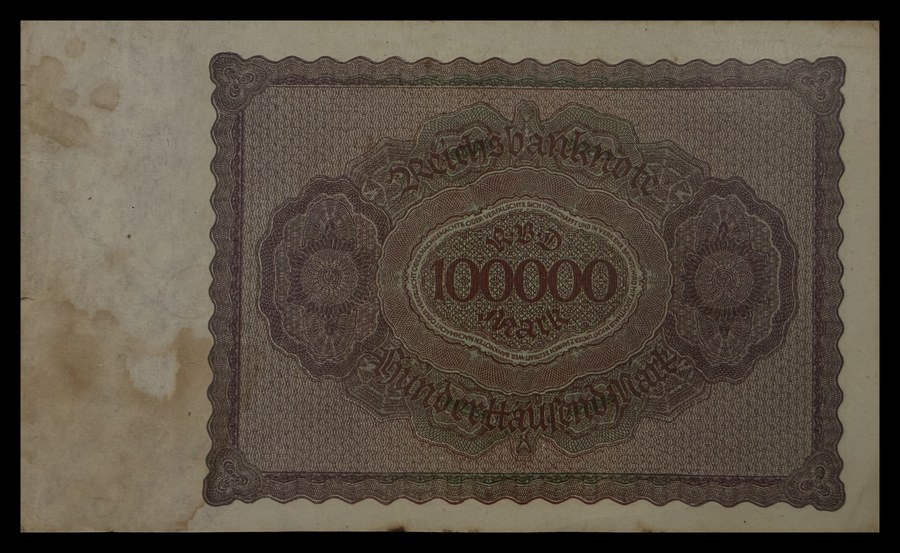
What's on the note
Front: Portrait of a merchant or burgher in Renaissance-era dress and cap, representing the German middle class and commercial tradition. The figure embodies the economic history of Germany during a period of catastrophic hyperinflation in 1923, when the Reichsmark lost virtually all value and such enormous denominations became necessary for daily transactions. The Weimar Republic issued notes in astronomical denominations as inflation spiraled out of control, with 100,000 Mark notes becoming commonplace before the currency reform.
Back: Ornate geometric guilloche pattern with the denomination 100000 Mark repeated in ornamental frames. The reverse design uses intricate line work and rosette patterns as anti-counterfeiting measures, though the rapid printing requirements during hyperinflation meant security features were often simplified. The text 'Reichsbanknote' appears in decorative script within the pattern work.
How it was made
Signatures: Reichsbankdirektorium
Security features: intaglio,microprint
Germany in Europe
Germany in Europe. Other countries on the same continent shown in muted grey.
Background & history
This 100,000 Mark note was issued during the catastrophic German hyperinflation of 1923, one of the most extreme episodes of currency devaluation in modern history. By late 1923, the Reichsmark had become essentially worthless, with prices doubling every few days. The Reichsbank printed notes in ever-larger denominations—millions, billions, and eventually trillions of Marks—to keep pace with inflation caused by war reparations, economic disruption, and the Ruhr occupation. This series was replaced by the Rentenmark in November 1923 at a rate of 1 Rentenmark = 1 trillion Papiermark, stabilizing the German economy. These hyperinflation notes remain common today as historical artifacts of economic catastrophe.
Collector references
How it came to me
Note shows handling wear, some soiling and staining on the back, edges show minor fraying, but overall intact with clear design elements and serial numbers visible.
What it's worth now
Valuation history (1)
| date | low | high | currency | source | note |
|---|---|---|---|---|---|
| 2026-05-08 17:20:21 | 5.0 | 15.0 | USD | ai | from claude-sonnet-4-5 |
History & extractions
AI extractions (3)
Edits & decisions (0)
No edits yet.
Manual fixups
Find near-duplicates
Manual pairing override
Edit specimen #218
All fields below post to the same save endpoint. Sections collapse to focus on what you need.
Re-crop manually
Drag the four corners to mark the banknote in each image. Click Save crop to apply.