Collection › Germany › #224
20 Mark
P-P-40b
AI extracted
✦ AI 92%
The AI flagged these for your attention. Use ✦ Fact-check to cross-check factual fields against another model's world-knowledge, or 🔍 Re-look at image when you suspect the AI misread the pixels.
-
Some fields the AI was unsure about — please verify:
- Watermark: “Denomination and decorative pattern visible in clear areas” (50%)
Click ✦ Ask AI to verify or fix any below.
IMG_6497.jpeg
cropped
IMG_6498.jpeg
cropped
Where & when
What's on the note
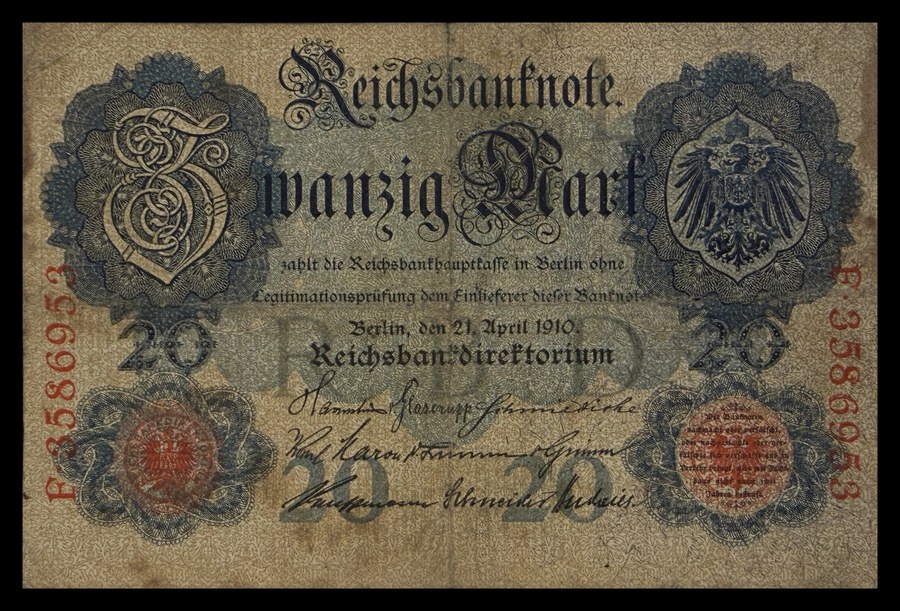
Front: Imperial German Reichsbanknote issued under Kaiser Wilhelm II. The note features the Imperial German Eagle (Reichsadler) at right within an ornate rosette, with elaborate guilloche patterns at left and bottom corners. The text states this 20 Mark note is payable by the Reichsbank main office in Berlin without legitimation verification to the bearer. Dated Berlin, 21 April 1910, bearing the heading 'Reichsbanknote' in ornate Gothic script and signed by the Reichsbankdirektorium. The serial number E7790582 appears in red on both left and right margins.
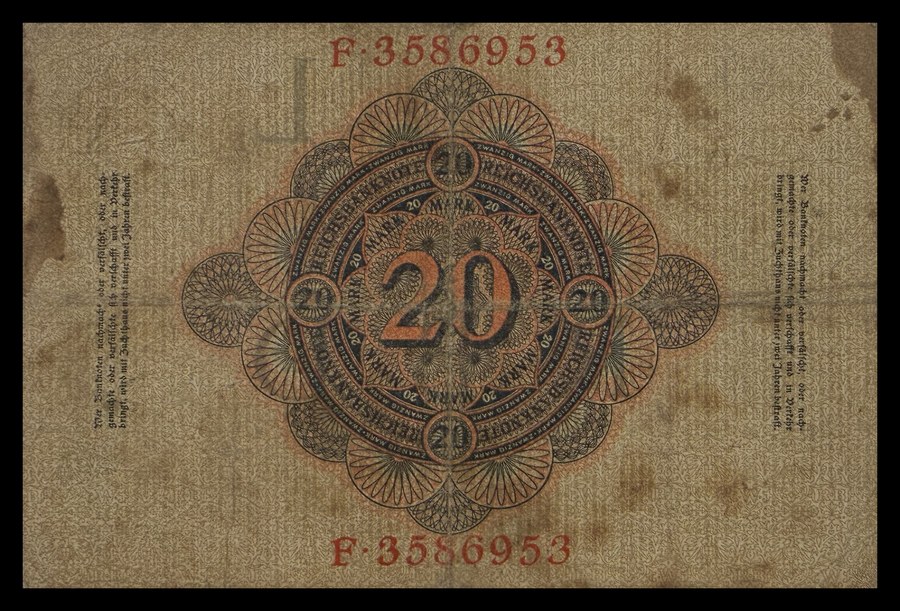
Back: Geometric guilloche pattern featuring an elaborate rosette design with interlocking circular motifs in brown and orange ink. The denomination '20' appears prominently at center within concentric circular bands containing repeated text 'ZWANZIG MARK'. The serial number E7790582 is repeated in red at top and bottom. Fine microtext legal warnings appear vertically along both left and right margins regarding counterfeiting penalties.
How it was made
Signatures: Reichsbankdirektorium: Three signatures visible but illegible in image
Security features: intaglio,microprint
Germany in Europe
Germany in Europe. Other countries on the same continent shown in muted grey.
Background & history
This note belongs to the Reichsbanknote series issued by the German Empire's Reichsbank from 1906 to 1914, during the reign of Kaiser Wilhelm II. These notes were the standard circulating currency of Imperial Germany before World War I. The 1910 issue date places it in the late Wilhelmine period of economic prosperity. Following Germany's defeat in WWI and the hyperinflation of the early 1920s, these notes were demonetized in 1924 with the currency reform that introduced the Reichsmark. The elaborate guilloche work and Gothic typography are characteristic of German banknote design of this period, emphasizing security through complex engraving rather than later technologies.
Collector references
How it came to me
Circulated note with visible fold marks and general wear consistent with age. Paper shows discoloration and some soiling. No tears visible but exhibits typical handling evidence for a 113-year-old note.
What it's worth now
Valuation history (1)
| date | low | high | currency | source | note |
|---|---|---|---|---|---|
| 2026-05-08 17:21:58 | 15.0 | 40.0 | USD | ai | from claude-sonnet-4-5 |
History & extractions
AI extractions (1)
Edits & decisions (0)
No edits yet.
Manual fixups
Find near-duplicates
Manual pairing override
Edit specimen #224
All fields below post to the same save endpoint. Sections collapse to focus on what you need.
Re-crop manually
Drag the four corners to mark the banknote in each image. Click Save crop to apply.