Collection › Greece › #239
50 GRD
P-199
AI extracted
✦ AI 92%
The AI flagged these for your attention. Use ✦ Fact-check to cross-check factual fields against another model's world-knowledge, or 🔍 Re-look at image when you suspect the AI misread the pixels.
-
Some fields the AI was unsure about — please verify:
- Printer: “—” (0%)
Click ✦ Ask AI to verify or fix any below.
IMG_6527.jpeg
cropped
IMG_6528.jpeg
cropped
Where & when
What's on the note
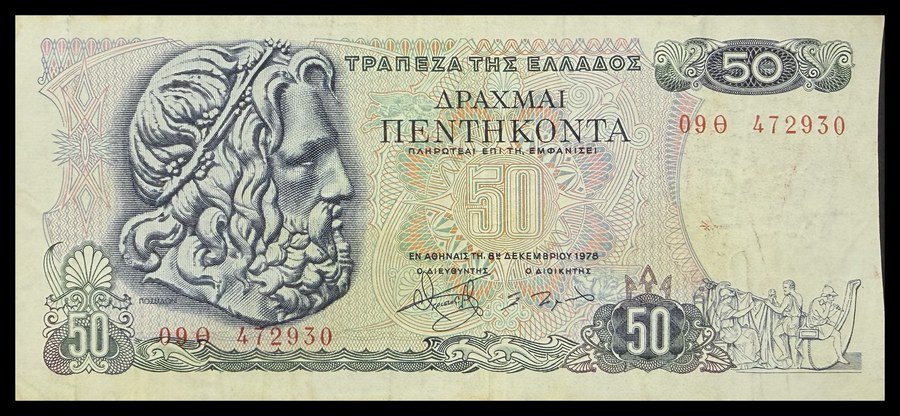
Front: Poseidon, ancient Greek god of the sea, earthquakes, and horses, depicted in classical sculptural style with flowing beard and trident. One of the twelve Olympian deities of the Greek pantheon, Poseidon was among the most powerful gods in Greek mythology and a central figure in Greek religion and culture. He appears frequently on Greek currency as a symbol of the nation's maritime heritage and classical legacy. The note includes classical Greek figures in a frieze at lower right, representing ancient Hellenic civilization.
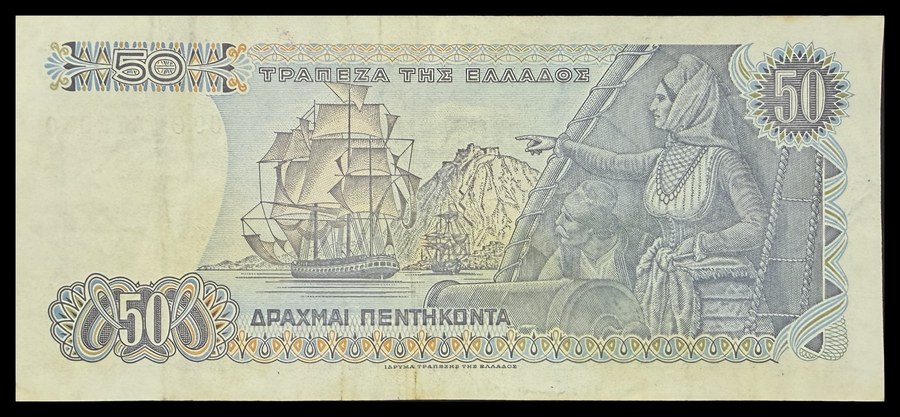
Back: Laskarina Bouboulina (1771–1825), Greek naval commander and heroine of the Greek War of Independence. She was one of the most prominent figures in the Greek revolution against Ottoman rule, commanding her own fleet of ships including the warship Agamemnon. A wealthy widow who devoted her fortune and life to the independence struggle, she participated in the naval blockade of Nafplion and is celebrated as one of the first female admirals in history. The reverse depicts her in traditional Greek costume alongside a sailing ship, symbolizing her naval command during the 1821 revolution.
How it was made
Signatures: Governor: signature present; Deputy Governor: signature present
Security features: watermark,intaglio,microprint
Greece in Europe
Greece in Europe. Other countries on the same continent shown in muted grey.
Background & history
Part of the 1978 drachma series issued by the Bank of Greece, which featured mythological figures on the obverse and historical personalities on the reverse. This series remained in circulation until Greece adopted the euro in 2002, when the drachma was withdrawn. The 50 drachma note was one of the lower denominations and saw widespread everyday use. Date printed: Athens, 8 December 1978 (EN ΑΘΗΝΑΙΣ ΤΗ 8Η ΔΕΚΕΜΒΡΙΟΥ 1978). The design reflects Greece's dual identity, celebrating both its ancient classical heritage through Poseidon and its modern national identity through the figure of Bouboulina, a key independence heroine.
Collector references
How it came to me
Note shows moderate circulation with visible folds, light soiling, and wear consistent with VF grade. Colors remain reasonably vibrant with good detail visible in the engraving.
What it's worth now
Valuation history (1)
| date | low | high | currency | source | note |
|---|---|---|---|---|---|
| 2026-05-08 17:24:48 | 2.0 | 8.0 | USD | ai | from claude-sonnet-4-5 |
History & extractions
AI extractions (1)
Edits & decisions (0)
No edits yet.
Manual fixups
Find near-duplicates
Manual pairing override
Edit specimen #239
All fields below post to the same save endpoint. Sections collapse to focus on what you need.
Re-crop manually
Drag the four corners to mark the banknote in each image. Click Save crop to apply.