Collection › Greece › #241
100 GRD
P-200
AI extracted
✦ AI 92%
The AI flagged these for your attention. Use ✦ Fact-check to cross-check factual fields against another model's world-knowledge, or 🔍 Re-look at image when you suspect the AI misread the pixels.
-
Some fields the AI was unsure about — please verify:
- Printer: “Bank of Greece Printing Works” (0%)
Click ✦ Ask AI to verify or fix any below.
IMG_6531.jpeg
cropped
IMG_6532.jpeg
cropped
Where & when
What's on the note
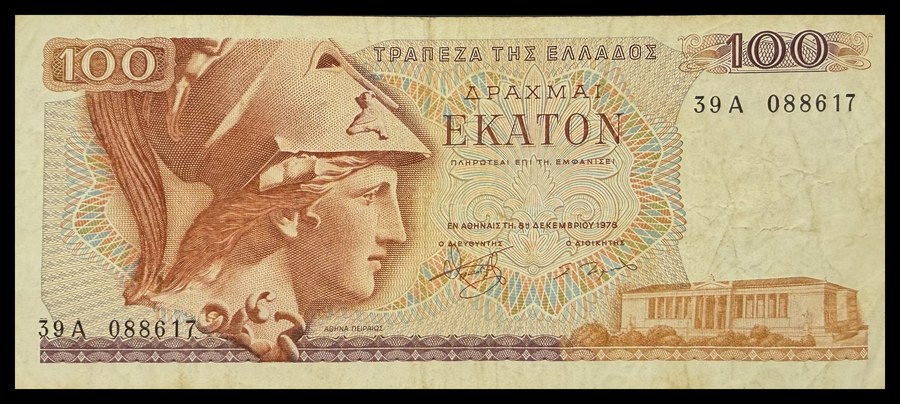
Front: Athena, ancient Greek goddess of wisdom, warfare, and handicraft, patron deity of Athens. The profile portrait shows her wearing a Corinthian helmet with decorative elements. Athena was central to Greek identity and culture, appearing on coinage from ancient times through the modern era. At lower right is the Zappeion Hall in Athens, a neoclassical building completed in 1888, used for exhibitions and the first modern Olympic Games in 1896. The building symbolizes Greece's cultural renaissance and connection to classical heritage.
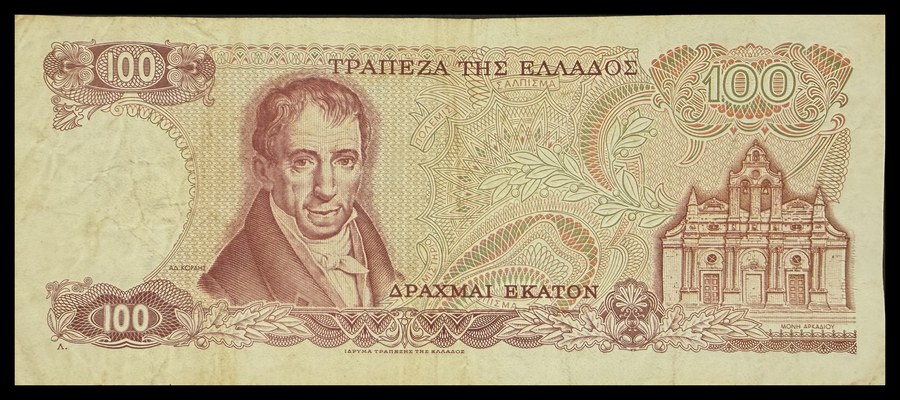
Back: Adamantios Korais (1748–1833), Greek humanist scholar and one of the most prominent figures of the Modern Greek Enlightenment. Born in Smyrna, he spent most of his life in Paris, where he worked to preserve and promote Greek language and culture during Ottoman rule. His extensive writings and editorial work on classical texts were instrumental in shaping modern Greek national consciousness and the standardization of the Greek language during the Greek War of Independence. At right is the Monastery of Arkadi in Crete, a historic monastery famous for its role in the Cretan resistance against Ottoman rule, particularly the 1866 explosion during the Cretan revolt.
How it was made
Signatures: Governor: signature visible; Director: signature visible
Security features: thread,microprint,intaglio
Greece in Europe
Greece in Europe. Other countries on the same continent shown in muted grey.
Background & history
This note belongs to the 1978 series of Greek drachma banknotes issued by the Bank of Greece, which circulated during the final decades before Greece adopted the euro in 2002. The series featured classical and neoclassical themes emphasizing Greek cultural continuity from ancient times through the modern era. The 100 drachma note paired the mythological figure of Athena with Adamantios Korais, linking ancient wisdom with modern enlightenment. These notes were demonetized on March 1, 2002, when Greece fully transitioned to the euro, though they could be exchanged at the Bank of Greece until March 1, 2012.
Collector references
How it came to me
Note shows moderate circulation with light soiling and handling marks, no major creases or tears visible
What it's worth now
Valuation history (1)
| date | low | high | currency | source | note |
|---|---|---|---|---|---|
| 2026-05-08 17:24:46 | 2.0 | 5.0 | USD | ai | from claude-sonnet-4-5 |
History & extractions
AI extractions (1)
Edits & decisions (0)
No edits yet.
Manual fixups
Find near-duplicates
Manual pairing override
Edit specimen #241
All fields below post to the same save endpoint. Sections collapse to focus on what you need.
Re-crop manually
Drag the four corners to mark the banknote in each image. Click Save crop to apply.