Collection › Greece › #245
1000000 GRD
P-P-127
Needs review
✦ AI 90%
The AI flagged these for your attention. Use ✦ Fact-check to cross-check factual fields against another model's world-knowledge, or 🔍 Re-look at image when you suspect the AI misread the pixels.
-
Some fields the AI was unsure about — please verify:
- Printer: “—” (0%)
- Watermark: “—” (0%)
Click ✦ Ask AI to verify or fix any below. -
Overall AI confidence is 90% (auto-approve threshold is 92%).Skim the Identity tab; the dots next to each field show what the AI was unsure about.
IMG_6539.jpeg
cropped
IMG_6540.jpeg
cropped
Where & when
What's on the note
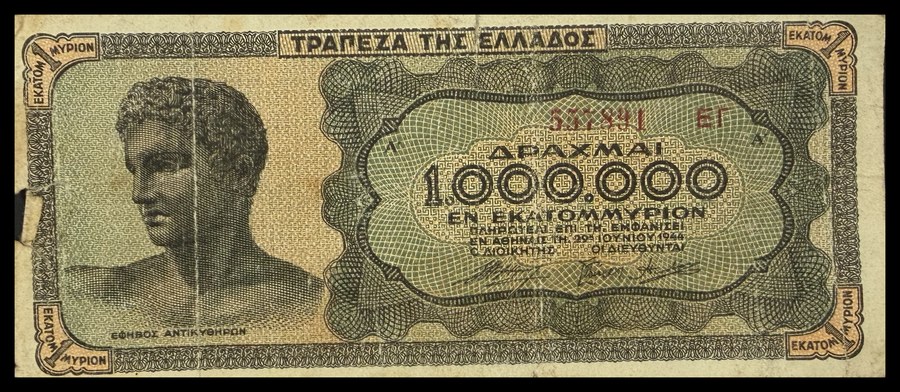
Front: The Ephebe of Antikythera (Ἔφηβος Ἀντικυθήρων), a bronze statue recovered from the Antikythera shipwreck in 1900, dating to circa 340–330 BC. The sculpture, now housed in the National Archaeological Museum of Athens, is believed to represent either Paris or Perseus. The inscription 'ΕΦΗΒΟΣ ΑΝΤΙΚΥΘΗΡΩΝ' (Ephebe of Antikythera) appears below the portrait. The note is dated 29 June 1944 during the German occupation hyperinflation period.
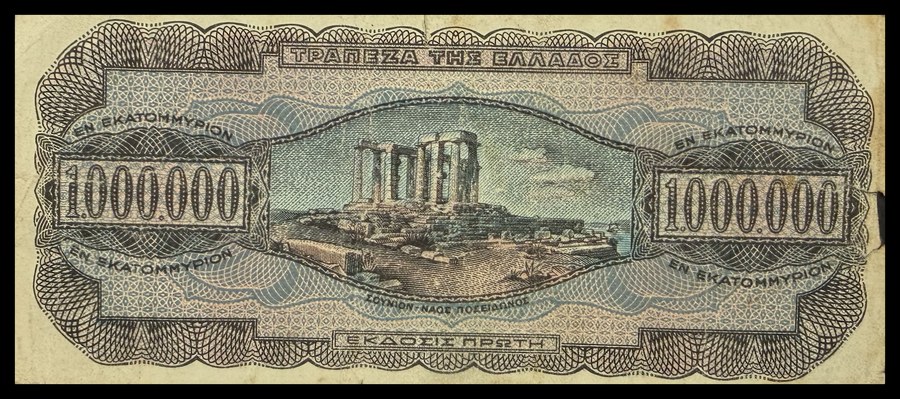
Back: The Temple of Poseidon at Cape Sounion, built circa 444–440 BC during the Age of Pericles. This Doric temple overlooks the Aegean Sea at the southernmost tip of Attica and remains one of Greece's most significant ancient monuments. The inscription 'ΣΟΥΝΙΟΝ-ΝΑΟΣ ΠΟΣΕΙΔΩΝΟΣ' (Sounion – Temple of Poseidon) identifies the scene. 'ΕΚΔΟΣΙΣ ΠΡΩΤΗ' (First Issue) appears at bottom.
How it was made
Security features: intaglio
Greece in Europe
Greece in Europe. Other countries on the same continent shown in muted grey.
Background & history
This 1,000,000 drachmai note was issued on 29 June 1944 during the catastrophic hyperinflation of the Greek occupation by Axis powers in World War II. The German occupation authorities forced the Bank of Greece to finance occupation costs, leading to one of history's worst hyperinflations. By November 1944, prices were doubling every 4.3 days. This note, despite its million-drachma face value, was nearly worthless by late 1944. A currency reform in November 1944 exchanged 50 billion old drachmai for one new drachma.
Collector references
How it came to me
Moderate circulation wear, some soiling, edge wear visible on left margin, minor tears at edges, paper remains intact with visible folds
What it's worth now
Valuation history (1)
| date | low | high | currency | source | note |
|---|---|---|---|---|---|
| 2026-05-08 17:26:13 | 1.0 | 5.0 | USD | ai | from claude-opus-4-5 |
History & extractions
AI extractions (3)
Edits & decisions (0)
No edits yet.
Manual fixups
Find near-duplicates
Manual pairing override
Edit specimen #245
All fields below post to the same save endpoint. Sections collapse to focus on what you need.
Re-crop manually
Drag the four corners to mark the banknote in each image. Click Save crop to apply.