Collection › Greece › #253
200 GRD
P-P-130
Needs review
✦ AI 85%
The AI flagged these for your attention. Use ✦ Fact-check to cross-check factual fields against another model's world-knowledge, or 🔍 Re-look at image when you suspect the AI misread the pixels.
-
Some fields the AI was unsure about — please verify:
- Series year: “—” (0%)
- Issue year: “—” (0%)
- Printer: “—” (0%)
- Dimensions (mm): “—” (0%)
- Watermark: “—” (0%)
- Front portrait: “—” (0%)
- …and 2 more
Click ✦ Ask AI to verify or fix any below. -
The photo is blurry.Mark Retake — re-photograph in better focus.
-
Lighting is too dim for confident reading.Mark Retake — re-photograph with more light.
-
Overall AI confidence is 85% (auto-approve threshold is 92%).Skim the Identity tab; the dots next to each field show what the AI was unsure about.
IMG_6555.jpeg
cropped
IMG_6556.jpeg
cropped
Where & when
What's on the note
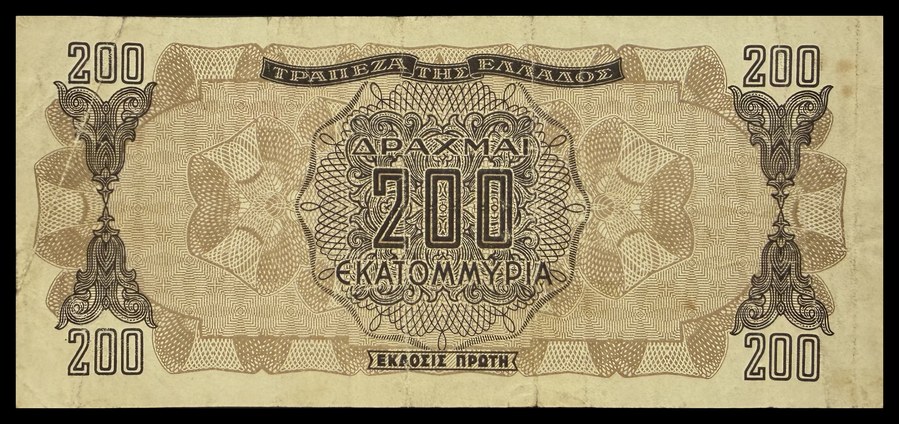
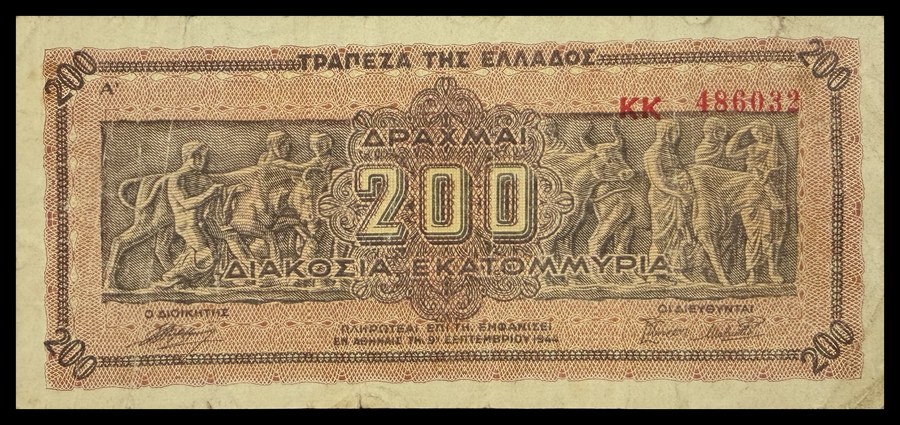
Front: Geometric design with central denomination '200 ΔΡΑΧΜΑΙ' in ornate guilloche rosette, without portrait. The note bears the text 'ΤΡΑΠΕΖΑ ΤΗΣ ΕΛΛΑΔΟΣ' (Bank of Greece) and 'ΕΚΔΟΣΙΣ ΠΡΩΤΗ' (First Issue). This design typifies the simplified, non-portrait banknotes issued during the Axis occupation of Greece (1941–1944), a period marked by catastrophic hyperinflation that rendered the drachma nearly worthless.
Back: Denomination '200 ΔΙΑΚΟΣΙΑΙ ΔΡΑΧΜΑΙ' (two hundred drachmas) at center with ornate guilloche patterns and Greek key meander borders. A red overprint stamp reading 'ΚΖ Σελλασίε' appears at upper right, likely a validation or control mark. The reverse design mirrors the front's emphasis on security printing rather than national iconography, reflecting wartime exigencies.
How it was made
Security features: guilloche,microprint
Greece in Europe
Greece in Europe. Other countries on the same continent shown in muted grey.
Background & history
This 200 drachma note belongs to the first issue series (ΕΚΔΟΣΙΣ ΠΡΩΤΗ) printed during the Axis occupation of Greece (1941–1944). The occupation triggered one of history's worst hyperinflations, with the drachma losing virtually all value as occupation authorities printed massive quantities of currency. By 1944, notes of astronomical denominations were required for basic transactions. Following liberation, Greece undertook currency reform to stabilize the drachma. These occupation-era notes are historically significant as tangible evidence of economic warfare and civilian suffering during WWII.
Collector references
How it came to me
Note shows significant circulation wear with creases, light staining, and aging consistent with wartime use. Paper is intact but worn.
What it's worth now
Valuation history (1)
| date | low | high | currency | source | note |
|---|---|---|---|---|---|
| 2026-05-08 17:27:21 | 5.0 | 15.0 | USD | ai | from claude-sonnet-4-5 |
History & extractions
AI extractions (2)
Edits & decisions (0)
No edits yet.
Manual fixups
Find near-duplicates
Manual pairing override
Edit specimen #253
All fields below post to the same save endpoint. Sections collapse to focus on what you need.
Re-crop manually
Drag the four corners to mark the banknote in each image. Click Save crop to apply.