Collection › Guyana › #267
1 GYD
P-21g
AI extracted
✦ AI 92%
The AI flagged these for your attention. Use ✦ Fact-check to cross-check factual fields against another model's world-knowledge, or 🔍 Re-look at image when you suspect the AI misread the pixels.
-
Some fields the AI was unsure about — please verify:
- Series year: “—” (0%)
- Issue year: “—” (0%)
Click ✦ Ask AI to verify or fix any below.
IMG_6583.jpeg
cropped
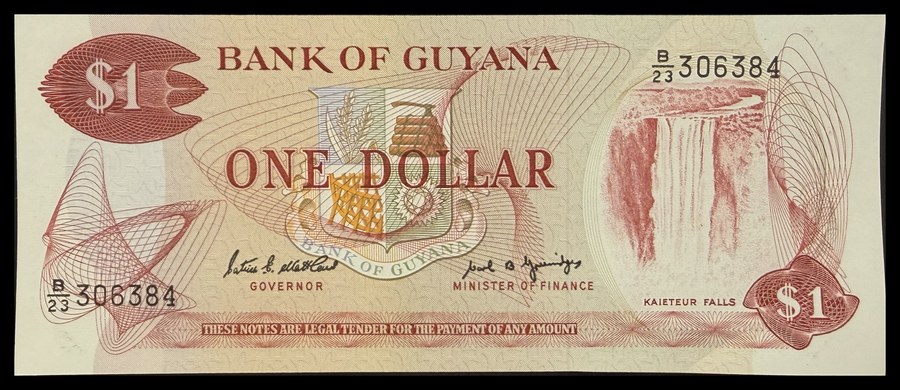
IMG_6584.jpeg
cropped
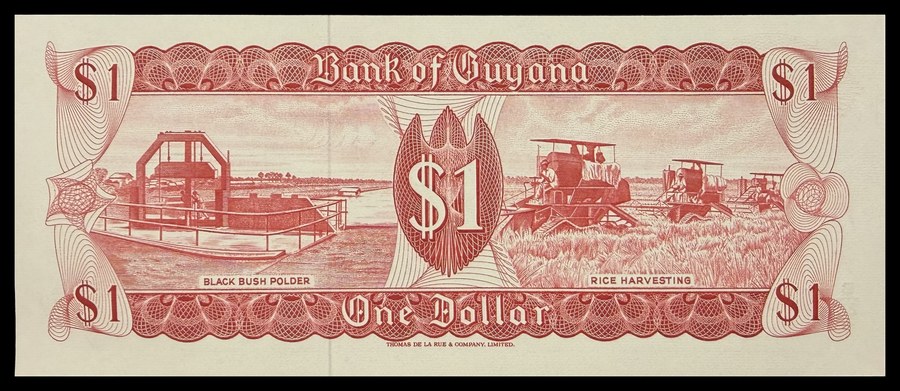
Where & when
What's on the note
Front: Kaieteur Falls, one of the world's most powerful waterfalls located on the Potaro River in Kaieteur National Park, Guyana. With a single drop of 226 meters (741 feet), it is approximately five times higher than Niagara Falls and about twice the height of Victoria Falls. The falls were named after Kai, a Patamona chief who according to legend sacrificed himself by paddling over the falls in an act to save his people. The coat of arms of Guyana appears at center, featuring supporters (a jaguar and a harpy eagle), rice and sugarcane symbols, and the national motto.
Back: Black Bush Polder and rice harvesting scenes, representing Guyana's agricultural economy. Black Bush Polder is a major rice-growing area in the Corentyne region of East Berbice-Corentyne, developed as part of post-independence agricultural expansion. The left vignette shows the polder's water management infrastructure (sluice gates and channels essential for rice cultivation), while the right depicts mechanical rice harvesting with combine harvesters in the fields. Rice has been one of Guyana's principal export crops since the mid-20th century.
How it was made
Signatures: Governor: (signature illegible); Minister of Finance: (signature illegible)
Security features: thread,intaglio,microprint
Guyana in South America
Guyana in South America. Other countries on the same continent shown in muted grey.
Background & history
This note belongs to the first series of the Guyanese Dollar, introduced in 1966 when Guyana gained independence from Britain, replacing the British Guiana Dollar at par. The series featured the new nation's symbols and economic activities, emphasizing national pride and development. The $1 note prominently featured Kaieteur Falls as a symbol of national heritage and natural beauty, while the reverse highlighted the country's agricultural base, particularly rice cultivation in the coastal plains. This series was replaced in 1989–1992 with new designs. The printer, Thomas De La Rue, was the preeminent banknote printer for Commonwealth nations during this era.
Collector references
How it came to me
Note shows circulation with a center fold and some handling wear, but retains good color and detail.
What it's worth now
Valuation history (1)
| date | low | high | currency | source | note |
|---|---|---|---|---|---|
| 2026-05-08 17:29:59 | 2.0 | 8.0 | USD | ai | from claude-sonnet-4-5 |
History & extractions
AI extractions (1)
Edits & decisions (0)
No edits yet.
Manual fixups
Find near-duplicates
Manual pairing override
Edit specimen #267
All fields below post to the same save endpoint. Sections collapse to focus on what you need.
Re-crop manually
Drag the four corners to mark the banknote in each image. Click Save crop to apply.