Collection › Austria-Hungary › #30
1000 Austro-Hungarian Krone
P-P-59
Needs review
✦ AI 88%
The AI flagged these for your attention. Use ✦ Fact-check to cross-check factual fields against another model's world-knowledge, or 🔍 Re-look at image when you suspect the AI misread the pixels.
-
Part of the note is cut out of the frame.Mark Retake — re-photograph with the whole note in view.
-
Overall AI confidence is 88% (auto-approve threshold is 92%).Skim the Identity tab; the dots next to each field show what the AI was unsure about.
IMG_6084.HEIC
cropped
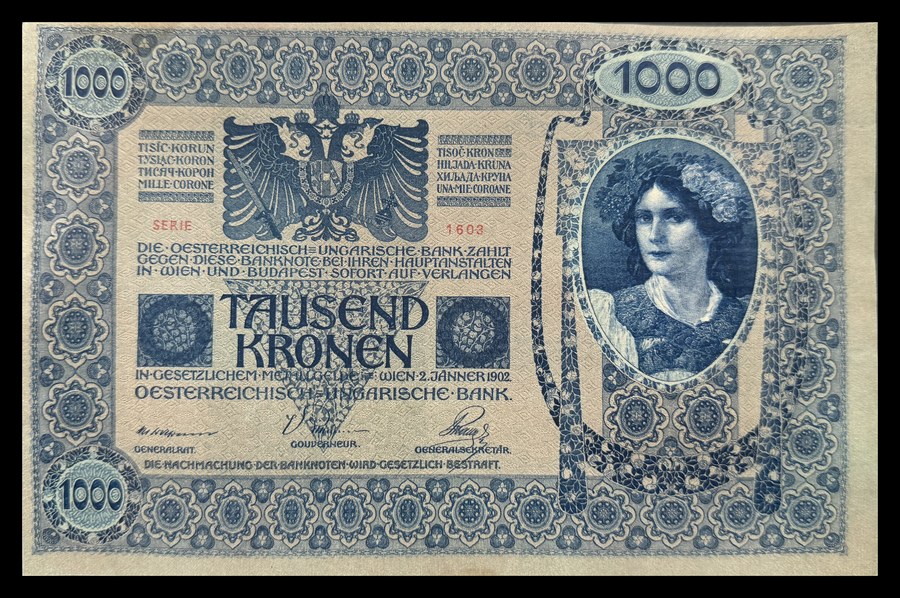
IMG_6085.HEIC
cropped
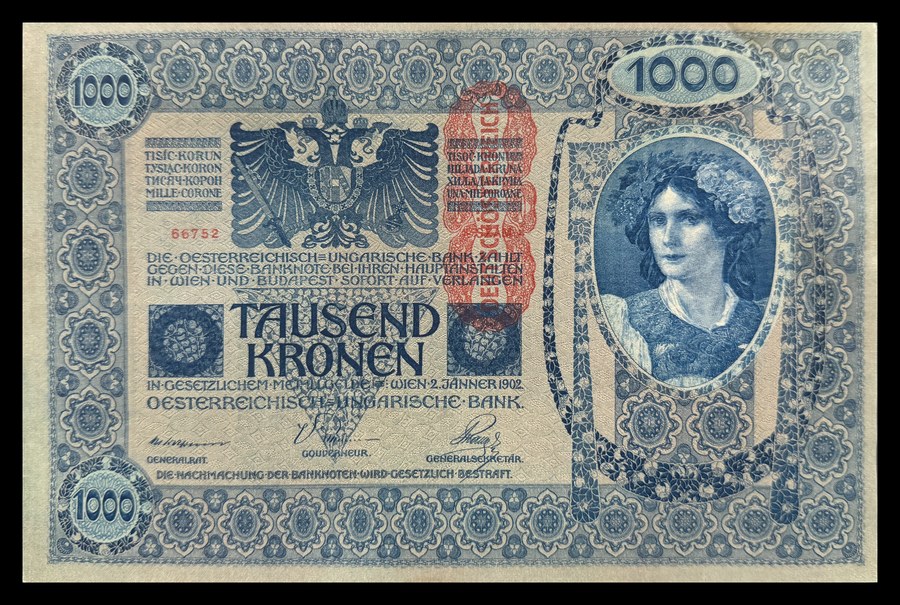
Where & when
What's on the note
Front: Allegorical female figure representing Austria or the monarchy, positioned at right in an ornate oval frame. The Austro-Hungarian double-headed eagle with crown and coat of arms appears at center-left. This design is typical of the Oesterreichisch-ungarische Bank's 1902 issue, which served the dual monarchy until its dissolution in 1918. The note bears inscriptions in multiple languages of the empire (German, Hungarian, Czech, Polish, Italian, Croatian, Romanian, Ruthenian) reflecting the multinational character of Austria-Hungary. Serial number 1603 appears in red at upper center.
Back: The reverse shows the same allegorical female figure and double-headed eagle design as the front, with a prominent red overprint stamp applied vertically at center bearing the Hungarian coat of arms and text. This stamp was applied after World War I during the transition period when Austria-Hungary dissolved. The serial number 66752 appears at left. The red overprint indicates special status or validation during the currency's final period of use.
How it was made
Signatures: Generalrat; Gouverneur; Generalsecretär
Security features: microprint,intaglio
Where in the world
Geography unknown for Austria-Hungary.
Background & history
This 1000 Kronen note belongs to the 1902 series issued by the Oesterreichisch-ungarische Bank, the central bank of the Austro-Hungarian Empire. The note was authorized by law on 2 January 1902 and circulated throughout the dual monarchy. The multilingual inscriptions demonstrate the empire's diverse ethnic composition, with denominations printed in eight languages. Following World War I and the empire's dissolution in 1918, these notes received various overstamps by successor states. The red Hungarian overprint visible on this example indicates post-war validation or transition use. The series was eventually demonetized as the successor states (Austria, Hungary, Czechoslovakia, Yugoslavia, Poland, Italy, Romania) introduced their own currencies. These notes are historically significant as artifacts of the final years of the Habsburg monarchy.
Collector references
How it came to me
Note shows moderate circulation with visible creases and wear, particularly at edges and corners. The overprint is clear and the paper remains intact with no major tears.
What it's worth now
Valuation history (1)
| date | low | high | currency | source | note |
|---|---|---|---|---|---|
| 2026-05-08 02:49:09 | 15.0 | 40.0 | USD | ai | from claude-sonnet-4-5 |
History & extractions
AI extractions (5)
Edits & decisions (0)
No edits yet.
Manual fixups
Find near-duplicates
Manual pairing override
Edit specimen #30
All fields below post to the same save endpoint. Sections collapse to focus on what you need.
Re-crop manually
Drag the four corners to mark the banknote in each image. Click Save crop to apply.