Collection › Myanmar › #392
15 Kyats MMK
P-62
Needs review
✦ AI 90%
The AI flagged these for your attention. Use ✦ Fact-check to cross-check factual fields against another model's world-knowledge, or 🔍 Re-look at image when you suspect the AI misread the pixels.
-
Some fields the AI was unsure about — please verify:
- Series name: “—” (50%)
- Series year: “—” (60%)
- Issue year: “—” (60%)
Click ✦ Ask AI to verify or fix any below. -
Overall AI confidence is 90% (auto-approve threshold is 92%).Skim the Identity tab; the dots next to each field show what the AI was unsure about.
IMG_6973.HEIC
cropped

IMG_6974.HEIC
cropped
Where & when
What's on the note
Front: Burmese farmer seated with water buffalo, representing the agricultural foundation of Myanmar's economy. The farmer is depicted in traditional dress engaged in rural farming life, which has been central to Burmese culture and economy for centuries. This motif honors the working class and the vital role of agriculture in Myanmar society. The note features ornate traditional Burmese decorative patterns and floral motifs in green and orange tones, with 'FIFTEEN KYATS' and 'UNION OF BURMA BANK' inscriptions in English.
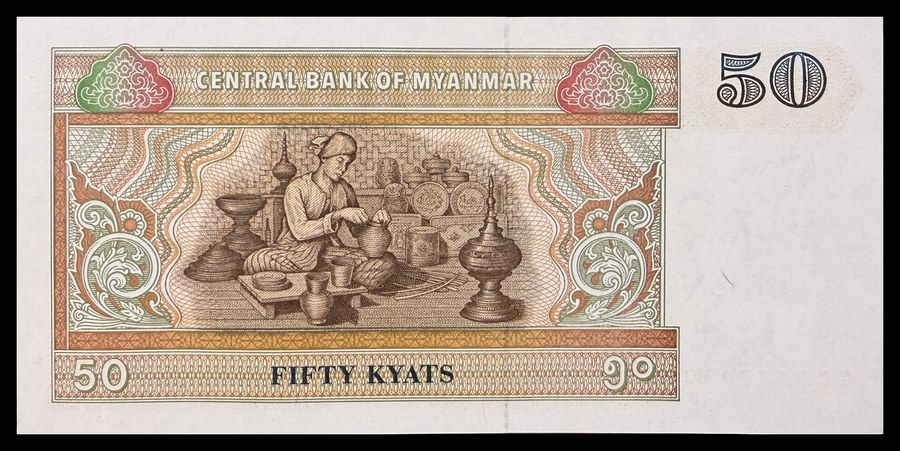
Back: Chinthe (also spelled Chinthé or Chinthe), the mythical guardian lion of Burmese Buddhist tradition. The chinthe is a leogryph that serves as a protector of pagodas and temples throughout Myanmar, deeply embedded in Burmese mythology and iconography. These creatures are typically placed in pairs at temple entrances and have been a symbol of Myanmar since ancient times. The chinthe on this note is rendered in detailed engraving showing the creature in a seated, vigilant pose with ornate decorative borders and Burmese script.
How it was made
Security features: watermark,intaglio,microprint
Myanmar in Asia
Myanmar in Asia. Other countries on the same continent shown in muted grey.
Background & history
This 15 kyat note belongs to the series issued by the Union of Burma Bank (later renamed Central Bank of Myanmar in 1990) following the 1987 demonetization. The note was part of the currency reform that replaced the previous denominations with new odd-numbered denominations (15, 35, 45, 75, 90 kyats) based on numerological beliefs of the ruling military government under General Ne Win. This unusual denomination system was highly unpopular and contributed to the 1988 pro-democracy uprising. The series was printed domestically at the Security Printing Works in Myanmar. The note features traditional Burmese artistic elements and symbolism reflecting the country's Buddhist heritage and agricultural economy. While technically still legal tender, notes of this series have been largely superseded by later issues.
Collector references
How it came to me
Note shows moderate circulation with visible handling marks and minor edge wear. Generally well-preserved with intact corners and legible details.
What it's worth now
Valuation history (1)
| date | low | high | currency | source | note |
|---|---|---|---|---|---|
| 2026-05-10 06:42:01 | 1.0 | 5.0 | USD | ai | from claude-sonnet-4-5 |
History & extractions
AI extractions (1)
Edits & decisions (0)
No edits yet.
Manual fixups
Find near-duplicates
Manual pairing override
Edit specimen #392
All fields below post to the same save endpoint. Sections collapse to focus on what you need.
Re-crop manually
Drag the four corners to mark the banknote in each image. Click Save crop to apply.