Collection › Myanmar › #394
100 MMK
P-74
Needs review
✦ AI 88%
The AI flagged these for your attention. Use ✦ Fact-check to cross-check factual fields against another model's world-knowledge, or 🔍 Re-look at image when you suspect the AI misread the pixels.
-
Some fields the AI was unsure about — please verify:
- Printer: “—” (30%)
- Series name: “—” (40%)
- Series year: “—” (50%)
- Issue year: “—” (50%)
Click ✦ Ask AI to verify or fix any below. -
Overall AI confidence is 88% (auto-approve threshold is 92%).Skim the Identity tab; the dots next to each field show what the AI was unsure about.
IMG_6977.HEIC
cropped
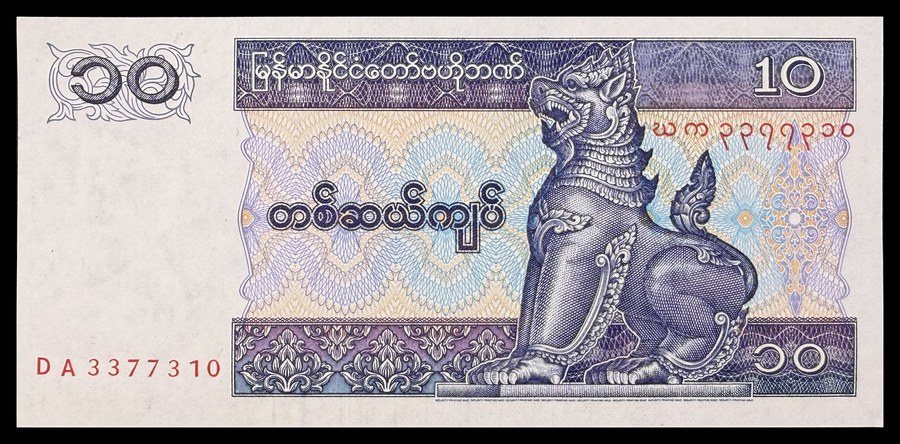
IMG_6978.HEIC
cropped
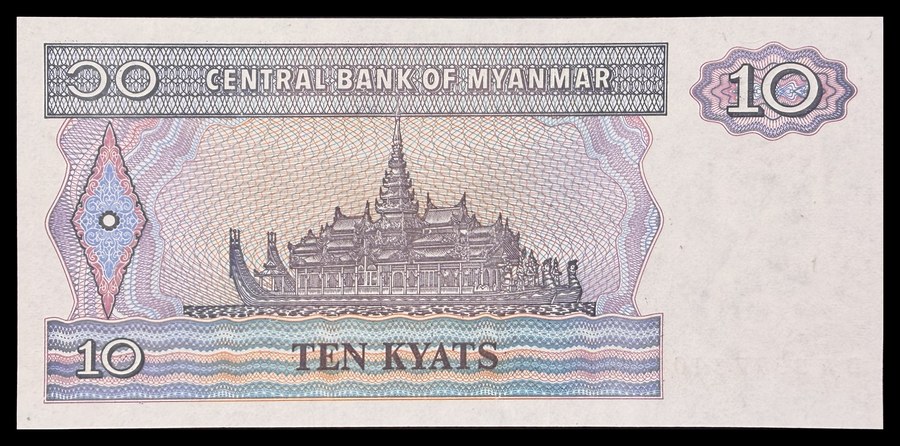
Where & when
What's on the note
Front: Scene depicting traditional Burmese life with farmers working in paddy fields near a multi-tiered Buddhist pagoda, representing the agrarian foundation of Myanmar's economy and the central role of Buddhism in national culture. The pagoda visible in the background exemplifies the distinctive Burmese architectural style with its characteristic tapering spire and multiple tiers.
Back: A chinthe (Burmese mythological lion guardian, also called leogryph), a traditional protective creature found at the entrances of Buddhist temples and pagodas throughout Myanmar. The chinthe is rendered in detailed intaglio engraving, seated in the traditional guardian posture, representing protection and strength in Burmese Buddhist culture and appearing as a national symbol on Myanmar currency since independence.
How it was made
Security features: microprint,intaglio,see_through_register
Myanmar in Asia
Myanmar in Asia. Other countries on the same continent shown in muted grey.
Background & history
This 100 Kyat note belongs to the series introduced after the 1988–1989 political transition when the State Law and Order Restoration Council (SLORC) changed the country's name from Burma to Myanmar and reorganized the currency. The Central Bank of Myanmar was established in 1990, replacing the Union of Burma Bank and the People's Bank. This denomination was part of the democratization of Myanmar's currency system, though the note has since been withdrawn from active circulation following subsequent currency reforms. The series featuring chinthes and cultural scenes was printed throughout the 1990s and early 2000s, though exact dating for individual notes without visible printed years is difficult without serial-number analysis. Myanmar's currency has historically featured Buddhist iconography and traditional cultural symbols.
Collector references
How it came to me
Crisp note with sharp corners, no visible folds or circulation wear
What it's worth now
Valuation history (1)
| date | low | high | currency | source | note |
|---|---|---|---|---|---|
| 2026-05-10 06:42:21 | 1.0 | 3.0 | USD | ai | from claude-sonnet-4-5 |
History & extractions
AI extractions (1)
Edits & decisions (0)
No edits yet.
Manual fixups
Find near-duplicates
Manual pairing override
Edit specimen #394
All fields below post to the same save endpoint. Sections collapse to focus on what you need.
Re-crop manually
Drag the four corners to mark the banknote in each image. Click Save crop to apply.