Collection › Nepal › #409
5 NPR
P-14
Needs review
✦ AI 88%
The AI flagged these for your attention. Use ✦ Fact-check to cross-check factual fields against another model's world-knowledge, or 🔍 Re-look at image when you suspect the AI misread the pixels.
-
Some fields the AI was unsure about — please verify:
- Series year: “—” (0%)
- Printer: “—” (0%)
- Dimensions (mm): “—” (0%)
- Watermark: “—” (0%)
Click ✦ Ask AI to verify or fix any below. -
Overall AI confidence is 88% (auto-approve threshold is 92%).Skim the Identity tab; the dots next to each field show what the AI was unsure about.
IMG_7008.HEIC
cropped
IMG_7009.HEIC
cropped
Where & when
What's on the note
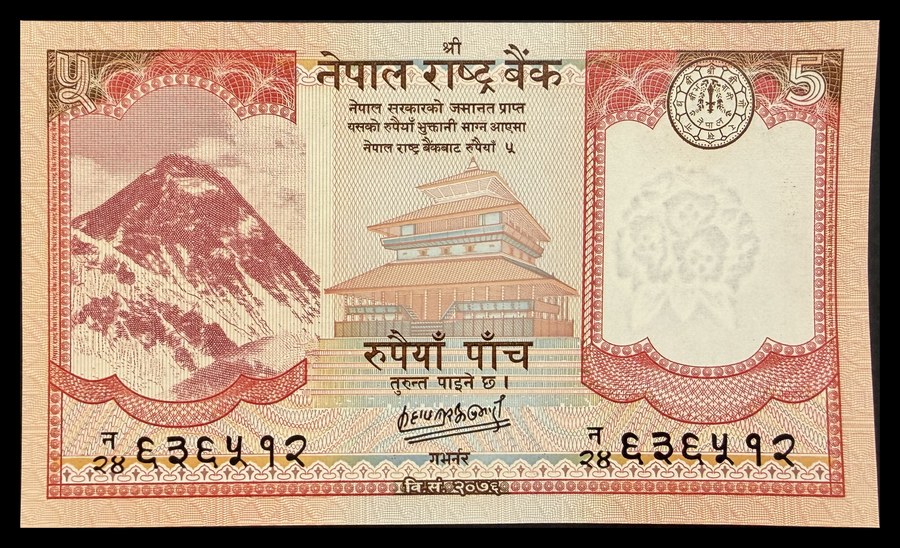
Front: Himalayan Musk Deer (Moschus leucogaster) in their native mountain habitat, with Mount Everest or similar Himalayan peak in the background. The musk deer are endemic to the Himalayan region and were historically hunted for musk; they represent Nepal's unique alpine wildlife. The royal coat of arms of Nepal appears at upper right, featuring crossed kukri knives, the cow and pheasant supporters, and the royal crown with the motto in Devanagari script. An ornate pillar with the royal emblem at center left frames the scene.
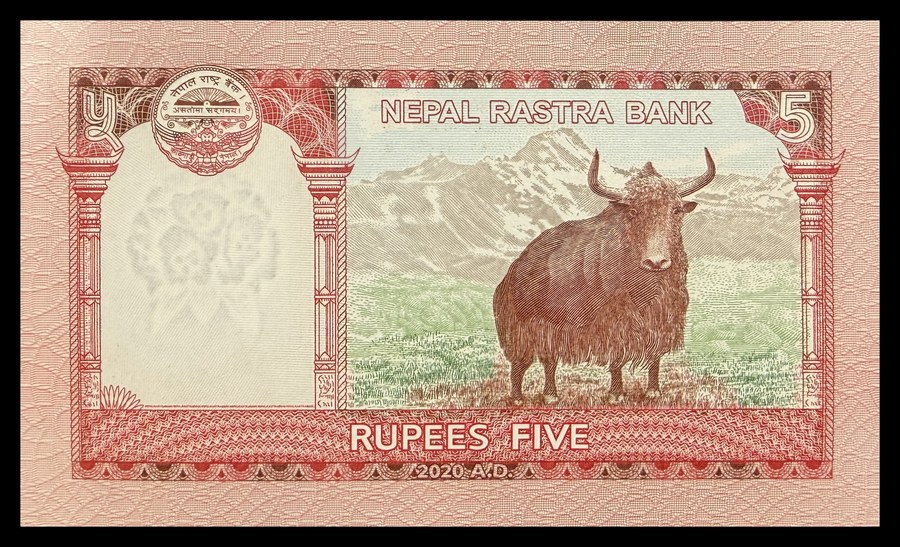
Back: Kasthamandap temple in Kathmandu, a historic three-tiered pagoda-style temple built in the 16th century from the wood of a single tree ('kastha' meaning wood, 'mandap' meaning pavilion). The temple gave Kathmandu its name and was a significant landmark in Durbar Square until its destruction in the 2015 earthquake. Mount Machapuchare (Fishtail Mountain) appears at left. The text reads 'Nepal Rastra Bank' in Devanagari at top, with denomination 'Rupaya Panch' (Five Rupees) prominently displayed.
How it was made
Signatures: Governor: signature present but name illegible
Security features: intaglio
Nepal in Asia
Nepal in Asia. Other countries on the same continent shown in muted grey.
Background & history
This 5 rupee note belongs to the King Mahendra series issued by Nepal Rastra Bank from 1961–1972, during the reign of King Mahendra Bir Bikram Shah Dev (1955–1972). The series was introduced following Nepal's modernization of its currency system. The note features distinctly Nepali imagery: the Himalayan musk deer representing the country's unique mountain wildlife, and the Kasthamandap temple representing cultural heritage. The visible date '२०१९' in Devanagari numerals corresponds to Bikram Sambat year 2019, which is 1962/1963 CE. This places the note in the early 1960s issue period. The note has been demonetized and is no longer legal tender, replaced by subsequent series. Serial number visible as 'ने ८३८४९२' with prefix 'ने' (ne).
Collector references
How it came to me
Note shows moderate circulation wear with some discoloration and handling marks visible on both sides. Paper remains intact with no tears.
What it's worth now
Valuation history (1)
| date | low | high | currency | source | note |
|---|---|---|---|---|---|
| 2026-05-10 06:45:58 | 2.0 | 8.0 | USD | ai | from claude-sonnet-4-5 |
History & extractions
AI extractions (1)
Edits & decisions (0)
No edits yet.
Manual fixups
Find near-duplicates
Manual pairing override
Edit specimen #409
All fields below post to the same save endpoint. Sections collapse to focus on what you need.
Re-crop manually
Drag the four corners to mark the banknote in each image. Click Save crop to apply.