Collection › Netherlands › #411
10 NLG
P-99
AI extracted
✦ AI 94%
The AI flagged these for your attention. Use ✦ Fact-check to cross-check factual fields against another model's world-knowledge, or 🔍 Re-look at image when you suspect the AI misread the pixels.
-
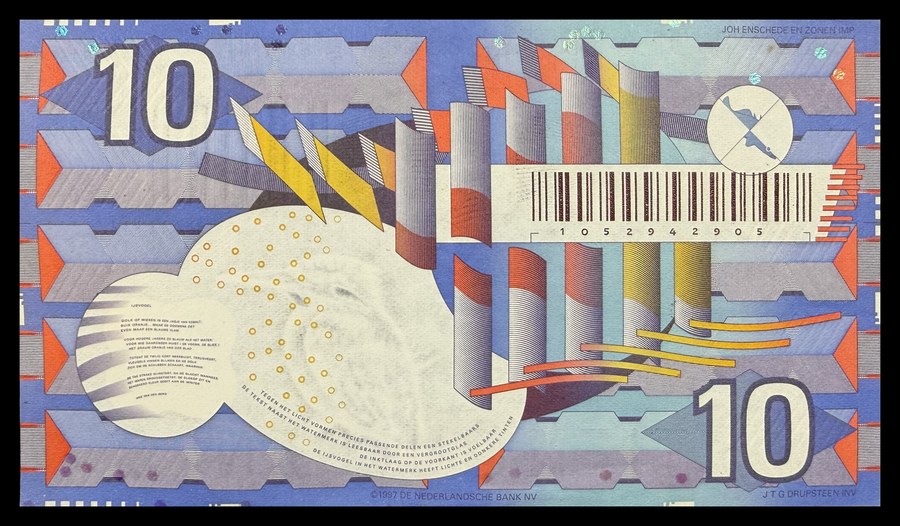
Auto-crop on the BACK was uncertain.Use ✂ Re-crop to mark the corners by hand.
IMG_7012.HEIC
uncertain
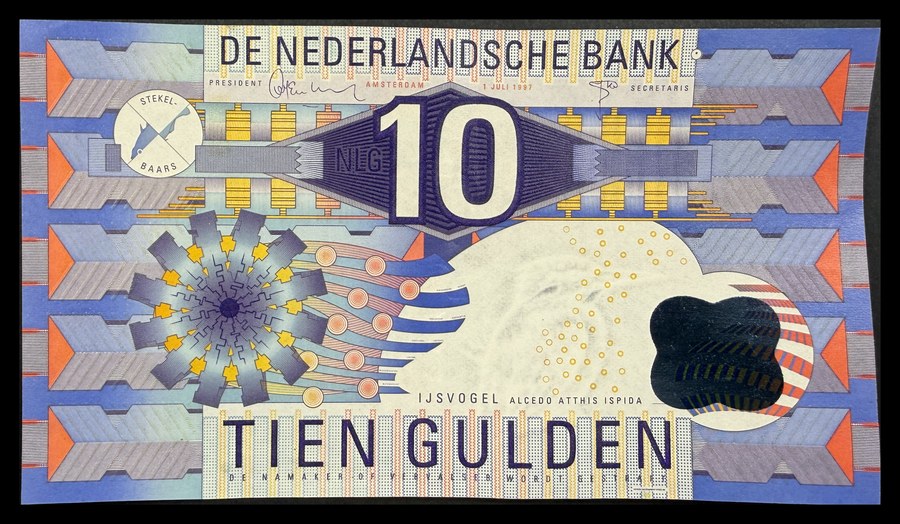
IMG_7013.HEIC
cropped
Where & when
What's on the note
Front: Abstract geometric design featuring intricate guilloché patterns forming interlocking circular shapes in blue and beige tones. This modernist design series, created by artist R.D.E. Oxenaar, marked a radical departure from traditional portrait-based banknotes and was the final guilder series before the euro transition. The denomination '10' appears prominently in blue. The text includes anti-counterfeiting warnings in Dutch referencing Article 208 of the Penal Code. Serial number 2188515258 appears twice.
Back: The avocet (kluut, scientific name Recurvirostra avosetta) depicted in abstract geometric form with the bird's distinctive upturned bill rendered as a black shape against a cream circle with yellow dots. The avocet is a distinctive black-and-white wading bird found in Dutch coastal wetlands and polders. The bird name 'IJSVOGEL ALCEDO ATTHIS ISPIDA' actually refers to the kingfisher (different from the avocet design shown), part of Oxenaar's nature theme. The modernist composition includes geometric patterns, arrows, and stylized industrial/natural elements. Text 'STEKEL BAARS' (stickleback fish) appears in a circular emblem at left.
How it was made
Signatures: President: W.F. Duisenberg; Secretary: M.R. Enthoven
Security features: microprint,intaglio,latent_image,see_through_register,optically_variable_ink
Netherlands in Europe
Netherlands in Europe. Other countries on the same continent shown in muted grey.
Background & history
This 10 guilder note belongs to the final series of Dutch banknotes issued before the Netherlands adopted the euro on January 1, 2002 (with a dual-circulation period ending January 28, 2002, after which guilders were demonetized). The 1997 series, designed by R.D.E. Oxenaar, featured abstract modernist designs based on Dutch nature themes rather than historical portraits—a controversial artistic choice that made these notes among the most distinctive in European currency history. Each denomination depicted different Dutch wildlife (birds and fish) in highly stylized geometric form. The series was printed by Joh. Enschedé en Zonen, the Dutch state printing house. The date 'JULI 1997' is printed on the reverse. Signatures are those of W.F. Duisenberg (who later became the first president of the European Central Bank) and M.R. Enthoven. These notes are now collectors' items representing the final chapter of Dutch monetary sovereignty before euro adoption.
Collector references
How it came to me
Note shows signs of circulation with visible wear, slight soiling, and handling marks throughout. Colors remain reasonably vibrant but paper shows age.
What it's worth now
Valuation history (1)
| date | low | high | currency | source | note |
|---|---|---|---|---|---|
| 2026-05-10 06:46:40 | 5.0 | 15.0 | EUR | ai | from claude-sonnet-4-5 |
History & extractions
AI extractions (1)
Edits & decisions (0)
No edits yet.
Manual fixups
Find near-duplicates
Manual pairing override
Edit specimen #411
All fields below post to the same save endpoint. Sections collapse to focus on what you need.
Re-crop manually
Drag the four corners to mark the banknote in each image. Click Save crop to apply.