Collection › North Korea › #433
5 Chon KPW
P-P-32
Needs review
✦ AI 75%
The AI flagged these for your attention. Use ✦ Fact-check to cross-check factual fields against another model's world-knowledge, or 🔍 Re-look at image when you suspect the AI misread the pixels.
-
Front and back images may not belong to the same note.Use 'Swap back with previous/next specimen' below — usually fixes a two-pair shuffle from photographing them out of order.
-
Some fields the AI was unsure about — please verify:
- Printer: “—” (0%)
- Watermark: “—” (0%)
- Front portrait: “—” (0%)
- Reverse subject: “—” (0%)
Click ✦ Ask AI to verify or fix any below. -
Overall AI confidence is 75% (auto-approve threshold is 92%).Skim the Identity tab; the dots next to each field show what the AI was unsure about.
IMG_7060.HEIC
cropped
IMG_7061.HEIC
cropped
Where & when
What's on the note
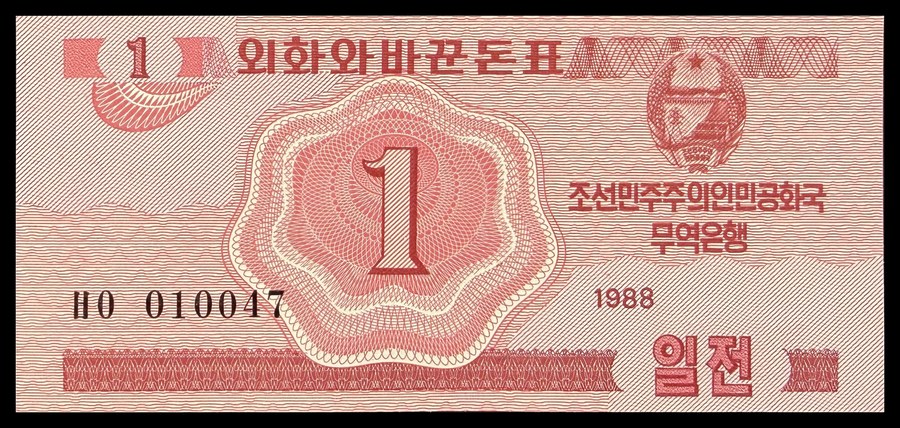
Front: North Korean Foreign Exchange Certificate for 5 chon, issued by the Foreign Trade Bank of the DPRK for use by visitors from socialist countries. Features the national emblem of North Korea (depicting Mount Paektu with a hydroelectric dam, a red star, and rice ears bound with a red ribbon) at upper right. The header text '외화와 바꾼 돈 표' indicates 'money exchanged for foreign currency'. This red-tinted note was part of a parallel currency system restricting foreigners' purchasing power.
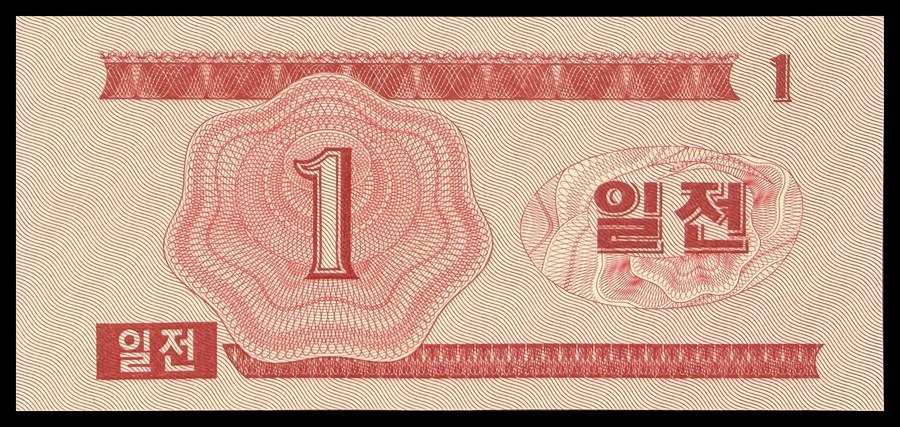
Back: The second image shows a different denomination (1 chon) from the same series, indicating a mismatched pair. This 1 chon note bears identical design elements: the DPRK national emblem, Foreign Trade Bank issuer text, and 1988 date, but with denomination '1' in the central rosette and '일전' (1 chon) at lower right.
How it was made
North Korea in Asia
North Korea in Asia. Other countries on the same continent shown in muted grey.
Background & history
North Korea operated a complex foreign exchange certificate (FEC) system from 1988 to 2002, with different colored notes for different visitor categories: red/pink for visitors from socialist countries, blue for visitors from capitalist countries, and green for DPRK citizens with foreign currency. These certificates had no value outside designated shops and were part of the regime's isolation of foreigners from the domestic economy. The socialist-visitor series (pink/red) was typically used by visitors from China, the Soviet Union, and other aligned nations. The system was abolished in 2002 when the won was revalued.
Collector references
How it came to me
Appears crisp and uncirculated with full original color and sharp corners
What it's worth now
Valuation history (1)
| date | low | high | currency | source | note |
|---|---|---|---|---|---|
| 2026-05-10 06:52:12 | 0.5 | 2.0 | USD | ai | from claude-opus-4-5 |
History & extractions
AI extractions (2)
Edits & decisions (0)
No edits yet.
Manual fixups
Find near-duplicates
Manual pairing override
Edit specimen #433
All fields below post to the same save endpoint. Sections collapse to focus on what you need.
Re-crop manually
Drag the four corners to mark the banknote in each image. Click Save crop to apply.