Collection › Peru › #449
1000 Intis Inti
P-136
AI extracted
✦ AI 95%
IMG_7092.HEIC
cropped
IMG_7093.HEIC
cropped
Where & when
What's on the note
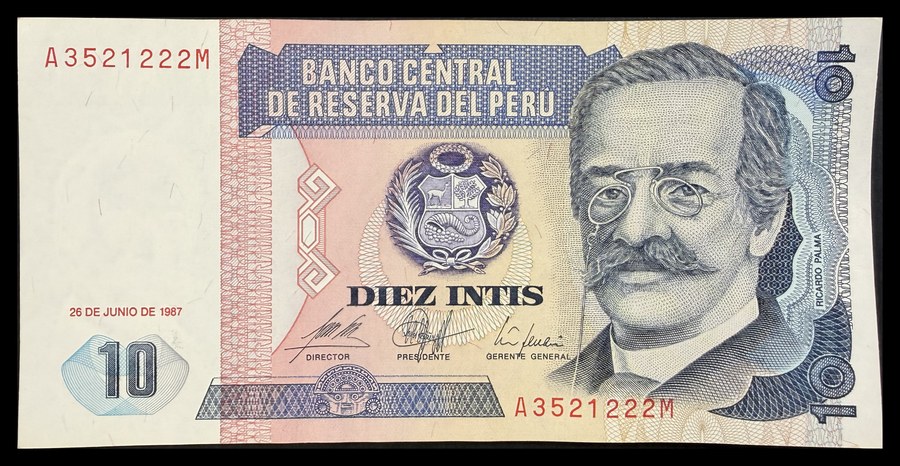
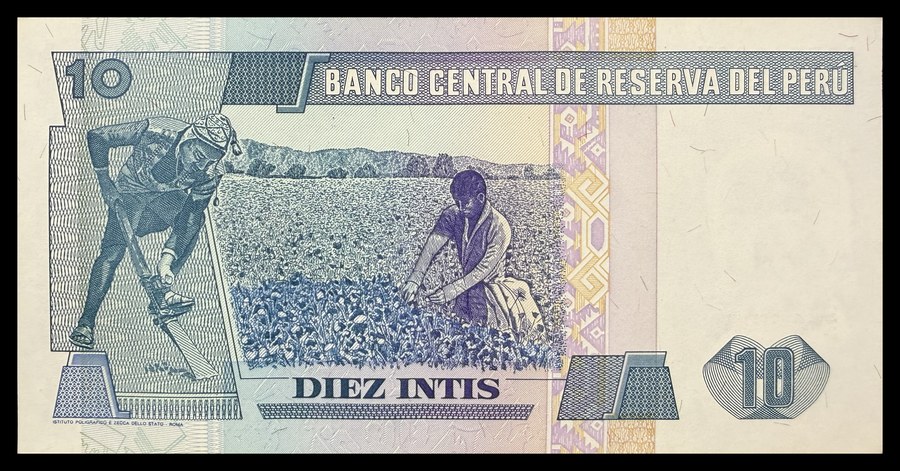
Front: Ruins of Chan Chan, the largest pre-Columbian adobe city in the Americas, located near Trujillo in northern Peru. Built by the Chimú civilization around 850 CE and serving as their capital until conquest by the Inca Empire around 1470, Chan Chan is a UNESCO World Heritage Site and represents one of the most significant archaeological sites in Peru. The ruins feature intricate geometric patterns and frieze decorations characteristic of Chimú architecture.
Back: Ricardo Palma (1833-1919), Peruvian author, scholar, librarian, and politician, best known as the creator of the literary genre 'tradiciones' (traditions), which blended historical fact with fiction to portray colonial and early republican Peru. He served as director of the Biblioteca Nacional del Perú (National Library of Peru) from 1884 to 1912, where he rebuilt the institution after its destruction during the War of the Pacific. The national coat of arms of Peru appears at center, featuring the vicuña, cinchona tree, and cornucopia.
How it was made
Signatures: Director: [signature]; Presidente: [signature]; Gerente General: [signature]
Security features: thread,microprint,intaglio
Peru in South America
Peru in South America. Other countries on the same continent shown in muted grey.
Background & history
This note is from Peru's Inti currency series, issued during a period of severe hyperinflation. The Inti was introduced on February 1, 1985, replacing the Sol de Oro at a rate of 1 Inti = 1,000 Soles de Oro. The date printed on this note is '26 DE JUNIO DE 1987', indicating a mid-series issue. The Inti itself rapidly lost value due to continuing hyperinflation, with inflation rates exceeding 7,000% by 1990. The currency was replaced by the Nuevo Sol in 1991 at a rate of 1 Nuevo Sol = 1,000,000 Intis. The series featured prominent Peruvian cultural and historical figures on the reverse and significant archaeological and natural sites on the front. Thomas De La Rue, the British security printer, produced these notes. The 1000 Intis denomination represents the hyperinflationary pressures of the late 1980s, as the government issued increasingly high-value notes to keep pace with price increases.
Collector references
How it came to me
Note shows moderate circulation with visible creases and handling marks but retains good structural integrity and color.
What it's worth now
Valuation history (1)
| date | low | high | currency | source | note |
|---|---|---|---|---|---|
| 2026-05-10 06:56:26 | 2.0 | 8.0 | USD | ai | from claude-sonnet-4-5 |
History & extractions
AI extractions (1)
Edits & decisions (0)
No edits yet.
Manual fixups
Find near-duplicates
Manual pairing override
Edit specimen #449
All fields below post to the same save endpoint. Sections collapse to focus on what you need.
Re-crop manually
Drag the four corners to mark the banknote in each image. Click Save crop to apply.