Collection › Philippines › #461
5 pesos Philippine peso
P-P-109a
Needs review
✦ AI 75%
The AI flagged these for your attention. Use ✦ Fact-check to cross-check factual fields against another model's world-knowledge, or 🔍 Re-look at image when you suspect the AI misread the pixels.
-
Front and back images may not belong to the same note.Use 'Swap back with previous/next specimen' below — usually fixes a two-pair shuffle from photographing them out of order.
-
Some fields the AI was unsure about — please verify:
- Printer: “—” (0%)
- Front portrait: “—” (0%)
Click ✦ Ask AI to verify or fix any below. -
The photo is blurry.Mark Retake — re-photograph in better focus.
-
Important detail is cropped out of the frame.Re-crop to extend the bounds, or Retake.
-
Overall AI confidence is 75% (auto-approve threshold is 92%).Skim the Identity tab; the dots next to each field show what the AI was unsure about.
IMG_7116.HEIC
cropped
IMG_7117.HEIC
cropped
Where & when
What's on the note
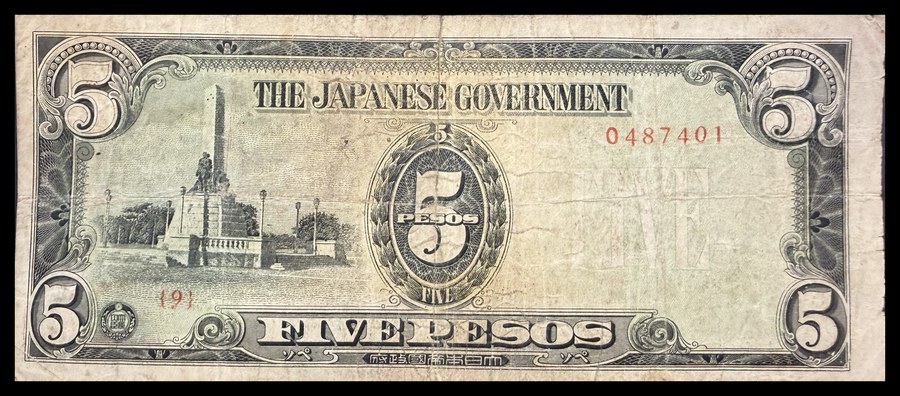
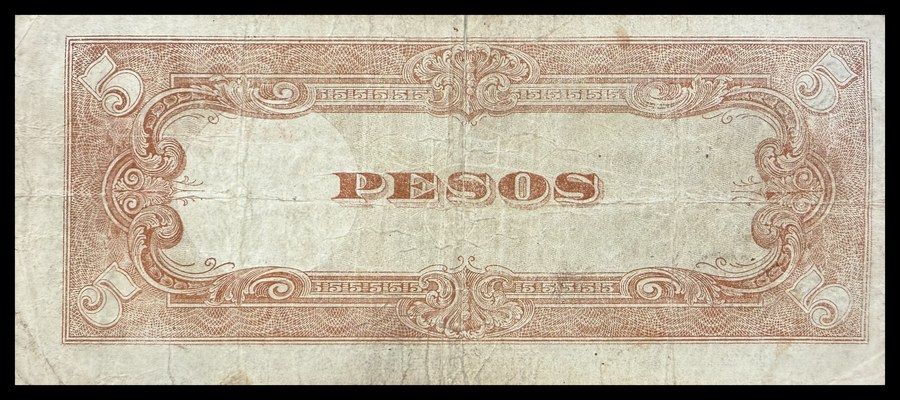
Front: Generic ornamental frame design with denomination 'ONE PESO' at center and corner numerals '1'. The front features elaborate scrollwork and guilloche patterns in blue-green ink but no portrait. This minimalist design was typical of Japanese occupation currency issued rapidly during World War II.
Back: The Rizal Monument (Monumento kay Rizal) in Manila's Luneta Park (now Rizal Park), erected in 1913 to honor Dr. José Rizal, Philippine national hero executed by the Spanish in 1896. The monument, designed by Swiss sculptor Richard Kissling, marks the site where Rizal was executed and became the symbolic heart of Philippine nationalism. Inscription reads 'THE JAPANESE GOVERNMENT' with denomination 'FIVE PESOS' and serial number 0487401 in red.
How it was made
Philippines in Asia
Philippines in Asia. Other countries on the same continent shown in muted grey.
Background & history
Japanese Occupation currency for the Philippines, Series issued 1942–1945 during World War II following the Japanese invasion and occupation of the Philippine Islands. These invasion notes, often called 'Mickey Mouse money' by Filipinos due to their rapid devaluation and poor quality, were printed by the Japanese Military Administration to replace the Commonwealth peso. The bilingual inscription 'THE JAPANESE GOVERNMENT' (English) and Japanese characters reflected Japanese military authority. These notes became nearly worthless by 1944 due to hyperinflation caused by massive overprinting to fund the occupation. All Japanese occupation currency was demonetized when the Philippines was liberated by Allied forces in 1945. The note's condition and heavy circulation wear are typical of these wartime emergency issues. The reversal of denominations (front shows '1 PESO' while back shows 'FIVE PESOS') suggests this may be a mismatched pair, though some sources document multi-denomination overprints during the chaotic final months of occupation.
Collector references
How it came to me
Heavy circulation wear, multiple vertical and horizontal fold lines, creasing throughout, edge wear, soiling, small stains including what appears to be ink marks at upper right. Paper remains intact with no major tears.
What it's worth now
Valuation history (1)
| date | low | high | currency | source | note |
|---|---|---|---|---|---|
| 2026-05-10 07:00:17 | 5.0 | 15.0 | USD | ai | from claude-sonnet-4-5 |
History & extractions
AI extractions (2)
Edits & decisions (0)
No edits yet.
Manual fixups
Find near-duplicates
Manual pairing override
Edit specimen #461
All fields below post to the same save endpoint. Sections collapse to focus on what you need.
Re-crop manually
Drag the four corners to mark the banknote in each image. Click Save crop to apply.