Collection › Soviet Union › #504
5 Soviet Ruble
P-P-224
AI extracted
✦ AI 92%
IMG_7203.HEIC
cropped
IMG_7204.HEIC
cropped
Where & when
What's on the note
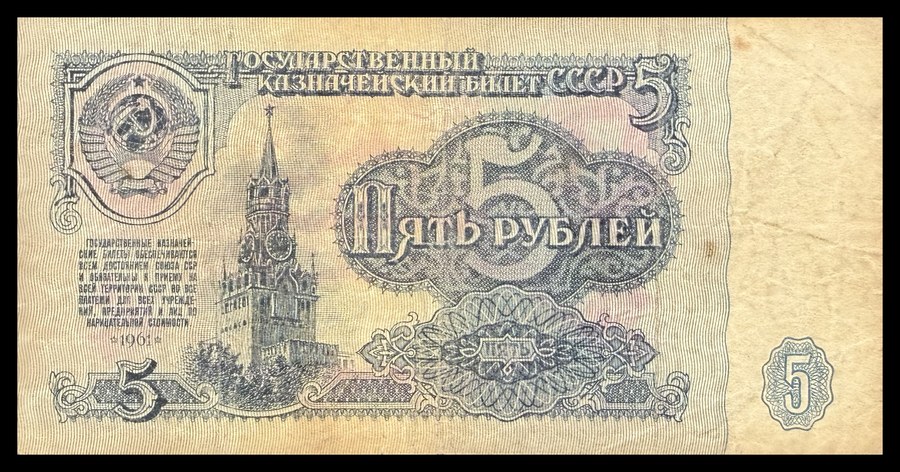
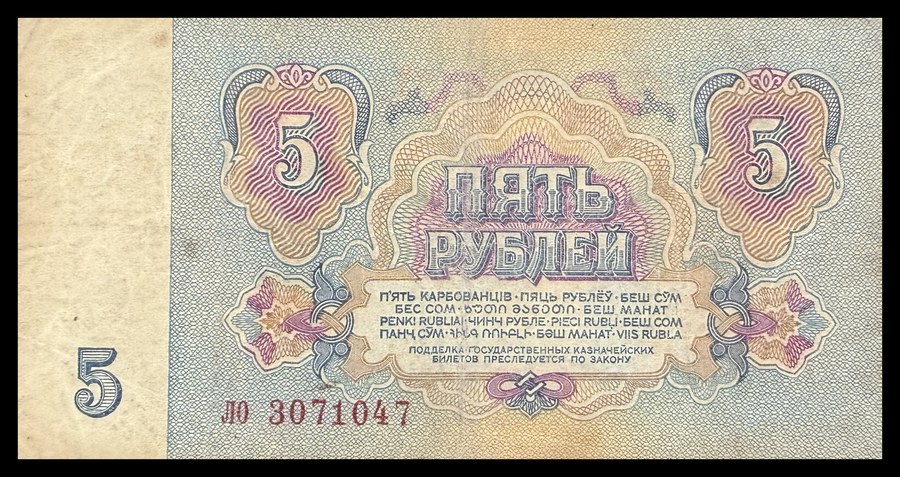
Front: State Treasury Note of the USSR, 5 rubles denomination. The front features multilingual text in fifteen languages of the Soviet republics (Russian, Ukrainian, Belarusian, Uzbek, Kazakh, Georgian, Azerbaijani, Lithuanian, Moldavian, Latvian, Kyrgyz, Tajik, Armenian, Turkmen, and Estonian) stating the denomination and legal tender status. The text reads 'ПЯТЬ РУБЛЕЙ' (Five Rubles) prominently at center, surrounded by ornate guilloche patterns in pastel shades. This design reflects the multi-ethnic character of the Soviet Union and was part of the 1961 currency reform that redenominated the ruble at a ratio of 10:1.
Back: Spasskaya Tower of the Moscow Kremlin, the principal tower facing Red Square, built in 1491 by Italian architect Pietro Antonio Solari and later topped with its distinctive tent roof and star in the Soviet era. The tower houses the famous Kremlin chimes and serves as the symbolic gateway to the Kremlin. The back also displays the Soviet coat of arms (hammer and sickle with globe and rising sun) at upper left, with text 'ГОСУДАРСТВЕННЫЙ КАЗНАЧЕЙСКИЙ БИЛЕТ СССР' (State Treasury Note of the USSR) and 'Пять рублей' (Five Rubles). The denomination '5' appears in numerals at corners. Year 1961 is printed in small text on the left side.
How it was made
Security features: microprint,intaglio
Where in the world
Geography unknown for Soviet Union.
Background & history
This 5-ruble note belongs to the 1961 Reform series issued by the State Bank of the USSR following Khrushchev's currency reform of January 1, 1961, which redenominated the Soviet ruble at 10 old rubles to 1 new ruble. The reform aimed to simplify monetary calculations and remove excess currency from circulation following post-WWII inflation. This series remained in circulation throughout the late Soviet period until the dissolution of the USSR in 1991. The multilingual text on the front demonstrates Soviet policy of recognizing the fifteen constituent republics. The note was printed by Goznak (the Soviet state printing works). The serial number format (Cyrillic prefix + digits) was standard for Soviet banknotes of this era. These notes are now common in the numismatic market as large quantities survived the Soviet collapse.
Collector references
How it came to me
Circulated note with visible wear, creasing, and some soiling. Paper shows age-related discoloration. Overall structure intact.
What it's worth now
Valuation history (1)
| date | low | high | currency | source | note |
|---|---|---|---|---|---|
| 2026-05-10 07:10:34 | 2.0 | 8.0 | USD | ai | from claude-sonnet-4-5 |
History & extractions
AI extractions (1)
Edits & decisions (0)
No edits yet.
Manual fixups
Find near-duplicates
Manual pairing override
Edit specimen #504
All fields below post to the same save endpoint. Sections collapse to focus on what you need.
Re-crop manually
Drag the four corners to mark the banknote in each image. Click Save crop to apply.