Collection › Russia › #510
5 RUB
The AI flagged these for your attention. Use ✦ Fact-check to cross-check factual fields against another model's world-knowledge, or 🔍 Re-look at image when you suspect the AI misread the pixels.
-
Front and back images may not belong to the same note.Use 'Swap back with previous/next specimen' below — usually fixes a two-pair shuffle from photographing them out of order.
-
AI couldn't confidently identify the portrait or scene.Try Re-extract with a stronger model, or Ask AI to verify.
-
Some fields the AI was unsure about — please verify:
- Dimensions (mm): “137x61” (0%)
- Watermark: “—” (0%)
- Pick #: “—” (0%)
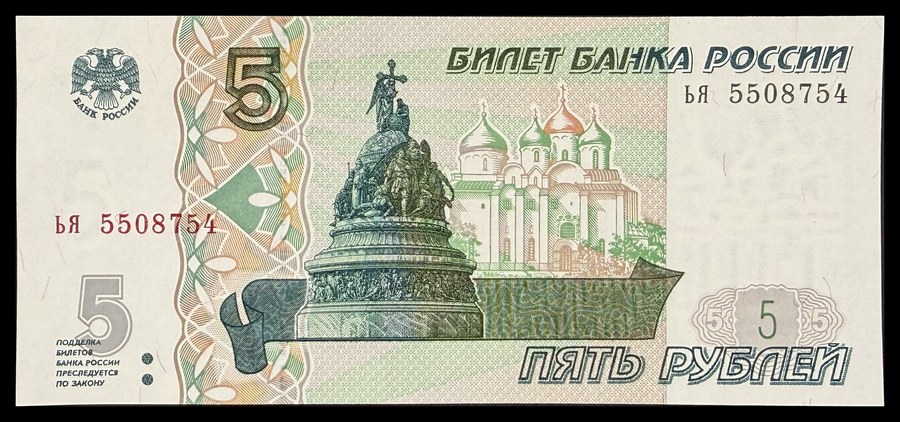
- Serial number: “ЬЯ 5508754” (0%)
- Condition: “VF” (0%)
- Currency: “RUB” (30%)
- …and 6 more
Click ✦ Ask AI to verify or fix any below. -
Overall AI confidence is 82% (auto-approve threshold is 92%).Skim the Identity tab; the dots next to each field show what the AI was unsure about.
IMG_7215.HEIC
cropped
IMG_7216.HEIC
cropped
Where & when
What's on the note
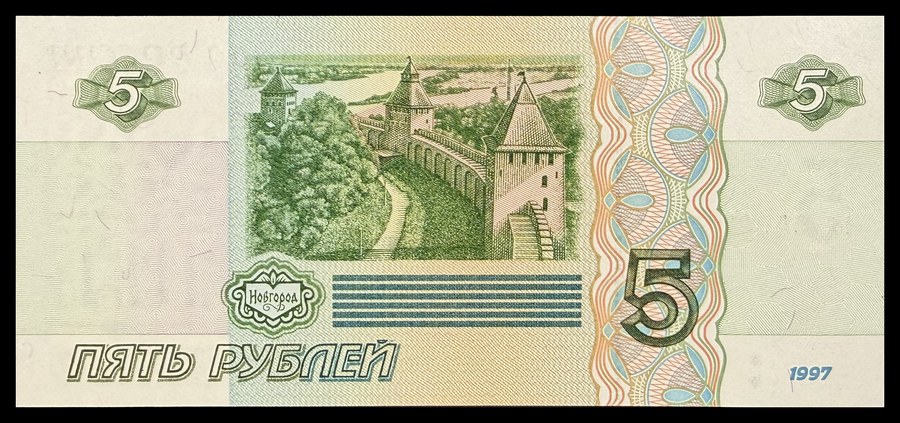
Front: Catherine II of Russia (Catherine the Great, 1729–1796), Empress of Russia from 1762 to 1796. She presided over the Russian Enlightenment, expanded the empire's borders through military victories and diplomatic skill, and is considered one of Russia's greatest rulers. The ornate design includes allegorical figures representing abundance and prosperity, reflecting the elaborate Imperial Russian aesthetic with baroque ornamentation, scrollwork, and the denomination '100 РУБЛЕЙ' (100 Rubles) in pre-revolutionary styling. This front design reproduces the Imperial 100-ruble note issued under Catherine II's reign.
Back: The Monument to the Millennium of Russia (Тысячелетие России) in Veliky Novgorod, unveiled in 1862 to commemorate the 1000th anniversary of Rurik's arrival in 862 CE, traditionally marking the founding of the Russian state. The monument, designed by Mikhail Mikeshin, stands in the Novgorod Kremlin and depicts key figures from Russian history. Behind it is Saint Sophia Cathedral with its distinctive green and silver onion domes, one of Russia's oldest stone structures, built in 1045–1050. The text reads 'БИЛЕТ БАНКА РОССИИ' (Bank of Russia Note) and 'ПЯТЬ РУБЛЕЙ' (Five Rubles).
How it was made
Security features: microprint,intaglio,thread,optically_variable_ink
Russia in Europe
Russia in Europe. Other countries on the same continent shown in muted grey.
Background & history
This note represents a hybrid design combining historical Imperial Russian imagery with modern Russian Federation currency. The front reproduces the elaborate Catherine II-era 100 ruble note design from the late 18th century, while the back features the modern 5 ruble denomination with 20th-century imagery. The 1997 Russian ruble reform (denomination 1000:1) introduced the current ruble series; 5-ruble notes from this series have been issued in multiple modifications (1997, 2001, 2010 onwards) with various security feature upgrades. The serial number prefix 'ЬЯ' (bYA) is a standard Bank of Russia series identifier. The juxtaposition of Imperial Catherine II imagery with Soviet/post-Soviet Novgorod monuments creates an unusual numismatic artifact bridging multiple eras of Russian history.
Collector references
How it came to me
Note shows signs of circulation with light soiling and edge wear; overall integrity good
What it's worth now
No current value set. Use Edit to add one, or run "Value all" on the collection page.
History & extractions
AI extractions (2)
Edits & decisions (0)
No edits yet.
Manual fixups
Find near-duplicates
Manual pairing override
Edit specimen #510
All fields below post to the same save endpoint. Sections collapse to focus on what you need.
Re-crop manually
Drag the four corners to mark the banknote in each image. Click Save crop to apply.