Collection › South Korea › #538
1000 won KRW
P-47
Needs review
✦ AI 88%
The AI flagged these for your attention. Use ✦ Fact-check to cross-check factual fields against another model's world-knowledge, or 🔍 Re-look at image when you suspect the AI misread the pixels.
-
Some fields the AI was unsure about — please verify:
- Printer: “—” (30%)
- Issue year: “—” (50%)
Click ✦ Ask AI to verify or fix any below. -
Overall AI confidence is 88% (auto-approve threshold is 92%).Skim the Identity tab; the dots next to each field show what the AI was unsure about.
IMG_7273.HEIC
cropped
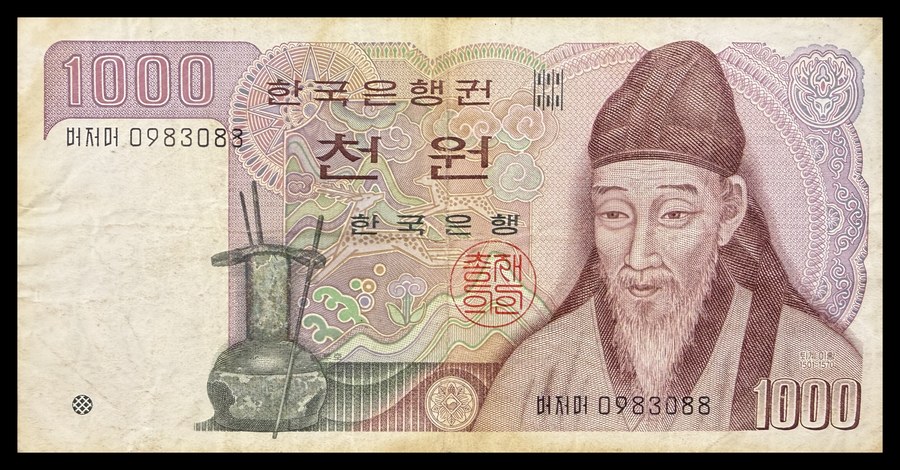
IMG_7274.HEIC
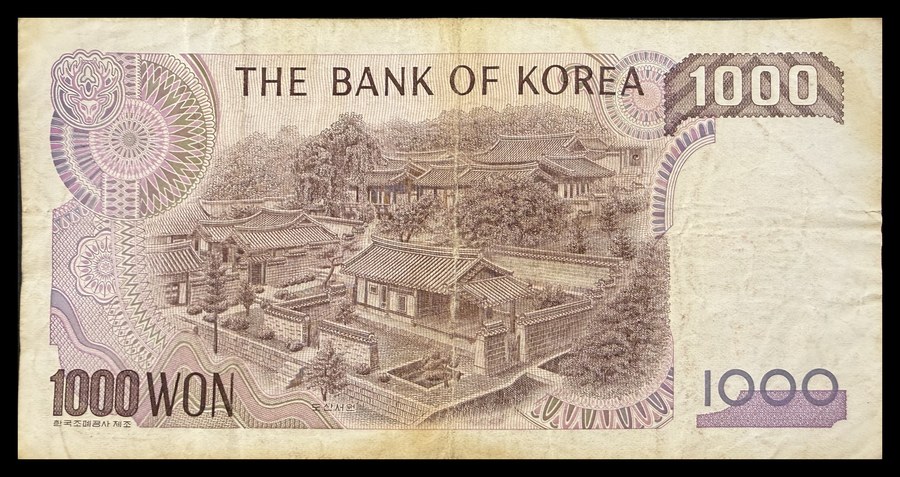
cropped
Where & when
What's on the note
Front: Yi Hwang (Toegye) (1501-1570), one of the most prominent Korean Confucian scholars of the Joseon Dynasty. Known by his pen name Toegye, he was a leading Neo-Confucian philosopher, educator, and poet who profoundly influenced Korean intellectual history. He established the Dosan Seowon academy and his philosophical writings, particularly on the Four-Seven debate, shaped East Asian Confucian thought for centuries.
Back: Dosan Seowon, the Confucian academy founded by Yi Hwang in 1574 (posthumously completed by his disciples) in Andong, North Gyeongsang Province. The academy served as a center of Neo-Confucian learning and became one of the most important educational institutions of the Joseon period. The scene shows the traditional Korean architecture of the academy complex surrounded by pine trees, with a rain gauge (Cheugugi) depicted at left - an early scientific instrument reflecting Yi Hwang's scholarly interests.
How it was made
Security features: thread,microprint,intaglio
South Korea in Asia
South Korea in Asia. Other countries on the same continent shown in muted grey.
Background & history
This note belongs to the third series of Bank of Korea banknotes, issued between 1983 and 2002. The 1000 won denomination featuring Yi Hwang was introduced on June 11, 1983, as part of a redesign that featured historical Korean scholars. The front inscription reads 'Central Bank of the Democratic People's Republic of Korea' in Korean. This series remained in circulation until being replaced by new security-enhanced designs in 2007. The serial number format with prefix letters followed by seven digits was standard for this era of Korean banknotes. No documented serial-year encoding system is known for Bank of Korea notes of this period.
Collector references
How it came to me
Note shows light circulation with minor handling marks but retains good paper quality and clear printing.
What it's worth now
Valuation history (1)
| date | low | high | currency | source | note |
|---|---|---|---|---|---|
| 2026-05-10 07:18:21 | 2.0 | 5.0 | USD | ai | from claude-sonnet-4-5 |
History & extractions
AI extractions (1)
Edits & decisions (0)
No edits yet.
Manual fixups
Find near-duplicates
Manual pairing override
Edit specimen #538
All fields below post to the same save endpoint. Sections collapse to focus on what you need.
Re-crop manually
Drag the four corners to mark the banknote in each image. Click Save crop to apply.