Bank.notes

Collection Bolivia #58

More ▾

10 Pesos Bolivianos BOB

Bolivia 1962 1946_1989 XF P-154a AI extracted ✦ AI 92%
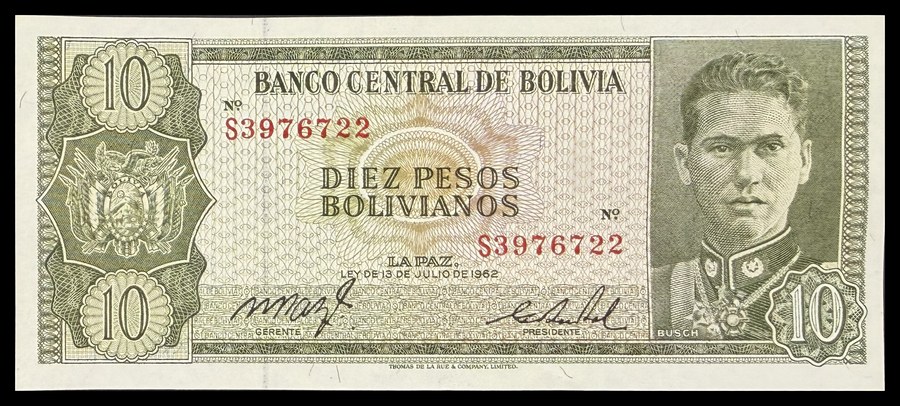
Front · IMG_6165.jpeg cropped
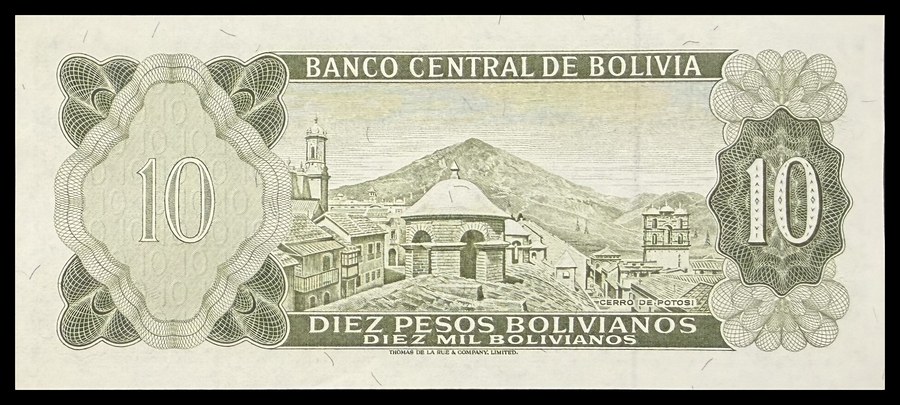
Back · IMG_6166.jpeg cropped
Pair check: ! check failed checked 2026-05-09T09:53:44.791468
Identity

Where & when

Country Bolivia
Currency BOB
Denomination 10 Pesos Bolivianos
Series name Peso Boliviano series
Series year 1962
Issue year 1962
Era 1946_1989
Legal status demonetized
Predecessor currency Boliviano
Successor currency Peso Boliviano (1963 reform), later Boliviano (1987)
Subjects & design

What's on the note

Front portrait Germán Busch Becerra
Reverse subject Cerro de Potosí with colonial architecture
Watermark
Color palette #6b7c4a,#d4c5a0,#2d3b1f
Themes military,statesman,architecture
Language / script Latin

Front: Germán Busch Becerra (1903–1939), Bolivian military officer and president of Bolivia from 1937 to 1939. He rose to prominence during the Chaco War against Paraguay and became a nationalist leader who attempted progressive economic reforms, particularly regarding Bolivia's natural resources and tin industry. His presidency ended with his death in 1939, officially ruled a suicide though circumstances remain debated. The note also displays the Bolivian coat of arms at left, featuring the national condor, alpaca, breadfruit tree, and Cerro de Potosí.

Back: Cerro de Potosí (Cerro Rico) with colonial-era buildings and churches in the foreground. Potosí was one of the richest silver mining centers in the Spanish colonial empire, and Cerro Rico (Rich Mountain) became legendary as the source of vast quantities of silver extracted from the 16th to 18th centuries. The mountain and the historic colonial architecture of Potosí represent Bolivia's mining heritage and colonial history, which fundamentally shaped the nation's economy and society.

Production

How it was made

Issuer Banco Central de Bolivia
Issuer (native)
Printer Thomas De La Rue & Company, Limited
Engraver
Material paper
Dimensions (mm) 156x67

Signatures: Gerente: [illegible signature]; Presidente: [illegible signature]

Security features: microprint,intaglio

Geography

Bolivia in South America

Bolivia in South America. Other countries on the same continent shown in muted grey.

The story

Background & history

This note belongs to the Peso Boliviano series issued under the Law of 13 July 1962 (as printed on the face: 'LEY DE 13 DE JULIO DE 1962'). The Peso Boliviano was introduced in 1963 to replace the previous Boliviano at a rate of 1,000 to 1 following a period of significant inflation. This transitional series bears the 1962 law date but circulated from 1962–1963. The currency was later replaced by the new Boliviano in 1987 at a rate of 1,000,000 pesos bolivianos to 1 boliviano during hyperinflation. Thomas De La Rue printed this series, and the design honors Germán Busch, who remains an important figure in Bolivian nationalist history.

Catalogue

Collector references

Pick # 154a
Krause ID
Rarity tier common
Series range 1962–1963
Provenance

How it came to me

Acquired date
Acquired from
Acquired price
Currency
Condition
Grade XF
Serial number S3976722
Serial prefix S

Note shows minor handling with light creasing and edge wear but retains good detail and original colors.

Valuation

What it's worth now

$5–$15
Type default range $5–$15
Valuation history (1)
datelowhighcurrencysourcenote
2026-05-08 22:58:54 5.0 15.0 USD ai from claude-sonnet-4-5
Technical

History & extractions

AI extractions (1)
anthropic · claude-sonnet-4-5 2026-05-08 22:58:54
status: ok · step 1 · $0.0374 · 6125↓ + 1270↑ tokens
Edits & decisions (1)
edit 2026-05-08 16:29:41
issuer_native: None → د افغانستان بانک commemorative: None → False successor_currency: None → New Afghani series_range: None → 1990-2002 language_script: None → Perso-Arabic reverse_subject: None → Mazar-e-Sharif Blue Mosque default_value_high: None → 2.0 dimensions_mm: None → 130x65 languages: None → ps,fa currency: None → AFN security_features: None → geometric_patterns,microprint country: None → Afghanistan legal_status: None → withdrawn era: None → 1990_present series_name: None → 1990 Government Issue pick_number: None → 55 back_description: None → The Afghan national emblem (coat of arms) showing a mosque with pulpit and flags on either side, encircled by sheaves of wheat, with the date 1369 (1990 CE in the Solar Hijri calendar). The emblem represents Afghanistan's Islamic identity and agricultural heritage. The circular emblem on the right contains text in Dari Persian and Pashto, the two official languages of Afghanistan, affirming the nation's sovereignty and Islamic character. rarity_tier: None → common front_description: None → The Shrine of Hazrat Ali (Blue Mosque) in Mazar-e-Sharif, northern Afghanistan. This mosque is one of the holiest sites in Afghanistan, believed by some to be the burial place of Ali ibn Abi Talib, cousin and son-in-law of the Prophet Muhammad. The shrine complex features distinctive blue-tiled domes and minarets and has been a pilgrimage site for centuries, representing the country's rich Islamic heritage and architectural tradition. The depiction shows the mosque's iconic skyline with multiple domes and white doves symbolizing peace. color_palette: None → #d4a574,#8b4513,#f5deb3 denomination: None → 1 Afghani predecessor_currency: None → Afghani (pre-1990) themes: None → architecture,religion default_value_low: None → 0.5 legal_status_date: None → 2002 issuer: None → Da Afghanistan Bank historical_notes: None → This note belongs to the 1990 Government Issue series of Afghanistan, produced during the final years of the Soviet-backed Democratic Republic of Afghanistan and continuing through the early years of the Islamic State. The series was issued during a period of civil war following Soviet withdrawal in 1989. The 1 Afghani denomination was the lowest value note of this series. These notes were replaced in 2002 when the new Afghan government introduced the New Afghani at a rate of 1 New Afghani = 1,000 old Afghanis following decades of inflation and instability. The note's design emphasizes Afghanistan's Islamic heritage through its depiction of the Blue Mosque, one of the country's most revered religious sites. material: None → paper
Power tools

Manual fixups

Find near-duplicates
Look for visually-similar images in your collection.
Manual pairing override