Collection › United Kingdom › #587
10 Shillings GBP
P-P-366
Needs review
✦ AI 88%
The AI flagged these for your attention. Use ✦ Fact-check to cross-check factual fields against another model's world-knowledge, or 🔍 Re-look at image when you suspect the AI misread the pixels.
-
Some fields the AI was unsure about — please verify:
- Issue year: “—” (0%)
- Reverse subject: “—” (0%)
Click ✦ Ask AI to verify or fix any below. -
Overall AI confidence is 88% (auto-approve threshold is 92%).Skim the Identity tab; the dots next to each field show what the AI was unsure about.
IMG_7371.HEIC
cropped
IMG_7372.HEIC
cropped
Where & when
What's on the note
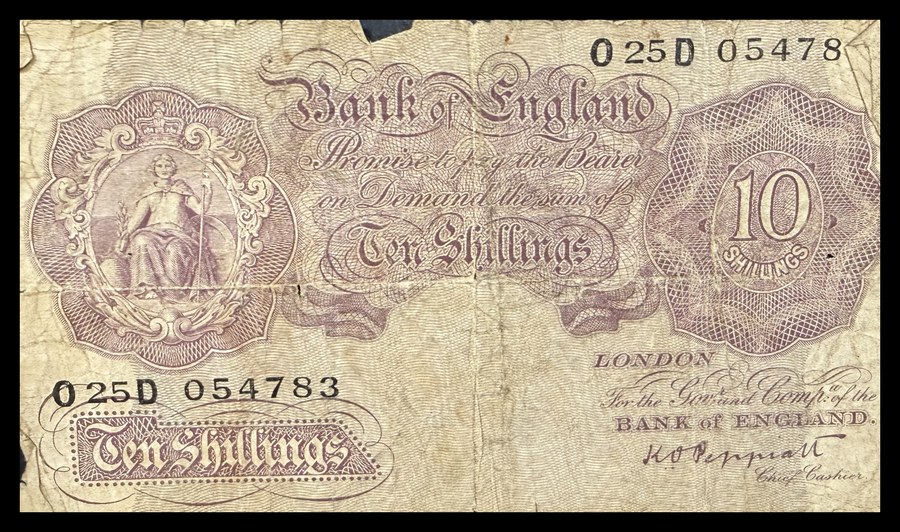
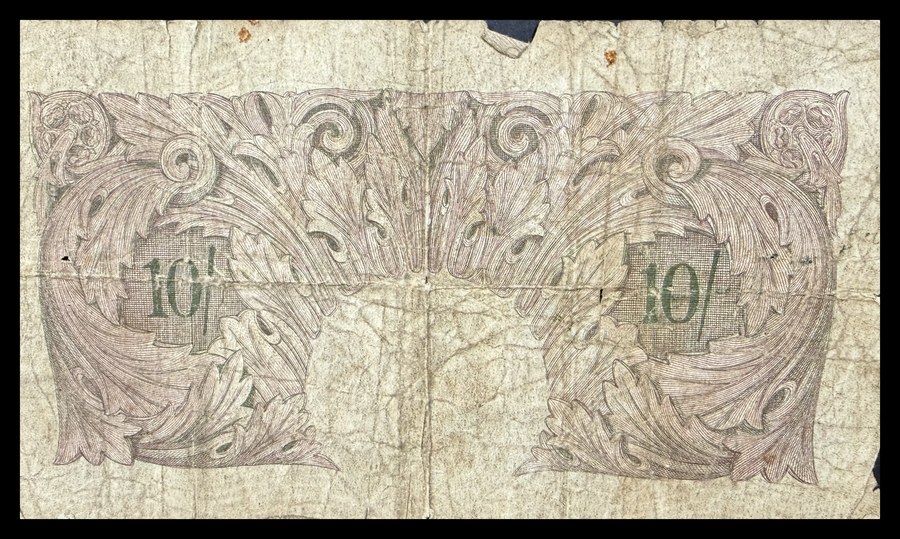
Front: Ornate geometric guilloché pattern in mauve and cream tones typical of Bank of England wartime issue notes. The reverse design shows through due to the thin paper characteristic of this emergency wartime production period.
Back: Britannia, the female personification of Britain, seated with shield, trident and olive branch, representing British naval power and peace. She has been the primary symbol on Bank of England notes since 1694. The denomination 'Ten Shillings' appears prominently in Gothic script, with the promise to pay the bearer on demand. Serial number O25D 054783 visible at top and bottom left. Signed by Kenneth Oswald Peppiatt, Chief Cashier 1934–1949, whose signature appears on notes throughout WWII.
How it was made
Signatures: Chief Cashier: K.O. Peppiatt
Security features: watermark,intaglio
United Kingdom in Europe
United Kingdom in Europe. Other countries on the same continent shown in muted grey.
Background & history
This Ten Shilling note was issued during the tenure of Chief Cashier K.O. Peppiatt (1934–1949), placing it firmly in the WWII or immediate post-war period. The Britannia design without a royal portrait was standard for Bank of England notes until 1960. Ten shillings was half a pound and remained a commonly used denomination until decimalization in 1971, when it was replaced by the 50 pence coin. This note shows significant circulation wear consistent with wartime usage. The O25D prefix indicates a later wartime or early post-war printing run.
Collector references
How it came to me
Heavy circulation wear with multiple folds and creases, paper toning and discoloration, minor edge damage, overall limp paper, some staining visible
What it's worth now
Valuation history (1)
| date | low | high | currency | source | note |
|---|---|---|---|---|---|
| 2026-05-10 07:30:45 | 5.0 | 15.0 | GBP | ai | from claude-opus-4-5 |
History & extractions
AI extractions (2)
Edits & decisions (0)
No edits yet.
Manual fixups
Find near-duplicates
Manual pairing override
Edit specimen #587
All fields below post to the same save endpoint. Sections collapse to focus on what you need.
Re-crop manually
Drag the four corners to mark the banknote in each image. Click Save crop to apply.