Collection › Bosnia and Herzegovina › #63
10 BAM
P-P-10
Needs review
✦ AI 90%
The AI flagged these for your attention. Use ✦ Fact-check to cross-check factual fields against another model's world-knowledge, or 🔍 Re-look at image when you suspect the AI misread the pixels.
-
Some fields the AI was unsure about — please verify:
- Printer: “—” (0%)
- Watermark: “—” (0%)
- Front portrait: “—” (0%)
Click ✦ Ask AI to verify or fix any below. -
Overall AI confidence is 90% (auto-approve threshold is 92%).Skim the Identity tab; the dots next to each field show what the AI was unsure about.
IMG_6175.jpeg
cropped
IMG_6176.jpeg
cropped
Where & when
What's on the note
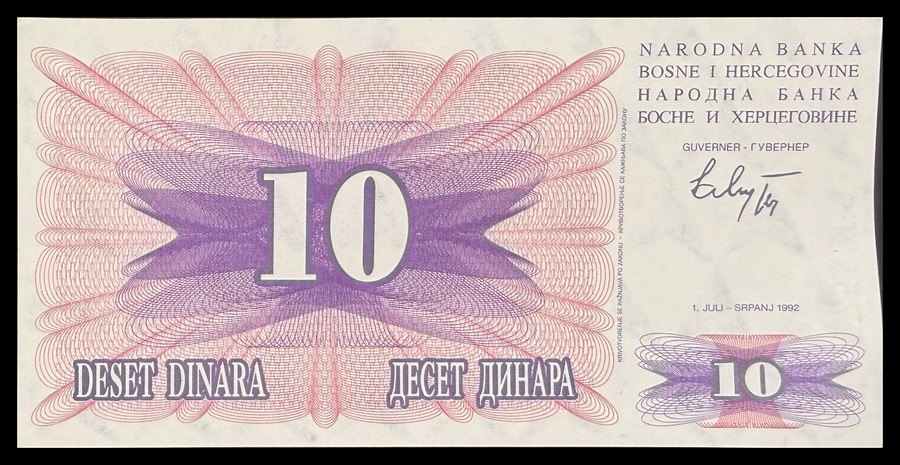
Front: Abstract guilloche rosette pattern in pink and purple creating an ornate security design. The note bears the denomination '10 DESET DINARA' (ten dinars) in Latin and Cyrillic scripts, issued by the Narodna Banka Bosne i Hercegovine (National Bank of Bosnia and Herzegovina). Dated '1. JULI – SRPANJ 1992', this represents the first currency issue following Bosnia and Herzegovina's declaration of independence during the breakup of Yugoslavia.
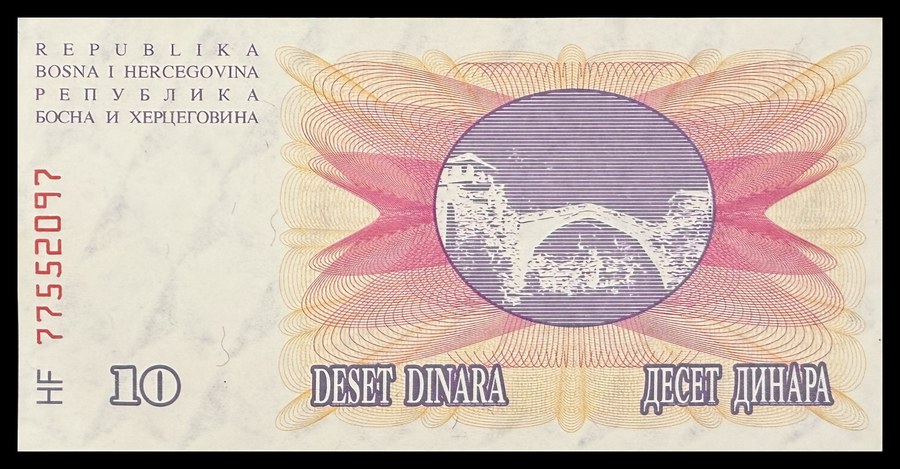
Back: Stećak medieval tombstone depicted within a circular vignette. Stećci are monumental medieval tombstones unique to Bosnia and Herzegovina and surrounding regions, dating from the 12th to 16th centuries, and recognized as UNESCO World Heritage. These distinctive stone monuments represent an important cultural symbol of medieval Bosnian identity and are among the most significant archaeological heritage of the region.
How it was made
Signatures: Guverner: signature present but illegible
Security features: guilloche_rosette,microprint
Bosnia and Herzegovina in Europe
Bosnia and Herzegovina in Europe. Other countries on the same continent shown in muted grey.
Background & history
🎉 Commemorating Independence of Bosnia and Herzegovina.
The Bosnian dinar was introduced on 1 July 1992 following Bosnia and Herzegovina's independence from Yugoslavia in March 1992. This first issue series (1992–1998) was produced during the Bosnian War and severe hyperinflation that characterized the early years of independence. The dinar was replaced by the convertible mark (konvertibilna marka) in 1998 at a rate of 1 mark = 100 dinars as part of the Dayton Agreement's economic stabilization measures. The choice of stećci as a motif reflects an attempt to use culturally neutral, pre-Ottoman symbols that could represent all ethnic groups in the newly independent state.
Collector references
How it came to me
Minor handling wear, creases visible, colors remain relatively bright
What it's worth now
Valuation history (1)
| date | low | high | currency | source | note |
|---|---|---|---|---|---|
| 2026-05-08 16:18:47 | 1.0 | 3.0 | USD | ai | from claude-sonnet-4-5 |
History & extractions
AI extractions (3)
Edits & decisions (0)
No edits yet.
Manual fixups
Find near-duplicates
Manual pairing override
Edit specimen #63
All fields below post to the same save endpoint. Sections collapse to focus on what you need.
Re-crop manually
Drag the four corners to mark the banknote in each image. Click Save crop to apply.