Collection › Iraq › #697
5 IQD
P-70
Needs review
✦ AI 87%
The AI flagged these for your attention. Use ✦ Fact-check to cross-check factual fields against another model's world-knowledge, or 🔍 Re-look at image when you suspect the AI misread the pixels.
-
Some fields the AI was unsure about — please verify:
- Series year: “—” (0%)
- Issue year: “—” (0%)
- Printer: “—” (0%)
- Serial number: “—” (0%)
Click ✦ Ask AI to verify or fix any below. -
Overall AI confidence is 87% (auto-approve threshold is 92%).Skim the Identity tab; the dots next to each field show what the AI was unsure about.
IMG_6710.jpeg
cropped
IMG_6711.jpeg
cropped
Where & when
What's on the note
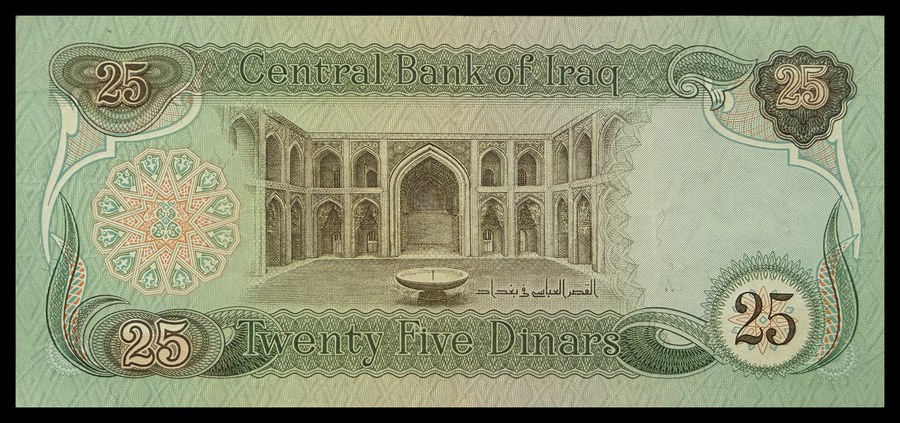
Front: Hammurabi (c. 1810–1750 BCE), sixth king of the First Babylonian Dynasty, depicted at left with his famous law code stele. Hammurabi is renowned for the Code of Hammurabi, one of the oldest deciphered writings of significant length in the world, establishing one of the earliest known systems of justice. Center shows an agricultural scene with a grain silo and wheat fields, representing Iraq's agricultural heritage in the Mesopotamian heartland. Text 'FIVE DINARS' at lower center; 'CENTRAL BANK OF IRAQ' at top in English.
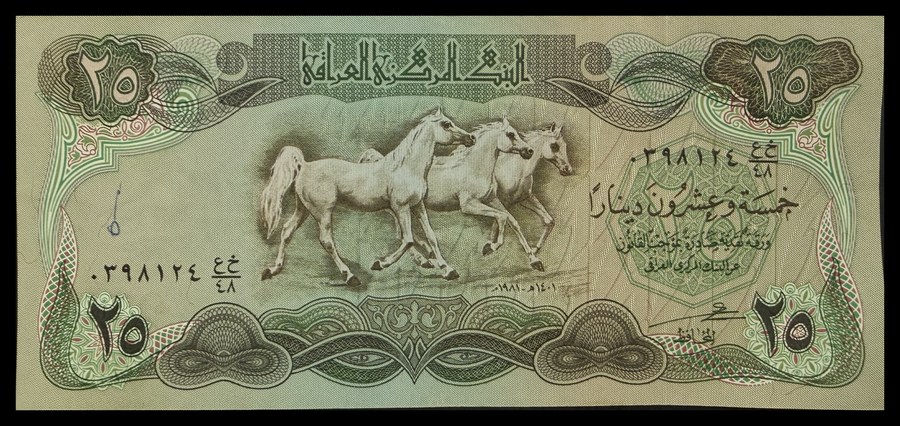
Back: Two Arabian horses (mare and foal) at center, representing Iraq's celebrated tradition of Arabian horse breeding. The Arabian horse is one of the oldest horse breeds, with origins tracing to the Arabian Peninsula, and Iraq historically was a major center for breeding these prized animals. Arabic inscriptions include 'البنك المركزي العراقي' (Central Bank of Iraq) at top and legal tender text. Serial number visible at left in Arabic-Indic numerals.
How it was made
Security features: watermark,intaglio,microprint
Iraq in Asia
Iraq in Asia. Other countries on the same continent shown in muted grey.
Background & history
This 5 Dinar note is from the Central Bank of Iraq series issued between 1973 and 1991, during the Ba'athist era under Saddam Hussein. The design emphasizes Iraq's ancient Mesopotamian heritage through Hammurabi, who ruled Babylon and created one of history's first comprehensive legal codes. The inclusion of Arabian horses reflects Iraq's role in breeding and preserving this ancient breed. These notes were withdrawn and demonetized following the 1991 Gulf War, when new series were introduced. The Pick reference P-70 applies to this design type with the Hammurabi portrait and horse reverse. No printed issue year appears on the note itself, and the Central Bank of Iraq did not employ a documented serial-number-year encoding system during this period. Dating must rely on the known circulation period of this design series (1973–1991). The watermark shows a horse head, reinforcing the equestrian theme.
Collector references
How it came to me
Note appears lightly circulated with minimal creasing; colors remain strong
What it's worth now
Valuation history (1)
| date | low | high | currency | source | note |
|---|---|---|---|---|---|
| 2026-05-10 09:31:20 | 2.0 | 8.0 | USD | ai | from claude-sonnet-4-5 |
History & extractions
AI extractions (1)
Edits & decisions (0)
No edits yet.
Manual fixups
Find near-duplicates
Manual pairing override
Edit specimen #697
All fields below post to the same save endpoint. Sections collapse to focus on what you need.
Re-crop manually
Drag the four corners to mark the banknote in each image. Click Save crop to apply.