Collection › Serbia › #91
50 Dinar
P-27a
Needs review
✦ AI 90%
The AI flagged these for your attention. Use ✦ Fact-check to cross-check factual fields against another model's world-knowledge, or 🔍 Re-look at image when you suspect the AI misread the pixels.
-
Some fields the AI was unsure about — please verify:
- Printer: “—” (0%)
- Dimensions (mm): “—” (0%)
- Watermark: “—” (0%)
Click ✦ Ask AI to verify or fix any below. -
Overall AI confidence is 90% (auto-approve threshold is 92%).Skim the Identity tab; the dots next to each field show what the AI was unsure about.
IMG_6231.jpeg
cropped
IMG_6232.jpeg
cropped
Where & when
What's on the note
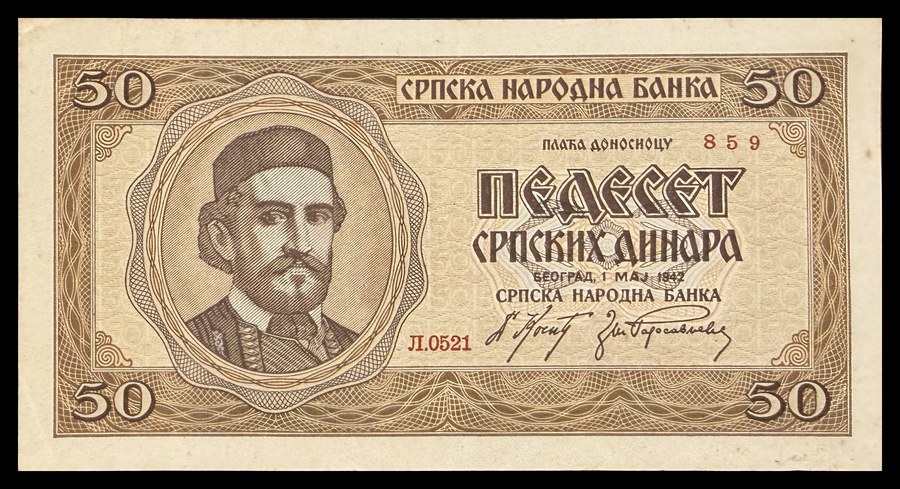
Front: Peter II of Yugoslavia (1923–1970), the last King of Yugoslavia who reigned from 1934 to 1945. He was overthrown as a minor in 1941 when the Axis powers invaded Yugoslavia, spending the war years in exile. This note was issued by the collaborationist Serbian puppet government under German occupation during World War II, using the young king's image despite his exile and opposition to the occupation.
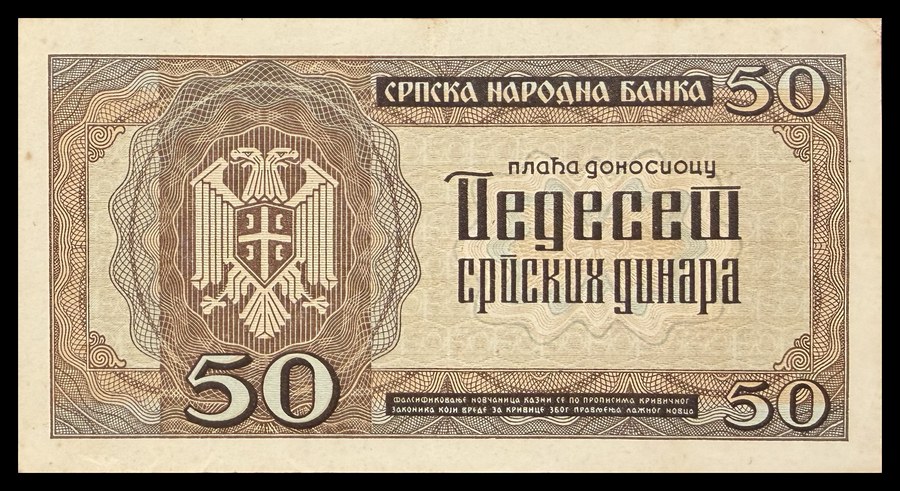
Back: The Serbian cross (tetragrammic cross) with four firesteels (ocila or огњила), a traditional Serbian heraldic symbol dating to medieval times. The cross and firesteels are the traditional coat of arms of Serbia, representing the four letters 'C' (Cyrillic 'S') meaning 'Само Слога Србина Спасава' ('Only Unity Saves the Serbs'). This symbol has been used on Serbian banknotes and official emblems throughout various historical periods.
How it was made
Signatures: Governor: Ljubo Jovanović
Security features: intaglio,microprint
Serbia in Europe
Serbia in Europe. Other countries on the same continent shown in muted grey.
Background & history
This 50 dinar note was issued by the Srpska Narodna Banka (Serbian National Bank) on May 1, 1942, during the German occupation of Serbia in World War II. The note is dated 'BEOGRAD, 1 MAJ 1942' (Belgrade, May 1, 1942). Despite featuring King Peter II, who was in exile and led the Yugoslav government-in-exile opposing the Axis, the note was issued by the collaborationist administration under German control. This series (1941–1944) represents a complex period where occupation authorities maintained some Serbian national symbols while controlling the puppet government of Milan Nedić. The currency was replaced after liberation in 1944.
Collector references
How it came to me
Note shows circulation wear with intact design, minor soiling typical of age
What it's worth now
Valuation history (1)
| date | low | high | currency | source | note |
|---|---|---|---|---|---|
| 2026-05-08 16:23:57 | 5.0 | 15.0 | USD | ai | from claude-sonnet-4-5 |
History & extractions
AI extractions (3)
Edits & decisions (1)
Manual fixups
Find near-duplicates
Manual pairing override
Edit specimen #91
All fields below post to the same save endpoint. Sections collapse to focus on what you need.
Re-crop manually
Drag the four corners to mark the banknote in each image. Click Save crop to apply.