Type details
| Country | Chile |
| Currency | Escudo |
| Denomination | ½ Escudo |
| Series | Escudo series |
| Series range | 1960–1975 |
| Issuer | Banco Central de Chile |
| Signatures | Presidente: Carlos Vial; Gerente General: (illegible) |
| Printer | Casa de Moneda de Chile |
| Front portrait | Bernardo O'Higgins |
| Reverse subject | Arrival of Diego de Almagro to Chile |
| Themes | statesman,military,indigenous_culture |
| Watermark | Portrait of Bernardo O'Higgins in oval at center |
| Security features | intaglio,microprint |
| Colour palette | #e8d7b8,#6b7f9c,#4a5a6b |
| Material | paper |
| Dimensions (mm) | 156x67 |
| Language / script | Latin |
| Languages | es |
| Pick # | 134 |
| Rarity | common |
| Legal status | demonetized |
| Legal status date | 1975 |
| Predecessor currency | Peso |
| Successor currency | Peso |
| Era | 1946_1989 |
| Default value (low) | 3.0 |
| Default value (high) | 8.0 |
| Value currency | USD |
Front
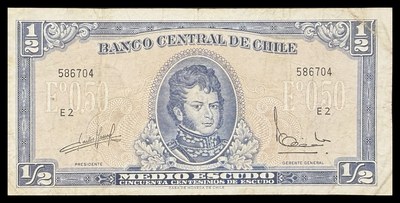
Bernardo O'Higgins Riquelme (1778–1842), Chilean independence leader and the first Supreme Director of Chile (1817–1823). O'Higgins was a central figure in Chile's liberation from Spanish colonial rule, leading the Chilean forces alongside José de San Martín; he is revered as the founding father of independent Chile and appears on numerous Chilean banknotes. The portrait is set within an ornate oval guilloche frame, flanked by two signatures titled 'Presidente' and 'Gerente General'.
Back
The arrival of Spanish conquistador Diego de Almagro to Chile in 1536, depicting Almagro with his expedition and indigenous peoples. This historical scene commemorates the first Spanish entrada into Chilean territory from Peru, marking the beginning of Spanish presence in Chile. The inscription 'LLEGADA DE ALMAGRO A CHILE' (Arrival of Almagro to Chile) identifies the scene, which was a common motif on Chilean Escudo banknotes celebrating foundational historical moments.
History
This ½ Escudo note belongs to the Escudo series issued by the Banco Central de Chile from 1960 to 1975. The Escudo replaced the Peso at a rate of 1 Escudo = 1,000 Pesos in 1960 as part of monetary reform to combat inflation. The series featured Chilean historical figures and scenes from the nation's colonial and independence periods. The Escudo itself was replaced by the current Chilean Peso in 1975 at a rate of 1 Peso = 1,000 Escudos. Printed by Casa de Moneda de Chile, these notes are recognizable by their intricate guilloche patterns and historical vignettes celebrating Chile's heritage.
Linked specimens (1)
Merge into another type
Repoints every linked specimen above to the chosen target type, fills any target nulls from this type, then deletes this type. This cannot be undone.