Type details
| Country | China |
| Currency | CNY |
| Denomination | 5 Yuan |
| Series | Fourth series |
| Series year | 1980 |
| Series range | 1987–1997 |
| Issue year | 1980 |
| Issuer | People's Bank of China |
| Issuer (native) | 中国人民银行 |
| Printer | China Banknote Printing and Minting Corporation |
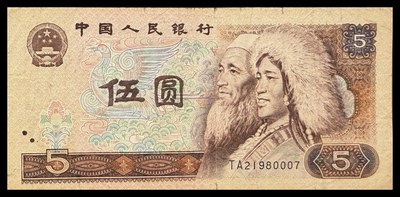
| Front portrait | Miao and Zhuang ethnic minorities |
| Reverse subject | Wulingyuan scenic area (Zhangjiajie National Forest Park) |
| Themes | indigenous_culture,wildlife,architecture |
| Watermark | Ancient coins pattern in clear field |
| Security features | watermark,intaglio,microprint,see_through_register |
| Colour palette | #8b6f47,#d4a574,#5d4e37 |
| Material | paper |
| Dimensions (mm) | 140x63 |
| Language / script | Chinese (Simplified), Mongolian, Tibetan, Uyghur, Zhuang |
| Languages | zh,mn,bo,ug,za |
| Pick # | P-886 |
| Rarity | common |
| Legal status | demonetized |
| Legal status date | 2018-05-01 |
| Predecessor currency | Third series Renminbi |
| Successor currency | Fifth series Renminbi |
| Era | 1946_1989 |
| Default value (low) | 3.0 |
| Default value (high) | 8.0 |
| Value currency | USD |
Front
Portraits of two women representing China's ethnic minorities: a Miao woman (left) and a Zhuang woman (right), both in traditional dress and headdress. The Miao and Zhuang are among China's largest minority ethnic groups, concentrated in the southern provinces. This design was part of the Fourth series Renminbi's emphasis on representing China's ethnic diversity and national unity, with each denomination featuring different minority groups.
Back
Wulingyuan scenic area in Hunan Province, showing the distinctive sandstone pillars and peaks of Zhangjiajie National Forest Park. This UNESCO World Heritage Site is famous for its quartzite-sandstone pillars rising over 200 meters, formed over 400 million years through erosion. The site later gained international fame as inspiration for the floating mountains in the film Avatar (2009). The area encompasses over 3,000 such pillars across 264 square kilometers.
History
Fourth series Renminbi, issued 1987–1997 with designs approved in 1980, officially withdrawn from circulation May 1, 2018. This series was the first to feature China's ethnic minorities as portrait subjects rather than solely Han Chinese workers or political figures, reflecting the policy of national unity and recognition of China's 56 ethnic groups. The 5 yuan note was among the most widely circulated denominations during China's economic reform period of the 1980s–1990s. The series was gradually replaced by the Fifth series beginning in 1999, with advanced anti-counterfeiting features.
Linked specimens (1)
Merge into another type
Repoints every linked specimen above to the chosen target type, fills any target nulls from this type, then deletes this type. This cannot be undone.