Type details
| Country | Colombia |
| Currency | Peso oro |
| Denomination | 10 |
| Series | Peso oro series |
| Series range | 1973–1992 |
| Issue year | 1980 |
| Issuer | Banco de la República |
| Signatures | Gerente: R. García; Secretario: Francisco J. Ortiz |
| Front portrait | Antonio Nariño |
| Reverse subject | San Agustín Archaeological Park statues |
| Themes | statesman,indigenous_culture,architecture |
| Watermark | Liberty head in center oval |
| Security features | microprint,intaglio,watermark |
| Colour palette | #8b4789,#d4af37,#2f4f4f |
| Material | paper |
| Dimensions (mm) | 140x70 |
| Language / script | Latin |
| Languages | es |
| Pick # | 407g |
| Rarity | common |
| Legal status | demonetized |
| Legal status date | 1993 |
| Successor currency | Colombian peso |
| Era | 1946_1989 |
| Default value (low) | 2.0 |
| Default value (high) | 5.0 |
| Value currency | USD |
Front
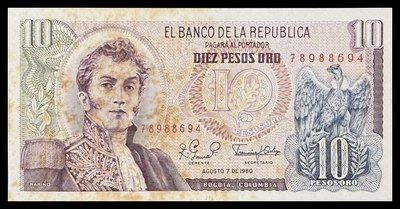
Antonio Nariño (1765–1824), Colombian ideologist and precursor of independence who translated and published the French Declaration of the Rights of Man in 1794, leading to his imprisonment and exile; he served as Vice President of Cundinamarca and is honored as a national hero for his role in Colombia's independence movement. At right, a Harpy Eagle (Harpia harpyja), Colombia's largest raptor and a symbol of national fauna. The note includes ornamental elements and a central medallion with the denomination.
Back
San Agustín Archaeological Park in Huila Department, a UNESCO World Heritage Site featuring pre-Columbian stone statues and monuments created by the San Agustín culture between the 1st and 8th centuries CE. The scene depicts multiple anthropomorphic stone sculptures characteristic of this ancient civilization, representing one of South America's most important archaeological sites with over 500 monumental statues.
History
Part of the peso oro series issued by the Banco de la República from 1973 to 1992, this denomination was printed with various dates throughout the 1970s and 1980s. The peso oro was replaced by the modern Colombian peso in 1993 following monetary reform. The 10 pesos oro note circulated widely during a period of relative economic stability before hyperinflation concerns led to the currency's eventual replacement. The series featured Colombian patriots and national symbols to promote cultural identity.
Linked specimens (1)
Merge into another type
Repoints every linked specimen above to the chosen target type, fills any target nulls from this type, then deletes this type. This cannot be undone.