Type details
| Country | Croatia |
| Currency | HRK |
| Denomination | 10 |
| Series | 2001–2014 series |
| Series year | 2012 |
| Series range | 2001–2014 |
| Issue year | 2012 |
| Issuer | Croatian National Bank |
| Issuer (native) | Hrvatska narodna banka |
| Signatures | Guverner: Boris Vujčić |
| Printer | Giesecke+Devrient |
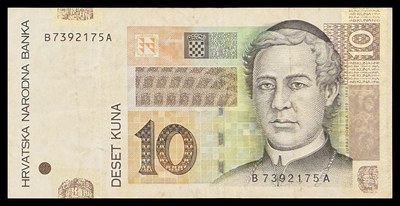
| Front portrait | Juraj Dobrila |
| Reverse subject | Pula Arena |
| Themes | statesman,architecture,religion |
| Watermark | Portrait of Juraj Dobrila in clear field |
| Security features | thread, microprint, intaglio, see_through_register, latent_image, uv |
| Colour palette | #c9b896,#a4c3a4,#8b7355 |
| Material | paper |
| Dimensions (mm) | 125x60 |
| Language / script | Latin, Glagolitic |
| Languages | hr |
| Pick # | P-38a |
| Rarity | common |
| Legal status | demonetized |
| Legal status date | 2023-01-15 |
| Predecessor currency | Croatian Dinar |
| Successor currency | Euro |
| Era | 1990_present |
| Default value (low) | 2.0 |
| Default value (high) | 5.0 |
| Value currency | USD |
Front
Juraj Dobrila (1812–1882), Croatian bishop, writer and politician. He was the Bishop of Poreč and Pula from 1857, a prominent advocate for the Croatian national movement in Istria, founder of educational and cultural institutions, and a champion of using Croatian and Slovenian languages in church and education. He established schools, libraries, and agricultural cooperatives, and is remembered as a key figure in the cultural and social awakening of Istria. The front also displays historical coats of arms associated with Croatian regions.
Back
The Pula Arena (Amphitheatrum Pola), a Roman amphitheatre built in the 1st century AD in Pula, Istria. It is one of the six largest surviving Roman arenas in the world and the best preserved ancient monument in Croatia. The arena could seat approximately 20,000 spectators and was used for gladiatorial contests. The inscription identifies it as 'PULA ARENA: I. ST. POSLIJE KRISTA' (1st century after Christ). A Glagolitic script detail 'MOTOVUN' appears below, referencing another Istrian town.
History
This note belongs to the 2001–2014 Croatian Kuna series issued by the Croatian National Bank. The kuna was introduced in 1994 to replace the Croatian dinar during the post-independence stabilization period. The 2001 series featured prominent Croatian historical figures and cultural landmarks. This 10 kuna note was dated 9 August 2012 (Zagreb, 9. Srpnja 2012). Croatia adopted the euro on 1 January 2023, and kuna banknotes were demonetized on 15 January 2023 after a dual-circulation period. The denomination honors Juraj Dobrila, reflecting Croatia's emphasis on regional identity and cultural heritage, particularly that of Istria.
Linked specimens (1)
Merge into another type
Repoints every linked specimen above to the chosen target type, fills any target nulls from this type, then deletes this type. This cannot be undone.