Type details
| Country | Croatia |
| Currency | HRK |
| Denomination | 20 |
| Series | Fourth series |
| Series year | 2012 |
| Series range | 1993–2023 |
| Issue year | 2012 |
| Issuer | Croatian National Bank |
| Issuer (native) | Hrvatska Narodna Banka |
| Signatures | Governor: Boris Vujčić |
| Printer | Giesecke+Devrient |
| Front portrait | Juraj Dobrila |
| Reverse subject | Eltz Palace Vukovar |
| Themes | statesman,architecture |
| Watermark | Portrait of Juraj Dobrila in clear field |
| Security features | thread,microprint,intaglio,latent_image,see_through_register |
| Colour palette | #d4a373,#c97b7b,#f5e6d3 |
| Material | paper |
| Dimensions (mm) | 134x68 |
| Language / script | Latin |
| Languages | hr |
| Pick # | P-40 |
| Rarity | common |
| Legal status | demonetized |
| Legal status date | 2023-01-15 |
| Predecessor currency | Croatian dinar |
| Successor currency | Euro |
| Era | 1990_present |
| Default value (low) | 3.0 |
| Default value (high) | 8.0 |
| Value currency | EUR |
Front
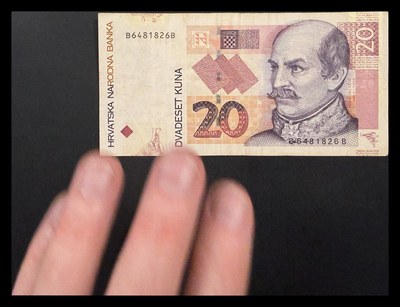
Juraj Dobrila (1812–1882), Croatian bishop, politician, and educator who served as Bishop of Poreč and Pula. A prominent advocate for Croatian language rights and education in Istria during the Austro-Hungarian period, he founded schools, libraries, and the newspaper 'Naša sloga'. The denomination '20' appears centrally with decorative patterns including Croatian checkerboard shield elements, and text 'DVADESET KUNA' (twenty kuna). The note displays the issuer 'HRVATSKA NARODNA BANKA' vertically on the left.
Back
Eltz Palace (Dvorac Eltz) in Vukovar, a baroque mansion built in the 18th century that now houses the Vukovar City Museum. The inscription reads 'VUKOVAR DVORAC ELTZ XVIII ST.' (Vukovar Eltz Palace 18th century). Below the building appears a Vučedol dove (Vučedolska golubica), a ceramic vessel from around 2500 BC representing the famous Vučedol culture archaeological site near Vukovar. The inscription notes '2500 GOD. PR. KR.' (2500 years before Christ). The date 'ZAGREB, 9. SRPNJA 2012.' and governor's signature appear on the right.
History
This note belongs to Croatia's fourth currency series, the Croatian kuna, introduced in 1994 to replace the Croatian dinar during the country's post-independence monetary reform. The kuna served as Croatia's currency from 1994 until Croatia adopted the euro on January 1, 2023. The 2012 dated notes represent a later printing within this series. The note features Juraj Dobrila, honoring his contributions to Croatian cultural development in Istria, while the reverse depicts Vukovar, a city of immense symbolic importance due to its suffering during the Croatian War of Independence (1991–1995). The Vučedol dove represents Croatia's ancient cultural heritage. The kuna was subdivided into 100 lipa.
Linked specimens (1)
Merge into another type
Repoints every linked specimen above to the chosen target type, fills any target nulls from this type, then deletes this type. This cannot be undone.