Type details
| Country | Croatia |
| Currency | HRK |
| Denomination | 1 |
| Series | Croatian Dinar series |
| Series year | 1991 |
| Series range | 1991–1994 |
| Issuer | Republic of Croatia Ministry of Finance |
| Issuer (native) | Republika Hrvatska |
| Signatures | Ministar Financija |
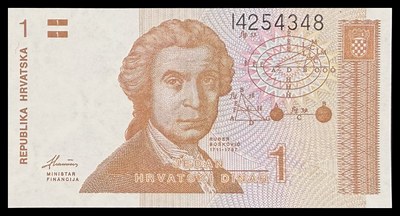
| Front portrait | Ruđer Bošković |
| Reverse subject | Zagreb Cathedral |
| Themes | scientist,architecture,religion |
| Security features | microprint,intaglio |
| Colour palette | #d2a679,#e6d5c3,#c88a9a |
| Material | paper |
| Dimensions (mm) | 120x60 |
| Language / script | Latin |
| Languages | hr |
| Pick # | P-16 |
| Rarity | common |
| Legal status | demonetized |
| Legal status date | 1994-05-30 |
| Predecessor currency | Yugoslav Dinar |
| Successor currency | Croatian Kuna |
| Era | 1990_present |
| Default value (low) | 1.0 |
| Default value (high) | 3.0 |
| Value currency | USD |
Front
Ruđer Josip Bošković (1711–1787), Croatian physicist, astronomer, mathematician, philosopher, diplomat, poet, theologian, and Jesuit priest. He is best known for his atomic theory and his work in astronomy and optics; he served as director of optics for the French Navy and was a member of learned societies across Europe. His portrait is accompanied by geometric diagrams representing his scientific work, including orbital mechanics and astronomical calculations. The note displays 'REPUBLIKA HRVATSKA' vertically on the left, the Croatian coat of arms (checkerboard shield) at upper right, and the denomination '1 JEDAN HRVATSKI DINAR' below the portrait.
Back
Zagreb Cathedral (Cathedral of the Assumption of the Blessed Virgin Mary), the tallest building in Croatia and the most monumental sacral structure in neo-Gothic style southeast of the Alps. The twin spires, standing at 105 meters, are shown with the cathedral's ornate Gothic revival façade. Construction began in the 13th century; the building was extensively rebuilt in neo-Gothic style by Hermann Bollé after the 1880 Zagreb earthquake. The reverse includes decorative geometric patterns and the text 'REPUBLIKA HRVATSKA' vertically along the right edge, with 'ZAGREB 8. LISTOPADA 1991' (Zagreb, October 8, 1991) along the left margin.
History
The Croatian Dinar was the first currency of independent Croatia, issued from 1991 to 1994 following the country's declaration of independence from Yugoslavia. This 1 dinar note was part of the initial series dated October 8, 1991, designed to replace the Yugoslav dinar during the Croatian War of Independence. The series featured prominent Croatian historical figures and national landmarks to assert national identity. Due to hyperinflation, the Croatian Dinar was replaced by the Croatian Kuna on May 30, 1994, at a rate of 1 kuna = 1,000 dinars. The series is notable for its modest design and simple security features, reflecting the urgent economic circumstances of its issuance.
Linked specimens (1)
Merge into another type
Repoints every linked specimen above to the chosen target type, fills any target nulls from this type, then deletes this type. This cannot be undone.