Type details
| Country | Croatia |
| Currency | HRK |
| Denomination | 50 |
| Series | Croatian Kuna series |
| Series year | 2002 |
| Series range | 1993–2022 |
| Issue year | 2002 |
| Issuer | Croatian National Bank |
| Issuer (native) | Hrvatska Narodna Banka |
| Signatures | Governor: Željko Rohatinski |
| Printer | Giesecke+Devrient |
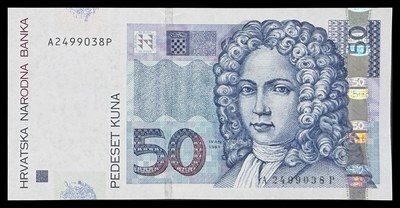
| Front portrait | Ivan Gundulić |
| Reverse subject | Dubrovnik Old Town |
| Themes | writer,architecture |
| Watermark | Portrait of Ivan Gundulić |
| Security features | hologram,thread,microprint,intaglio,see_through_register,optically_variable_ink |
| Colour palette | #4a6fa5,#c9d4e0,#8b7355 |
| Material | paper |
| Dimensions (mm) | 140x66 |
| Language / script | Latin |
| Languages | hr |
| Pick # | P-40a |
| Rarity | common |
| Legal status | demonetized |
| Legal status date | 2023-01-01 |
| Predecessor currency | Yugoslav Dinar |
| Successor currency | Euro |
| Era | 1990_present |
| Default value (low) | 8.0 |
| Default value (high) | 15.0 |
| Value currency | USD |
Front
Ivan Gundulić (1589–1638), the foremost poet of the Croatian Baroque and a central figure of Ragusan literature. His epic poem 'Osman' is considered a masterpiece of Croatian literature, celebrating Slavic resistance against the Ottoman Empire. He spent his entire life in the Republic of Ragusa (Dubrovnik) where he held various government positions. The Croatian coat of arms with its distinctive red and white checkerboard (šahovnica) appears at upper left.
Back
Panoramic view of the historic Old Town of Dubrovnik, UNESCO World Heritage Site since 1979. The illustration shows the famous city walls, the Adriatic coastline, and the Rector's Palace in the foreground. Dubrovnik was the capital of the Republic of Ragusa, an independent maritime republic from 1358 to 1808, and Gundulić's birthplace and home. The text 'DUBROVNIK' identifies the location. Designer credits appear on the left margin: M.S. Guttag and V. Žiljak.
History
The Croatian kuna was introduced on 30 May 1994, replacing the Croatian dinar at a rate of 1 kuna = 1000 dinars. This 50 kuna note dated 7 March 2002 (Zagreb, 7. ožujka 2002) was signed by Governor Željko Rohatinski who served from 2000 to 2012. The kuna circulated until Croatia adopted the euro on 1 January 2023, becoming the 20th eurozone member. The name 'kuna' derives from the marten, whose pelts were used as a form of currency in medieval Croatia.
Linked specimens (1)
Merge into another type
Repoints every linked specimen above to the chosen target type, fills any target nulls from this type, then deletes this type. This cannot be undone.