Type details
| Country | Egypt |
| Currency | EGP |
| Denomination | 20 |
| Series | 1976-1978 Issue |
| Series range | 1976-1978 |
| Issuer | Central Bank of Egypt |
| Issuer (native) | البنك المركزي المصري |
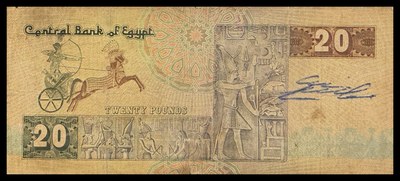
| Front portrait | Tutankhamun |
| Reverse subject | Mosque of Muhammad Ali |
| Themes | monarch,architecture,indigenous_culture |
| Watermark | Tutankhamun mask in clear field |
| Security features | watermark,intaglio |
| Colour palette | #d4a574,#8b7355,#556b2f |
| Material | paper |
| Dimensions (mm) | 165x80 |
| Language / script | Latin,Arabic |
| Languages | en,ar |
| Pick # | P-48 |
| Rarity | common |
| Legal status | demonetized |
| Era | 1946_1989 |
Front
Pharaoh Tutankhamun (ruled c. 1332–1323 BCE), the young Egyptian pharaoh of the 18th Dynasty whose intact tomb was discovered by Howard Carter in 1922, making him one of the most famous pharaohs in history. The note depicts an ancient Egyptian chariot scene with hieroglyphics and traditional motifs, celebrating Egypt's pharaonic heritage.
Back
The Mosque of Muhammad Ali (also known as the Alabaster Mosque), built 1830-1848 on the Citadel of Cairo. Commissioned by Muhammad Ali Pasha, ruler of Egypt and Sudan, this Ottoman-style mosque with its distinctive domes and minarets is one of Cairo's most iconic landmarks and a symbol of 19th-century Egyptian modernization.
History
Part of the 1976-1978 Issue by the Central Bank of Egypt, this series featured ancient Egyptian themes on the obverse and Islamic architectural landmarks on the reverse, representing Egypt's dual heritage. The 20 pound note was a high-value denomination during this period. These notes were eventually replaced by later series as Egypt updated its currency designs through the 1980s and 1990s.
Linked specimens (1)
Merge into another type
Repoints every linked specimen above to the chosen target type, fills any target nulls from this type, then deletes this type. This cannot be undone.