Type details
| Country | Egypt |
| Currency | EGP |
| Denomination | 10 |
| Issue year | 2012 |
| Issuer | Central Bank of Egypt |
| Issuer (native) | البنك المركزي المصري |
| Signatures | Governor: Hisham Ramez |
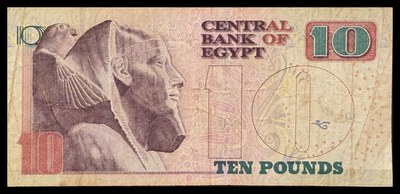
| Front portrait | Tutankhamun |
| Reverse subject | Al-Azhar Mosque |
| Themes | statesman,architecture,religion,indigenous_culture |
| Watermark | Tutankhamun death mask in clear field at center |
| Security features | thread,microprint,watermark,see_through_register |
| Colour palette | #d4af7a,#8b4949,#4a7c59 |
| Material | paper |
| Dimensions (mm) | 150x70 |
| Language / script | Latin, Arabic |
| Languages | en,ar |
| Pick # | 64 |
| Rarity | common |
| Legal status | withdrawn |
| Era | 1990_present |
| Default value (low) | 1.0 |
| Default value (high) | 3.0 |
| Value currency | USD |
Front
Tutankhamun (c. 1341–1323 BCE), the boy pharaoh of ancient Egypt's 18th Dynasty whose intact tomb discovered by Howard Carter in 1922 became one of archaeology's greatest finds. His golden funerary mask is among the most iconic symbols of ancient Egyptian civilization and appears frequently on Egyptian banknotes as a representation of national heritage.
Back
Al-Azhar Mosque in Cairo, founded in 970 CE during the Fatimid Caliphate and one of the oldest functioning mosques in Egypt. The mosque is part of Al-Azhar University, the world's second-oldest surviving university and a leading center of Islamic scholarship for over a millennium. The distinctive dome and twin minarets shown are characteristic of Mamluk and Ottoman architectural additions.
History
This note is part of the modern series issued by the Central Bank of Egypt in the early 21st century, featuring pharaonic imagery alongside Islamic architectural monuments to represent Egypt's layered cultural heritage. The 10 pound denomination was a common circulating note before newer series were introduced. The date shown (2012/4/3 in Arabic numerals) indicates this specific printing was from 2012. These notes have been gradually replaced by newer designs but were widely used throughout the 2010s.
Linked specimens (1)
Merge into another type
Repoints every linked specimen above to the chosen target type, fills any target nulls from this type, then deletes this type. This cannot be undone.