Type details
| Country | Egypt |
| Currency | EGP |
| Denomination | 5 |
| Series | 1978-2017 Issue |
| Series range | 1978-2017 |
| Issuer | Central Bank of Egypt |
| Issuer (native) | البنك المركزي المصري |
| Signatures | Governor: Farouk El Okdah |
| Reverse subject | Ancient Egyptian reliefs and agricultural scenes |
| Themes | architecture,religion,agriculture,ancient_history |
| Watermark | Tutankhamun's death mask in clear field at right |
| Security features | watermark,security_thread,intaglio,microprint |
| Colour palette | #d4c5a0,#8b7355,#a67c52 |
| Material | paper |
| Dimensions (mm) | 166x86 |
| Language / script | Arabic, English |
| Languages | ar,en |
| Pick # | 56 |
| Rarity | common |
| Legal status | withdrawn |
| Legal status date | 2017 |
| Era | 1990_present |
| Default value (low) | 1.0 |
| Default value (high) | 3.0 |
| Value currency | USD |
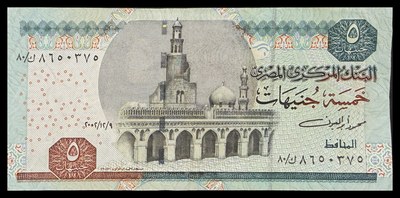
Front
The Mosque of Ibn Tulun in Cairo, built 876-879 CE by Ahmad ibn Tulun, the Abbasid governor of Egypt. It is one of the oldest mosques in Cairo and the largest in area, featuring a distinctive spiral minaret modeled after the Great Mosque of Samarra. The mosque represents an important example of Abbasid architecture and remains an active place of worship, honored on Egyptian currency as a symbol of the nation's Islamic heritage and architectural legacy.
Back
Ancient Egyptian reliefs depicting agricultural and daily life scenes from pharaonic times, including farming, harvesting, and craftwork. The central relief shows a standing figure in traditional ancient Egyptian style, flanked by horizontal friezes showing laborers engaged in agricultural activities. These scenes celebrate Egypt's ancient civilization and the importance of the Nile Valley's agricultural productivity that sustained pharaonic society for millennia.
History
This 5 Egyptian pound note belongs to the long-running series issued by the Central Bank of Egypt from 1978 through 2017. The design pairs Islamic architectural heritage (the Ibn Tulun Mosque) with pharaonic civilization motifs, reflecting Egypt's dual identity as inheritor of both ancient Egyptian and Islamic traditions. The series was gradually replaced beginning in 2016-2017 with new polymer notes featuring enhanced security features. These paper notes remain a familiar sight but have been largely withdrawn from active circulation.
Linked specimens (1)
Merge into another type
Repoints every linked specimen above to the chosen target type, fills any target nulls from this type, then deletes this type. This cannot be undone.