Type details
| Country | Egypt |
| Currency | EGP |
| Denomination | 1 |
| Series | 2001-2017 issue |
| Series range | 2001-2017 |
| Issue year | 2001 |
| Issuer | Central Bank of Egypt |
| Issuer (native) | البنك المركزي المصري |
| Reverse subject | Abu Simbel temples |
| Themes | architecture,mythology,statesman |
| Watermark | Tutankhamun's funeral mask in clear field at left |
| Security features | watermark,microprint,intaglio,see_through_register |
| Colour palette | #d4a574,#8b6f47,#f5e6d3 |
| Material | paper |
| Dimensions (mm) | 166x76 |
| Language / script | Arabic and Latin |
| Languages | ar,en |
| Pick # | P-50 |
| Rarity | common |
| Legal status | withdrawn |
| Legal status date | 2017 |
| Era | 1990_present |
| Default value (low) | 1.0 |
| Default value (high) | 3.0 |
| Value currency | USD |
Front
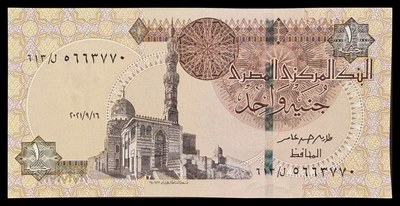
The Mosque-Madrassa of Sultan Hassan in Cairo, one of the largest mosques in the world, built between 1356 and 1363 during the Mamluk period under Sultan Hassan. The mosque is renowned for its monumental scale and Mamluk architectural features including its massive dome and towering minarets. It stands as one of the finest examples of Mamluk architecture and has been featured on Egyptian currency to represent the country's Islamic heritage and medieval architectural achievements.
Back
The Great Temple of Abu Simbel, showing the four colossal seated statues of Ramesses II (ruled 1279-1213 BCE) carved into the rock face. Built in the 13th century BCE in Nubia, the temple was relocated in the 1960s during the UNESCO campaign to save it from the rising waters of Lake Nasser following construction of the Aswan High Dam. The temple demonstrates ancient Egypt's architectural mastery and the enduring legacy of one of its most powerful pharaohs.
History
This note belongs to the 2001-2017 issue series of Egyptian pounds, which featured Islamic and ancient Egyptian architectural monuments. The series was gradually replaced beginning in 2016-2017 with new designs featuring updated security features. The 1 pound denomination is one of the most commonly used notes in Egypt for everyday transactions. The date 2021/9/16 printed on the front indicates this specific note was issued on September 16, 2021, making it one of the later printings of this series design.
Linked specimens (1)
Merge into another type
Repoints every linked specimen above to the chosen target type, fills any target nulls from this type, then deletes this type. This cannot be undone.