Type details
| Country | Argentina |
| Currency | ARS |
| Denomination | 1000 |
| Series | Peso Ley 18.188 |
| Series range | 1970–1983 |
| Issuer | Banco Central de la República Argentina |
| Signatures | Gerente General; Presidente |
| Printer | Casa de Moneda de la Nación |
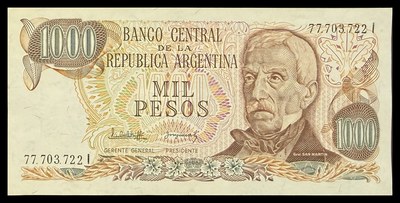
| Front portrait | José de San Martín |
| Reverse subject | Plaza de Mayo and Casa Rosada, Buenos Aires |
| Themes | military,statesman,architecture |
| Watermark | Portrait of General José de San Martín |
| Security features | watermark,intaglio,microprint |
| Colour palette | #c4a574,#8b7355,#d4c4a8 |
| Material | paper |
| Dimensions (mm) | 155x75 |
| Language / script | Latin |
| Languages | es |
| Pick # | P-304 |
| Rarity | common |
| Legal status | demonetized |
| Legal status date | 1983 |
| Predecessor currency | Peso Moneda Nacional |
| Successor currency | Peso Argentino |
| Era | 1946_1989 |
| Default value (low) | 2.0 |
| Default value (high) | 5.0 |
| Value currency | USD |
Front
General José de San Martín (1778–1850), the principal leader of the southern and central parts of South America's struggle for independence from the Spanish Empire. Known as the 'Liberator of Argentina, Chile and Peru,' San Martín is revered as a national hero and the father of the Argentine nation. He led the famous crossing of the Andes and is among the most depicted figures on Argentine currency. The note identifies him as 'Gral. SAN MARTIN.'
Back
Plaza de Mayo in Buenos Aires, Argentina's most important public square, with the Casa Rosada (Pink House) presidential palace visible in the background. The Pirámide de Mayo monument, erected in 1811 to commemorate the first anniversary of the May Revolution, stands prominently in the center. The plaza has been the focal point of Argentine political life since the May Revolution of 1810. The Argentine coat of arms appears at left featuring the Sun of May and clasped hands.
History
This 1000 Peso Ley note was issued under Law 18.188 which established the Peso Ley currency system in 1970, replacing the Peso Moneda Nacional at a rate of 100 to 1. The series circulated during a turbulent period in Argentine history including military governments and the beginning of severe inflation. The Peso Ley was itself replaced by the Peso Argentino in 1983 at a rate of 10,000 to 1, reflecting the hyperinflationary pressures of the era. Printed by Casa de Moneda de la Nación as indicated on the reverse.
Linked specimens (1)
Merge into another type
Repoints every linked specimen above to the chosen target type, fills any target nulls from this type, then deletes this type. This cannot be undone.