Type details
| Country | Georgia |
| Currency | Georgian Lari |
| Denomination | 1 |
| Series | First Lari series |
| Series range | 1995–2002 |
| Issuer | National Bank of Georgia |
| Issuer (native) | საქართველოს ეროვნული ბანკი |
| Reverse subject | Metekhi Church and King Vakhtang I Gorgasali monument |
| Themes | architecture,statesman,religion,indigenous_culture |
| Security features | microprint,guilloche_patterns |
| Colour palette | #c4817c,#f5e6e8,#8b5a54 |
| Material | paper |
| Dimensions (mm) | 120x64 |
| Language / script | Georgian (Mkhedruli script) |
| Languages | ka |
| Pick # | P-53 |
| Rarity | common |
| Legal status | withdrawn |
| Legal status date | 2002 |
| Predecessor currency | Georgian Kupon Lari |
| Era | 1990_present |
| Default value (low) | 2.0 |
| Default value (high) | 8.0 |
| Value currency | USD |
Front
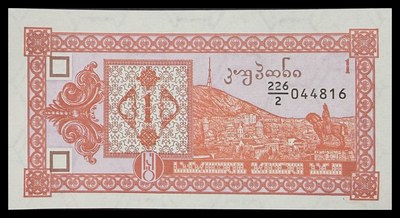
View of Tbilisi cityscape with Mount Mtatsminda (Holy Mountain) topped by the Tbilisi TV broadcasting tower (built 1972), which rises 274 meters above the city center. The mountain has been a sacred site and prominent landmark in Georgian history since ancient times. Text in Georgian script and ornamental geometric border patterns characteristic of Georgian medieval manuscript decoration. Serial number 226/2 044816.
Back
Metekhi Church, a 13th-century Georgian Orthodox church perched on a cliff above the Mtkvari River in Tbilisi's historic Old Town, with the equestrian monument of King Vakhtang I Gorgasali (c. 440–502 CE), legendary founder of Tbilisi and one of Georgia's most revered monarchs. The statue by sculptor Elguja Amashukeli was erected in 1967. The church served as a royal residence and fortress in medieval times and stands as an iconic symbol of Georgian Christianity and statehood.
History
This note belongs to the first series of the Georgian Lari, introduced on 25 September 1995 to replace the transitional Kupon Lari at a rate of 1 Lari = 1,000,000 Kupon, ending Georgia's post-Soviet hyperinflation. The 1 Lari denomination was the lowest value in this series, issued 1995–2002. It was replaced by a redesigned second series beginning in 2002. The motifs celebrate Tbilisi's ancient heritage and Georgia's Christian monarchy, establishing the visual identity of the newly independent state's currency.